
TL;DR
Listen free for 30 days with Audible
Thousands of audiobooks and originals — cancel anytime.
Start your free trialAs an affiliate, we earn on qualifying purchases.
IdeaClyst is a local-first, AI-powered war room for your ideas. It combines structured debate, discovery, and planning, all on your own device, helping you avoid costly market missteps and boost confidence.
Imagine standing in a dedicated war room—walls plastered with sticky notes, whiteboards filled with diagrams, a team of sharp minds hashing out the next big move. Now, picture doing all that on your laptop, privately, without the clutter or distraction.
That’s the core promise of IdeaClyst: a digital war room for your ideas. It’s a space where your raw concepts get tested, challenged, and shaped into solid plans—without the noise of endless meetings or the risk of exposing your thinking prematurely. This isn’t just about organizing; it’s about creating a focused, strategic hub for your most valuable work.
A war room for your next idea
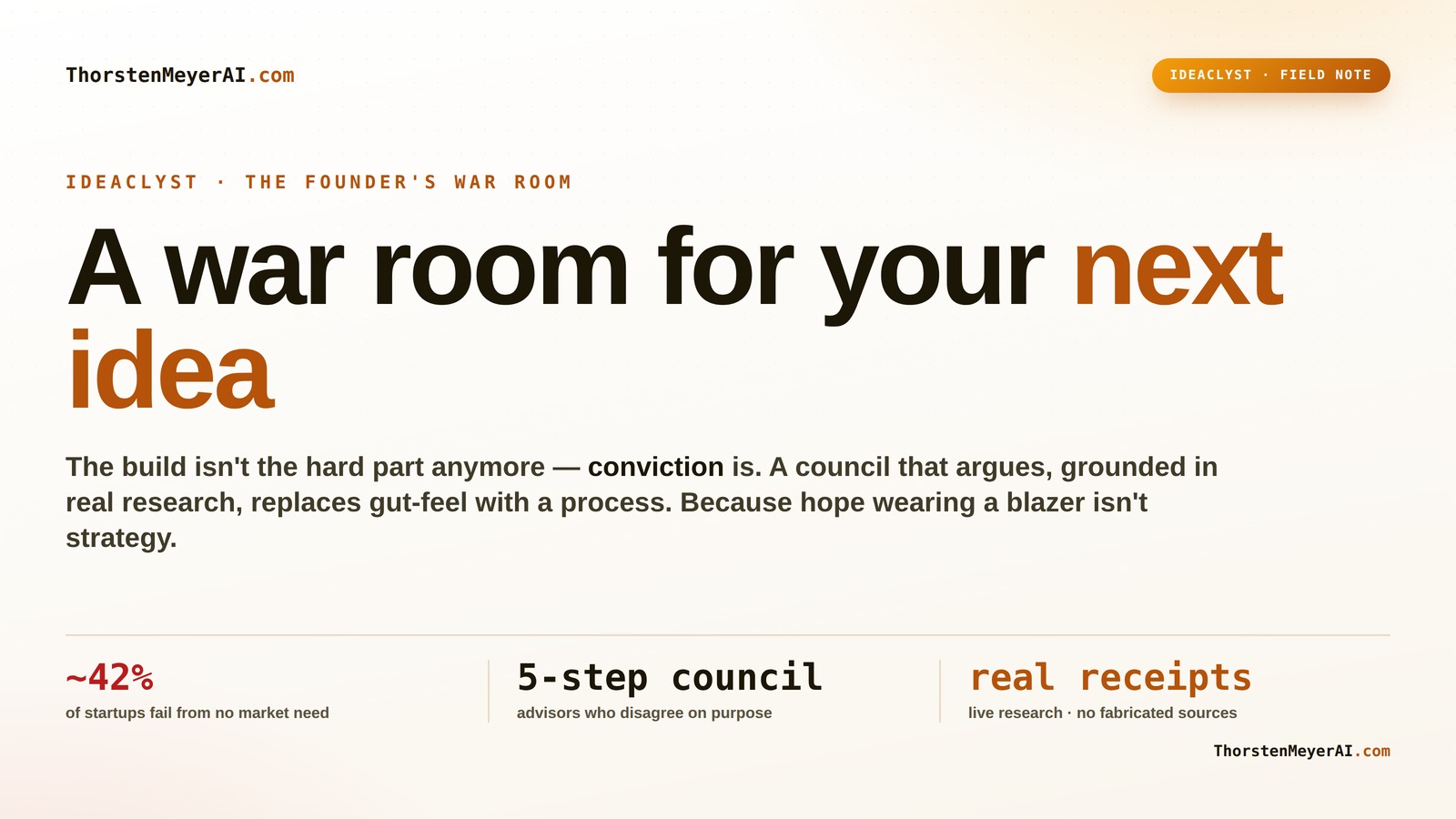
The build isn’t the hard part anymore — conviction is. Knowing which idea deserves the next six months, and being able to defend it. Most founders answer with gut feel and optimistic math. That’s hope wearing a blazer. IdeaClyst replaces it with a process.
The most expensive decision is what to build
The single most valuable thing a tool can do is talk you out of the wrong six months. The numbers make the case better than any pitch.
Three tools in one — on your own machine
Strip away the framing and IdeaClyst is three things at once, all running locally with nothing leaving your laptop.
An AI council
Pressure-tests an idea you bring it — advisors who argue on purpose.
A discovery engine
Finds ideas you didn’t know to look for by hunting real demand signals.
A founder’s workspace
Carries winners from “interesting” all the way to “ready to build.”
Advisors who disagree on purpose
Not one confident, agreeable answer — a structured five-step deliberation where models play different roles and turn on their own work. The disagreement is the feature.
The five-step deliberation
A council that leads with the bad news surfaces the objections you’d otherwise find the expensive way, on month five.
Product strategy
Who’s it for, what’s the wedge, why now, what’s the business model.
Technical architecture
What would it actually take to build — and where’s the risk.
Critique pass
The council turns on its own work. Where’s the hand-waving? What kills this?
Second, independent critique
A different voice, a different angle — so blind spots don’t survive.
Final synthesis
Everything into one coherent founder packet: strategy, architecture, validation, plan.
When IdeaClyst cites a source, it actually fetched it
The hard departure from “ask an AI what it thinks of my startup.” It runs in a strict, real-data-only mode — if it can’t gather genuine evidence, it says so plainly rather than inventing a plausible paragraph.
Confidence with receipts
No fabricated statistics, no imaginary competitors, no made-up citations. The packet survives a skeptical co-founder or a sharp investor because the reasoning has receipts.
Market research first
Scouts the landscape before the council reasons about anything.
Competitor read
Real positioning, pricing signals, feature claims — differentiation vs. reality.
Validation with links
Not “talk to customers” — concrete signals & sources you can click.
From the blank page to build-ready
Evaluation is half the problem; the blank page is the other half. And a plan is worthless if it dies in a tab you never reopen.
Bring a space, not an idea
“AI for accountants,” “tools for indie game studios” — plus your goal and real capacity. It hunts demand signals across HN, Reddit, Product Hunt, GitHub, pricing pages.
- An honest market read — leads with the bad news when a space is hard
- An opportunity map — high pain, thin competition
- Ranked candidates — wedge, who pays, effort, risk, confidence
- each with KILL CRITERIA — when to walk away
A home and a forward path
Every promising idea gets carried forward, with every artifact in plain files on your disk.
- Validation tooling — sprint board, interview list, evidence browser
- Founder profile — a personal-fit lens; same discovery, different advice
- Build workspaces — funnel, personas, landing draft, version history
- “Build this idea” → a PRD + task queue, ready for a coding agent
Key Takeaways
- IdeaClyst transforms your idea process into a structured debate, reducing blind spots and costly mistakes.
- The AI council stages a five-step critique—strategy, architecture, critique, validation, synthesis—giving you a comprehensive plan.
- Grounded in live web research, it replaces vague market claims with evidence-backed insights.
- Being local-first means your ideas stay private, secure, and in your control, unlike cloud-based tools.
- Regularly updating and reviewing your war room keeps your ideas sharp and your plans actionable.
digital whiteboard for brainstorming
As an affiliate, we earn on qualifying purchases.
As an affiliate, we earn on qualifying purchases.
What Exactly Is a War Room—And How Does IdeaClyst Fit In?
Most people think of a war room as a physical space filled with whiteboards and screens, where teams gather to make strategic decisions fast. But in today’s hybrid world, a war room is more like a digital command center—an organized hub for ideas, data, and debate.
IdeaClyst turns your laptop into that command center. It’s a local-first, open-source tool that acts like a virtual war room—minus the clutter, and with all your notes and plans staying private on your device. It’s perfect for solo founders or remote teams who need a focused space to develop ideas without external noise or data leaks.
Think of it as your personal strategy bunker, where each idea gets the attention and debate it deserves before you commit.
As an affiliate, we earn on qualifying purchases.
Why a Digital War Room Like IdeaClyst Matters More Than Ever
In the startup world, the cost of building the wrong thing can wipe out months of work—sometimes hundreds of thousands of dollars. Industry estimates in 2026 say that building a product nobody needs wastes at least $50,000 for solo founders and over $150,000 for larger teams, including opportunity costs.
Using AI to compress market research from months to hours is a game-changer, but only if you have a solid process to interpret that research. That’s where IdeaClyst’s war room shines. It’s a safe, private space to challenge assumptions, find blind spots, and prioritize ideas—before the build starts.
It’s like having a boardroom of skeptical advisors at your fingertips, without the risk of leaks or bias—saving you time, money, and heartache.
Why does this matter? Because in fast-moving markets, the ability to quickly validate or invalidate ideas can be the difference between success and failure. The tradeoff, however, is that this process requires disciplined engagement—it’s easy to fall into confirmation bias or neglect tough questions if you’re not vigilant. IdeaClyst’s structured debates help mitigate that risk, but founders must remain committed to honest critique and continuous iteration.
idea management software for laptop
As an affiliate, we earn on qualifying purchases.
As an affiliate, we earn on qualifying purchases.
How IdeaClyst’s AI Council Debates Your Ideas—And Why That’s a Game-Changer
Picture a panel of experts—product strategist, tech lead, market analyst—each playing devil’s advocate to your idea. That’s exactly what IdeaClyst’s AI council does. It stages a five-step debate: from defining your target customer to analyzing technical risks, then critically examining assumptions, and finally synthesizing the best plan.
Each step involves different AI models taking on roles that challenge your thinking, not just confirming it. The result? A detailed, markdown-packed founder packet that highlights risks, opportunities, and next steps—ready for your team or investors.
This structured disagreement isn’t just about catching flaws; it’s about deliberately exposing your idea to rigorous scrutiny, which can reveal hidden vulnerabilities or overlooked opportunities. The implication is that you no longer rely solely on personal intuition or limited feedback—your ideas are subjected to a multi-perspective, evidence-based review. The tradeoff? It requires honest input and willingness to confront uncomfortable truths, but the payoff is a more resilient, validated plan that’s ready for real-world challenges.
As an affiliate, we earn on qualifying purchases.
Grounded in Evidence, Not Just Model Vibes
Many AI tools give you vague or overly optimistic feedback—like a cheerleader with no real stake. IdeaClyst breaks that mold. It anchors its council in live web research, pulling in fresh data to validate or challenge your assumptions. This approach turns fuzzy market claims into evidence-backed insights.
For example, instead of a vague statement like “the market is growing,” it analyzes real-time data, reports, and trends. This grounding in facts helps you make smarter decisions, reducing the risk of building products that flop because of false signals.
The importance of this approach lies in its capacity to reduce false positives—where a founder might believe there’s a market when there isn’t—and false negatives, where promising ideas are prematurely discarded due to lack of evidence. By continuously integrating fresh data, IdeaClyst encourages a dynamic validation process that adapts as new information emerges. This evidence-based critique fosters more confident decision-making but also demands ongoing effort to keep data sources current and relevant, which can be resource-intensive but ultimately more reliable.
How to Turn IdeaClyst Into Your Personal War Room—A Step-by-Step Guide
- Download and install IdeaClyst on your local machine from their website. No cloud, no fuss.
- Write down your initial idea—be it a sentence or a paragraph—inside the app. Think of it as placing a flag in your strategic base.
- Activate the AI council: it stages its five-step debate—strategy, architecture, critique, validation, synthesis—challenging your idea from multiple angles.
- Review the detailed founder packet it generates, packed with risks, assumptions, and next steps. Save or export it as Markdown.
- Use this output to refine your idea, test with customers, or pitch to investors with confidence.
This process turns fuzzy ideas into clear, defendable plans—without ever leaving your laptop.
Best Practices for Your Digital War Room
- Keep your idea notes concise but detailed enough to challenge.
- Update your plans regularly—make the space a living document.
- Use visuals—diagrams, mind maps—to clarify complex concepts.
- Frame the AI debates around specific questions: “What’s the biggest risk?” or “Who exactly is this for?”
- Review critiques and synthesis at least once a week to keep momentum.
Think of it like a gym for your ideas—consistent effort turns raw thoughts into strategic gold.
Use Cases: From Startup Ideas to Content Campaigns
Whether you’re brainstorming a new SaaS product, designing a marketing campaign, or planning a team retreat, IdeaClyst adapts. It’s especially powerful for early-stage startups needing a clear, evidence-backed decision framework.
For example, a founder developing a health app used IdeaClyst to challenge their target market assumptions. The AI council identified overlooked risks and suggested new features—saving months of misguided development.
Content strategists can also use it to vet ideas before production, ensuring their messaging hits the right nerve and aligns with market data.
What Makes IdeaClyst Stand Out From Other Brainstorm Tools?
Unlike simple sticky notes or mind maps, IdeaClyst offers a structured, debate-driven process grounded in real data. Its AI council isn’t just a brainstorming buddy—it’s a rigorous, evidence-backed critic that challenges your assumptions at every turn.
Plus, it’s local-first, so everything stays on your device—no cloud, no data leaks. And it produces detailed, ready-to-share founder packets, making your idea development transparent and professional.
In essence, it’s a strategic fortress—combining the discipline of a war room with the flexibility of digital tools.
Frequently Asked Questions
Is IdeaClyst suitable for solo founders or only teams?
IdeaClyst works perfectly for solo founders because it provides a structured way to challenge and develop ideas privately. Its local-first approach also means you don’t need a team to get valuable, evidence-backed insights.Can I use IdeaClyst for remote or hybrid teams?
Absolutely. While it’s a desktop app, you can export and share your founder packets easily, making it suitable for remote collaboration. Its emphasis on private, structured debate helps teams stay aligned without cloud dependencies.How does IdeaClyst prevent me from just confirming my biases?
The AI council stages structured disagreements, with different models playing devil’s advocate. This deliberate setup forces your idea to face multiple perspectives, surfacing flaws you might overlook alone.What’s the main advantage over traditional brainstorming tools?
Unlike simple mind maps, IdeaClyst offers a rigorous, evidence-based critique process. Its structured debates and grounded research help you develop ideas that are both innovative and realistic.Is IdeaClyst hard to learn or set up?
Not at all. It’s designed to be straightforward—just install, input your idea, and let the AI council do the heavy lifting. It’s a step-by-step process that gets you from concept to plan efficiently.Conclusion
Think of IdeaClyst as your personal strategic bunker—a private space where your ideas get the tough love they need to succeed. It’s a digital war room that keeps your thinking honest, evidence-based, and ready for action.
The next time you’re torn between ideas, remember: a focused, debate-driven space can save you months and thousands of dollars. Your best idea is waiting—give it the war room it deserves.
Flea & tick season Picks
flea and tick prevention
As an affiliate, we earn on qualifying purchases.