
TL;DR

Get the latest gadgets delivered free with Prime
- Fast, free delivery on millions of items
- Prime Video, Amazon Music and more included
- Member-only deals all year
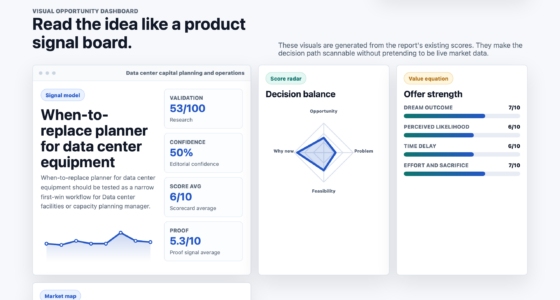
Thorsten Meyer AI has published a field note presenting IdeaClyst as a standalone, local-first workspace for startup idea validation. The source describes the tool as combining an AI council, live research and a founder workspace, while leaving open details such as distribution, pricing and independent performance evidence.
Thorsten Meyer AI has described IdeaClyst as a standalone, local-first tool meant to help founders pressure-test startup ideas before committing months of work, framing it as more than a roadmap input for Threlmark and as a separate workspace for research, critique and planning.
The source material says IdeaClyst combines three functions: an AI council that evaluates a founder’s proposed idea, a discovery engine that searches for demand signals, and a workspace that carries selected ideas from early interest toward a build-ready plan. It says the system runs locally, keeps files on the user’s machine and writes outputs as Markdown files that founders can own, version and reuse.
According to Thorsten Meyer AI, the council process is built around disagreement rather than a single agreeable answer. The described workflow includes product strategy, technical architecture, a critique pass, a second independent critique and a final synthesis that gathers strategy, architecture, validation tests and a plan into a sectioned founder packet.
The source also says IdeaClyst uses live research rather than relying only on model-generated opinions. It is described as opening real pages, reviewing competitor sites, scanning discussions and adding source links to its analysis. The material says the tool is designed to state when it cannot gather evidence instead of inventing claims.
Why It Matters
The development matters because early product choice remains one of the highest-risk decisions for founders. The source cites CB Insights for the claim that about 42% of startups fail because there is no market need, and it cites 2026 industry estimates that a solo founder or small team can waste $35,000 to $150,000 building the wrong product over six to 12 months.
If IdeaClyst works as described, its main value would be reducing false confidence before build work begins. The source argues that modern coding tools have made software faster to ship, which moves more pressure onto deciding what should be built in the first place. That is a claim from the source, not independent proof of the tool’s effect on founder outcomes.
startup idea validation software
As an affiliate, we earn on qualifying purchases.
As an affiliate, we earn on qualifying purchases.
Background
Thorsten Meyer AI says it previously covered IdeaClyst through its connection to Threlmark, where scored suggestions feed into a roadmap. The new material shifts attention to IdeaClyst itself, describing the roadmap connection as only the final step of a larger decision workflow.
The field note places IdeaClyst in a growing category of founder tools using AI for research, validation and planning. Its distinguishing claim, according to the source, is that sensitive early ideas stay local as plain files on the founder’s disk
“The build isn’t the hard part anymore — conviction is.”
— Thorsten Meyer AI source material
“The single most valuable thing a tool can do is talk you out of the wrong six months.”
— Thorsten Meyer AI source material
“That’s not validation — that’s getting approval from something that can’t say no.”
— Founder quoted from r/SaaS in the source material
“When IdeaClyst cites a source, it actually fetched it.”
— Thorsten Meyer AI source material
local-first research tool for entrepreneurs
As an affiliate, we earn on qualifying purchases.
As an affiliate, we earn on qualifying purchases.
What Remains Unclear
Several details remain unclear from the supplied material. The source does not provide a release date, installation path, supported operating systems, pricing, model-provider requirements or independent test results. It also does not show whether third parties have verified the tool’s research accuracy, local-only data handling or effectiveness at improving founder decisions.
AI-powered business idea critique
As an affiliate, we earn on qualifying purchases.
As an affiliate, we earn on qualifying purchases.
What’s Next
The next step for readers is to look for product documentation, repository details, demos or release notes that confirm how IdeaClyst can be installed and used. For the tool itself, the next milestone would be evidence from real founder workflows showing whether its council process and research packets change product decisions before teams begin building.
founder workspace for product planning
As an affiliate, we earn on qualifying purchases.
As an affiliate, we earn on qualifying purchases.
Key Questions
What is the actual news development?
Thorsten Meyer AI has presented IdeaClyst as a standalone founder workspace for idea validation, expanding the focus beyond its earlier connection to Threlmark roadmaps.
What is confirmed by the source material?
The source states that IdeaClyst is local-first, writes Markdown files, uses an AI council workflow and adds live research with source links. Those details are attributed to Thorsten Meyer AI.
What is claimed but not independently proven here?
The source claims IdeaClyst can help founders avoid wasting months on weak ideas. The supplied material does not include independent outcome data showing how often it changes decisions or improves startup success rates.
Why would founders care?
Founders often face large time and cost risks before they know whether a product has real demand. A tool that tests assumptions early could help teams challenge weak ideas before committing engineering time and money.
What remains unknown?
The material does not specify availability, pricing, platform support, required AI models, setup process or third-party verification of its local-first and research claims.
Source: Thorsten Meyer AI
Halloween Picks
halloween
As an affiliate, we earn on qualifying purchases.