
TL;DR

Get the latest gadgets delivered free with Prime
- Fast, free delivery on millions of items
- Prime Video, Amazon Music and more included
- Member-only deals all year
Mistral is betting on sovereignty, open weights, and efficiency for regulated industries, not raw scale. Its rapid revenue growth suggests a strong market fit, but questions remain if it can truly challenge US giants on quality or ecosystem influence.
In the high-stakes world of AI, the question isn’t just about who builds the biggest models anymore. It’s about who controls and deploys AI where it matters—safety, regulation, and sovereignty. Mistral’s recent moves hint at a different game—one where control beats size, and sovereignty could be the real market driver.
They’re not just aiming to match OpenAI or Anthropic on raw power. Instead, Mistral is positioning itself as a full-stack builder for enterprises that want to keep data local, models open, and control close. But does this strategy mark a breakthrough or a sign of being already behind? That’s what we’ll explore.
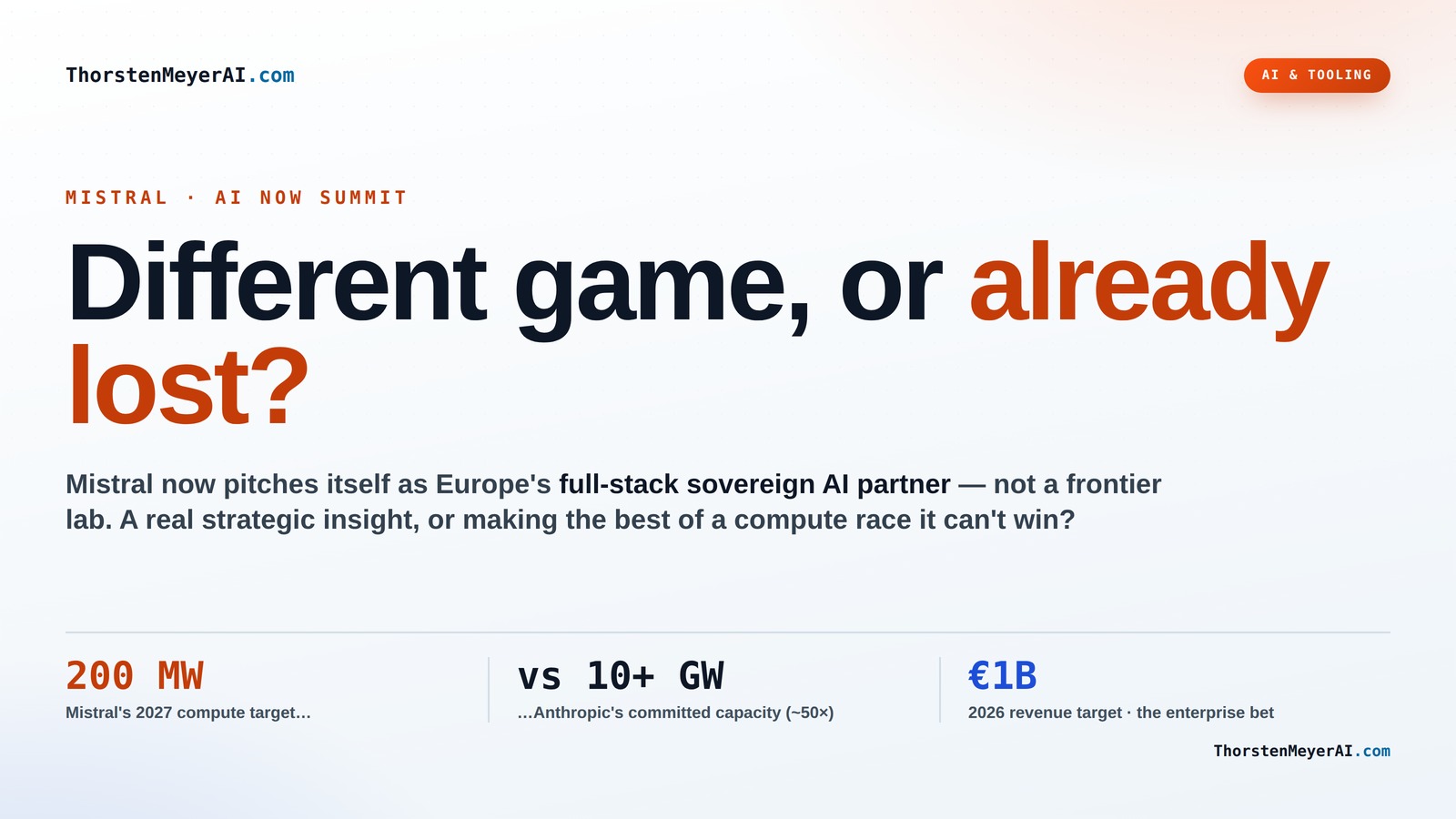
Different game, or already lost?
Mistral now pitches itself as Europe’s full-stack AI provider — compute, models, platform, consultancy — not a frontier-model lab. Is that a real strategic insight, or making the best of a race it can’t win? Both readings fit the same facts.
From model lab to full-stack provider
The clearest signal from the summit wasn’t a model — it was a posture. Heavy on enterprise logos and partnerships (ASML, BNP Paribas, Alexa+), light on new-model announcements. That absence is exactly what skeptics seized on.
Compute
40MW Paris DC + Sweden build · 200MW target by 2027
Models
Open & custom · efficient · you own and run them
Platform
Forge for custom models · Vibe for Work agent
Consultancy
Sales teams, integrators, EU provenance & support
Small & focused, or large & general?
Mistral bets on specialized small models. The claim isn’t that they win a reasoning leaderboard — they don’t. It’s that on the metrics that matter in production agent systems, a purpose-built small model wins. Flip the metric to see the case reverse.
Small specialized vs large general — by what you measure
In token-heavy agentic apps making hundreds of calls, speed/energy/cost compound. Toggle the metric.
Narrow models doing real work
Each is one model doing one thing efficiently — the tangible version of the strategy. Strong on their own terms; the open question is whether the bundle beats a free Chinese open-weight download.
On-prem KYC compliance
Mistral models run inside the bank’s walls for know-your-customer checks. Sensitive financial data never leaves. (BNP was Mistral’s first customer, 2023.)
Voxtral multilingual voice
A focused voice model powering Alexa+ across Europe — speed and efficiency over raw size.
Robostral industrial robotics
Plus a “physics AI” push (via the Emmi acquisition) into aerospace, automotive & semiconductor design and simulation.
Document AI / OCR at scale
Large-scale text extraction — the unglamorous, high-volume enterprise work small models excel at.
The strategy is downstream of the compute gap
Once you see the raw numbers, “why is Mistral behind?” answers itself — and the specialized-small-model strategy starts looking partly like a smart adaptation to a binding constraint, not a pure philosophical choice.
Compute & capital · Mistral vs a frontier leader, this same week
Not a knock — it’s the constraint that forces the efficiency-first, sovereignty-wedge strategy. Adapting intelligently to your position is what good strategy is.
“I want them to win, but I’m worried”
That ambivalence is the most accurate read of where Mistral sits. The enterprise pivot gets read two opposite ways — and both deserve airing.
On-prem, real sales teams, the Koyeb deployment acquisition, EU provenance — exactly what regulated enterprises want, and stickier than consumer mindshare. Targeting €1B revenue in 2026 with 1,000 staff, up from 15 people and one customer in 2023. US closed-API labs structurally can’t match the sovereignty axis.
“Software consultancy with a data center,” not a foundation-model moat. Enterprise B2B is where European startups go when they can’t win consumer or world-scale SaaS. Why pay Mistral on-prem when you could run Qwen free? One paying Le Chat Pro user said the quality gap with frontier labs is now hard to ignore.
Key Takeaways
- Mistral’s focus on sovereignty and open weights addresses a critical need in European regulated industries, creating a strong niche market.
- Its use of mixture-of-experts architecture enables faster, cheaper, and more efficient models—ideal for enterprise deployment.
- Rapid revenue growth signals strong regional demand, but questions remain about scalability and global influence.
- Sovereignty isn’t just hosting models locally—it’s about control over data, infrastructure, and governance, which Mistral emphasizes.
- The debate isn’t just about Mistral’s size; it’s whether control and efficiency can carve out a sustainable, competitive advantage against US giants.
enterprise AI model deployment platform
As an affiliate, we earn on qualifying purchases.
As an affiliate, we earn on qualifying purchases.
What Does ‘Sovereign’ Really Mean for Mistral?
Mistral’s idea of sovereignty isn’t just about hosting models locally—it’s about control over data, infrastructure, and model ownership. For their clients, especially in Europe, sovereignty means keeping sensitive info inside national borders, not relying on US or Chinese cloud giants.
Take BNP Paribas, which runs Mistral models on-prem for compliance, keeping customer data tightly inside the bank’s own walls. That’s a concrete example of sovereignty in action—where the model’s deployment environment is as important as the model itself.
For Mistral, sovereignty is a strategic wedge—serving regulated industries that demand control, transparency, and independence from external vendors. It’s a different game than chasing scale, but one that’s gaining momentum among European businesses.
Deeply, sovereignty matters because it fundamentally shifts power dynamics in AI deployment. Instead of being dependent on tech giants’ cloud infrastructure, organizations retain ownership and oversight, reducing risks associated with data breaches, government scrutiny, or policy changes. However, this approach often involves tradeoffs: increased costs, complexity, and the need for specialized technical expertise. It also limits rapid scalability and ecosystem integration, which are critical in a hyper-competitive global AI landscape. Therefore, sovereignty can be a double-edged sword—enhancing control but potentially constraining agility and innovation.

local data AI models for regulated industries
As an affiliate, we earn on qualifying purchases.
As an affiliate, we earn on qualifying purchases.
Why Open-Weight Models Are a Game Changer for Enterprises
Open weights mean you can download, fine-tune, and run models locally—no API calls, no dependence on a cloud provider. For regulated industries, this is a massive advantage. It’s about security, compliance, and customization.
Compare this with OpenAI’s API approach: you send your data off to a third-party, losing control. Mistral’s open approach lets organizations keep sensitive data inside their own systems, reducing risk and increasing trust.
For example, a European bank can adapt Mistral’s models to meet strict GDPR rules, something that’s harder with closed, API-only models. This flexibility is why many see open weights as a strategic advantage—even if it means sacrificing some scale and ecosystem dominance.
However, the tradeoff is that open models require organizations to have the technical capacity to fine-tune and maintain them. Unlike API models, which are plug-and-play, open weights demand ongoing management, updates, and security oversight. For enterprises, this can be both a benefit and a burden—offering control but demanding resources and expertise. The implications are significant: open weights can democratize AI customization, but they also deepen the divide between tech-savvy organizations and those lacking in-house capabilities. As the ecosystem evolves, the success of open models will depend on the availability of user-friendly tools and community support, which are still maturing.

As an affiliate, we earn on qualifying purchases.
How Mistral’s Architecture Supports Cost and Speed Wins
Mistral leans on mixture-of-experts (MoE) architectures—where only parts of the model activate per task. This design reduces inference costs and boosts speed, especially for targeted, purpose-built models.
Imagine a model used for legal document review. Instead of a giant, 175B reasoning model, Mistral’s smaller, specialized models process documents faster and cheaper, with less energy wasted.
Take their Voxtral model for multilingual voice: it’s optimized for quick responses in European languages, making it perfect for real-time voice assistants. This focus on efficiency gives Mistral an edge in production environments—where speed and cost matter more than chasing the biggest model.
Deeply, the architecture choice reflects a strategic tradeoff. By prioritizing efficiency and specialization, Mistral sacrifices some of the general-purpose versatility that scale models offer. This limits the breadth of applications but enhances performance in targeted use cases. For enterprises, this means more cost-effective, rapid deployment of AI solutions tailored to specific needs, reducing barriers to adoption and enabling faster ROI. The tradeoff, however, is that these specialized models may lack the flexibility for unforeseen or broad applications, potentially constraining future scalability. Nonetheless, in regulated industries where precision and compliance are paramount, this architecture can be a decisive advantage, aligning technical design with business priorities.

As an affiliate, we earn on qualifying purchases.
Europe’s Drive for Digital Independence—And Mistral’s Role
The EU is pushing hard for digital and AI sovereignty—aiming to reduce reliance on US and Chinese tech giants. Learn more about Europe’s drive for digital independence. Mistral fits into this push perfectly with its European roots, open models, and focus on local deployment.
Recent reports show around 60% of Mistral’s revenue comes from Europe, highlighting strong regional demand. Governments and public sector organizations are especially interested in models they can control, tune, and audit.
But sovereignty isn’t just hosting in Europe. It’s about data governance, operational independence, and regulatory compliance—areas where Mistral’s approach is gaining real traction.
Deeply, this regional focus is a strategic choice that aligns with broader geopolitical trends. See how regional strategies shape AI development. Europe’s push for sovereignty reflects a desire to create a resilient, competitive digital economy that isn’t overly dependent on external giants. For Mistral, this means tailoring solutions to regional needs and regulations, which can foster loyalty and trust. However, it also means navigating complex regulatory landscapes and ensuring compliance across different jurisdictions. The regional emphasis can be both a competitive advantage and a barrier, depending on how well Mistral manages these challenges. Ultimately, the focus on sovereignty is a recognition that control over AI infrastructure and data is becoming a critical aspect of national security and economic independence—values that resonate strongly within the European context.

Is Mistral Winning by Focusing on a Smaller, Smarter Niche?
Mistral’s bet is that small, specialized models can outperform giant, general-purpose ones in real-world enterprise scenarios. These models are faster, cheaper, and easier to run locally—perfect for regulated industries.
Think of their document AI for large-scale text extraction or their voice models powering Alexa+ in Europe. These are narrow, purpose-built models doing one thing well, with minimal latency and cost.
While Mistral isn’t trying to beat OpenAI on scale, it’s carving out a lucrative niche—serving organizations that need control and efficiency, not just raw power. But can this approach scale globally? That’s still a big open question.
Deeply, this niche focus reflects a strategic acknowledgment that enterprise AI needs are highly specialized and context-dependent. By concentrating on targeted solutions, Mistral can build deeper expertise and trust within specific sectors, allowing for more tailored product development and regulatory compliance. The challenge lies in whether this niche can expand beyond regional markets into broader industries and geographies. The scalability depends on whether other regions with similar sovereignty concerns adopt these models and whether Mistral can adapt its offerings for different regulatory and linguistic environments. If successful, this approach could redefine enterprise AI deployment—moving away from monolithic models to a federation of specialized, regional solutions. But if the niche remains too limited, growth potential could be constrained, making Mistral’s long-term impact uncertain.

Is Mistral’s Rapid Revenue Growth a Sign of Success or Just Trend Riding?
Mistral’s revenue jumped from about $20 million early this year to over $400 million by early 2026. CEO Arthur Mensch expects it to hit €1 billion in annual revenue soon. That’s a blistering pace, especially for a company that’s only a few months old.
This growth suggests that enterprises are eager for sovereignty-focused AI—especially in Europe where regulation and control matter. But is it sustainable? Or is Mistral riding the wave of regional politics and a growing demand for local AI?
The real question: can Mistral maintain this momentum as global giants close the gap or as the sovereignty trend matures? Or will it plateau once the market’s initial excitement cools?
Deeply, rapid growth in this context indicates a potent combination of regional regulatory environments, customer trust, and the current geopolitical climate favoring localized solutions. However, such growth might also be driven by nascent demand that could plateau or shift as larger players adapt or as regulatory frameworks evolve. The sustainability depends on Mistral’s ability to innovate, expand its offerings, and deepen its ecosystem—factors that are still unfolding. The risk is that initial enthusiasm may fade if competitors introduce comparable sovereignty-focused models or if the regional market saturates. Conversely, if Mistral can leverage its momentum to build a broader ecosystem and expand beyond regional borders, this growth could be sustained, shaping a new paradigm for enterprise AI centered on control and localization.

The Big Question: Different Game or Already Lost?
This debate hinges on whether sovereignty and open weights are enough to challenge giants like OpenAI or Anthropic. For some, Mistral’s strategy is a fresh game—serving niche markets that prioritize control and compliance. For others, it’s a sign that the real race for AI dominance—scale, ecosystem, and consumer mindshare—is already lost.
Both views have merit. Mistral’s rapid growth and regional focus show a clear market demand. But the size gap with US giants remains vast, and their ecosystem advantage is hard to beat.
Deeply, this debate underscores a fundamental tension: is the future of AI one dominated by global scale and ecosystem integration, or by regional control and specialized solutions? Mistral’s approach suggests a potential shift—if regional sovereignty becomes a priority for governments and industries worldwide, it could redefine competitive dynamics. However, the entrenched advantages of scale, data access, and ecosystem networks held by US giants mean that challenging their dominance requires more than regional focus—it demands innovation, ecosystem development, and global reach. Ultimately, the outcome hinges on which values—control or scale—resonate more with the evolving AI landscape and regulatory environment.
Frequently Asked Questions
What does ‘sovereign’ mean in Mistral’s case?
Sovereign in Mistral’s context means providing AI models that can be deployed and run within a client’s own infrastructure, giving control over data, compliance, and operational independence—especially important for European regulators and enterprises.Is sovereignty about data location, model ownership, or both?
It’s both. Sovereignty involves hosting data locally, owning the models outright, and maintaining full control over how AI is used, updated, and governed—reducing reliance on external cloud providers.How is Mistral different from OpenAI and Anthropic?
Mistral emphasizes open-weight models, local deployment, and a full-stack approach, whereas OpenAI and Anthropic focus on closed, API-only models hosted in their clouds—making Mistral more appealing for regulated sectors seeking control.Why do governments and regulated enterprises care about open-weight models?
Open weights allow organizations to customize, audit, and keep sensitive data in-house, ensuring compliance with strict regulations like GDPR, which closed APIs can’t guarantee as easily.Can a sovereignty-first strategy scale globally, or is it mostly a European niche?
While currently concentrated in Europe, the sovereignty approach could expand globally among nations and industries prioritizing control, but it faces hurdles competing with US giants on ecosystem and scale.Conclusion
In the end, Mistral’s strategy might be a different game—focused on sovereignty, control, and efficiency rather than sheer scale. It’s a play that’s resonating in Europe and among regulated sectors, carving out a crucial niche.
But whether this approach can reshape the global AI landscape or just serve regional needs remains uncertain. The real question isn’t who builds the biggest model—it’s who owns and controls the AI you depend on. That’s the game to watch.

Halloween Picks
halloween
As an affiliate, we earn on qualifying purchases.