
🔍 Read the full analysis: What Makes The UGREEN NAS DXP4800 Pro Worth Considering For AI? on ThorstenMeyerAI.com

Get the latest gadgets delivered free with Prime
- Fast, free delivery on millions of items
- Prime Video, Amazon Music and more included
- Member-only deals all year
TL;DR
The UGREEN NAS DXP4800 Pro combines four drive bays, an Intel Core i3-1315U, expandable DDR5 memory and 10GbE networking, with UGOS Pro features that include on-device AI photo organization. That hardware could suit home-lab users and small teams running multiple services, but the 144TB capacity depends on drives purchased separately, and faster transfers require a compatible network.
The UGREEN NAS DXP4800 Pro pairs a four-bay storage enclosure with an Intel Core i3-1315U, expandable DDR5 memory and 10GbE networking, positioning it for more than routine household backups, as discussed in the original analysis. Its UGOS Pro software also offers on-device AI photo organization, but the listed 144TB capacity depends on drives buyers supply, and the faster network speeds require compatible equipment.
The DXP4800 Pro is equipped with a six-core, eight-thread Intel Core i3-1315U, 8GB of DDR5 memory and support for expansion up to 96GB. According to the product information, it can run Docker services and virtual machines alongside file storage. That flexibility may help home-lab users consolidate tasks on one device; people using a NAS only for simple backups are less likely to need the extra processing headroom.
Its storage options include four 3.5-inch drive bays and two PCIe 4.0 M.2 slots. The stated maximum of 144TB is a possible configuration across four hard drives and two M.2 SSDs, not a claim that this amount of storage is included. The source does not state that drives come with the unit, so buyers should account for the cost and configuration of storage separately. Supported RAID options include RAID 0, 1, 5 and 10; RAID can provide resilience against some drive failures, but does not replace a separate backup.
For networking, the NAS has one 10GbE port and one 2.5GbE port, with a stated maximum transfer speed of 1.25GB/s. That figure describes the system’s stated capability, not a guaranteed speed for every setup. The connected computer, cabling, switches, drives and workload all affect actual transfers. The software package, UGOS Pro, includes media, photo and cloud-sync features, including on-device AI tools for organizing photos, according to the supplied product description.

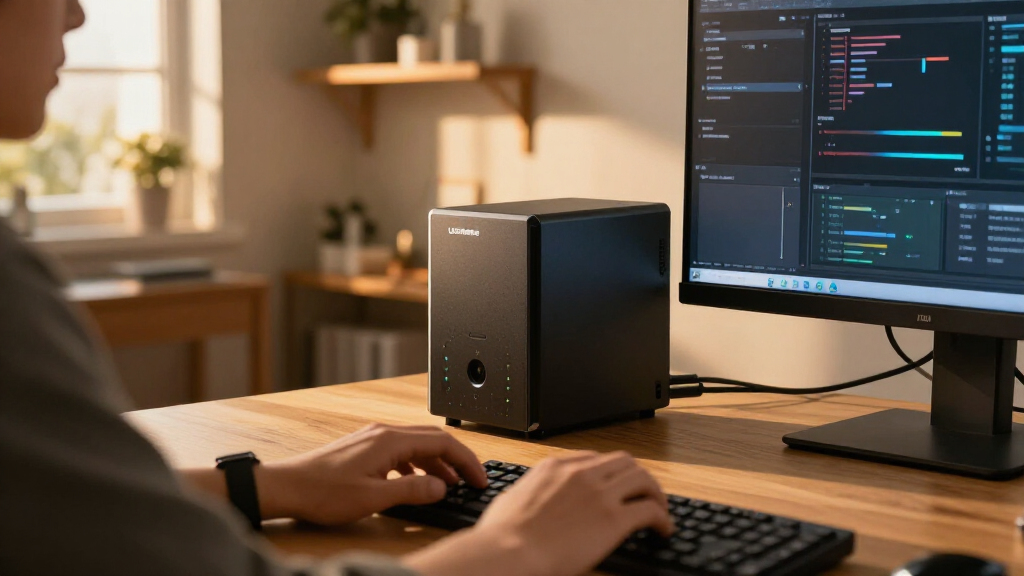
UGREEN NAS DXP4800 Pro 4-Bay Network Attached Storage
- ✔ Processor: Intel Core i3-1315U, 6 cores, 8 threads, up to 4.5GHz
- ✔ Memory: 8GB DDR5, expandable to 96GB
- ✔ Graphics: 13th Gen Intel UHD Graphics
The 1 picks
- 1
 UGREEN NAS DXP4800 Pro 4-Bay Desktop NAS with Intel Core i3-1315U, 8GB DDR5,…View on Amazon →
AI Features Need the Right Hardware
The DXP4800 Pro’s appeal for AI is practical rather than a promise of a general-purpose AI computer: its advertised on-device AI photo organization could help users sort a growing library while keeping the NAS at the center of their storage setup. That may matter to households, creators and small teams who want their photos and files on a device they manage, rather than relying entirely on a separate hosted service. The source does not provide a performance benchmark or explain the AI feature’s exact capabilities, so buyers should not treat the listing as evidence of a particular speed or accuracy.
The broader hardware matters if the NAS will run several jobs at once. Expandable memory, a Core i3 processor and multiple drive bays give users more room to add services and storage than a basic two-bay backup device. A compatible 10GbE network can also make large file transfers more practical for a team. But those benefits come with planning and cost: users need to choose drives, may need to upgrade memory, and need compatible network equipment to approach the stated transfer potential. For straightforward shared folders and backups, the extra capacity may not justify that complexity.
Beyond a Basic Two-Bay NAS
The source compares the four-bay DXP4800 Pro with simpler two-bay systems such as the Synology DS223 and DS223j. The UGREEN unit offers more drive bays, higher-speed networking and hardware described as suitable for Docker and virtual machines. Those distinctions make it a different kind of purchase from a compact appliance intended mainly for backups and shared files, rather than proving that one model is better for every buyer.
Setup is also part of the comparison. The DXP4800 Pro has tool-free drive trays, but users still have to obtain storage and decide how to configure the drives and network. The supplied information lists a two-year warranty and an aluminum chassis. It does not provide evidence about long-term reliability, operating noise or real-world performance under specific workloads.
Performance Claims Need Testing
The available material is a product assessment, not a lab test or an announcement of a new release. It does not include independent benchmark results, pricing, availability details or a direct measurement of how quickly the AI photo tools process a library. The listed 1.25GB/s maximum should be understood as a stated capability; actual transfer rates depend on the full network and storage setup.
It is also unclear whether the unit is sold with any drives, beyond the source’s statement that the listing does not say drives are included. Buyers should confirm the package contents before purchase. The source does not specify the AI feature’s supported formats, privacy settings, accuracy or software update policy, nor does it establish how the system performs acoustically or over extended operation.
Check the Setup Before Buying
Prospective buyers should verify the current package contents, price and warranty terms with the seller, then budget for the drives needed to build their intended array. They should also check whether their computers, switches and cabling support 2.5GbE or 10GbE before paying extra for faster networking. Users planning to run several virtual machines or services should review whether the included 8GB of memory is sufficient for their workload.
Any firmer assessment of the AI tools or transfer performance will depend on product testing and the software configuration. Until independent results or further product details are available, the clearest case for the DXP4800 Pro is for buyers who expect to use its storage expansion, self-hosted services or faster network options. Those seeking only basic backup and file sharing may find a simpler two-bay NAS a closer fit.
Key Questions
What makes the DXP4800 Pro relevant to AI?
Its UGOS Pro software includes on-device AI photo organization, according to the product information. The source does not provide benchmarks or detailed information about the feature’s speed, accuracy or supported formats.
Does it include 144TB of storage?
No. 144TB is a stated maximum configuration across four hard drives and two M.2 SSDs. Buyers need to confirm what is included and purchase drives as needed.
Will the 10GbE port make file transfers faster?
Only if the wider setup supports it. The computer, switch, cabling, drives and workload must all be able to use the faster connection; on a standard gigabit network, the port’s extra capacity will be limited.
Who is most likely to benefit from this NAS?
It is best suited to people who plan to use multiple drive bays, self-hosted services, virtual machines or faster networking. For basic backups and shared folders, a simpler two-bay model may be more appropriate.
Source: ThorstenMeyerAI.com