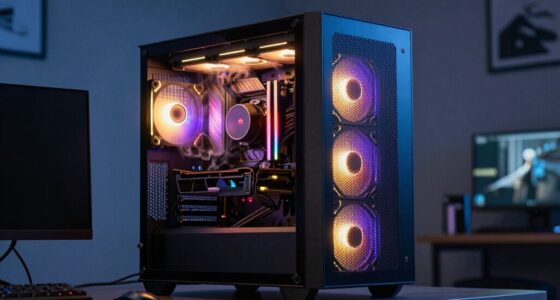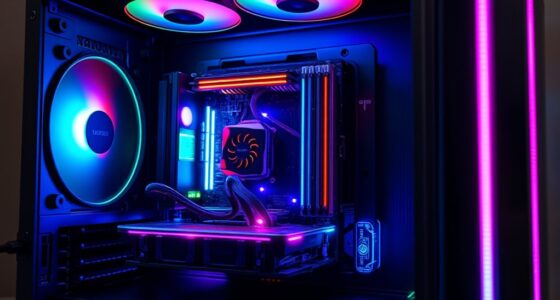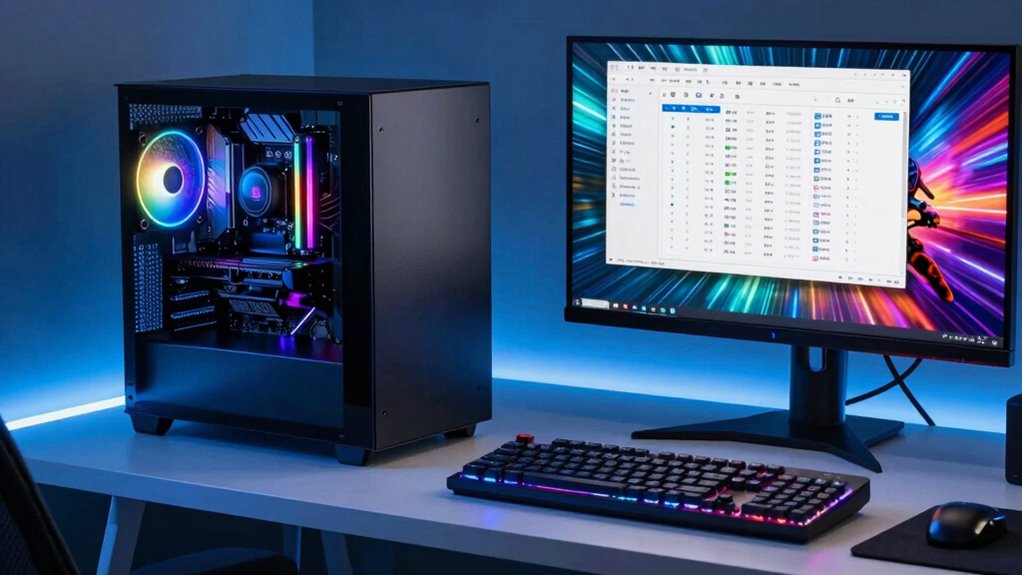

If you’re choosing a CPU for productivity, look for high core counts, large caches, and stable performance for multitasking and demanding workloads, while overclocking isn’t a top priority. For gaming, focus on CPUs with overclocking potential, high clock speeds, and in some cases, integrated graphics for lighter gaming. Dedicated GPUs are preferred for high-end games. Understanding these key features will help you pick the right processor—keep going to discover more about matching your needs.

Get the latest gadgets delivered free — and shop member deals
- Fast, free delivery on millions of items
- Access to Prime Big Deal Days deals on October 6–7
- Prime Video, Amazon Music and more included
Key Takeaways
- Productivity CPUs prioritize high core counts, large caches, and stable performance for multitasking and demanding workloads.
- Gaming CPUs focus on overclocking potential and high single-thread performance to boost frame rates and reduce latency.
- Integrated graphics are more beneficial for light tasks and troubleshooting in productivity builds, less critical for gaming.
- Overclocking capabilities are essential for gaming CPUs to maximize performance, less important for productivity-focused processors.
- Efficient thermal management and cooling are vital for sustained performance in both productivity and gaming CPUs.
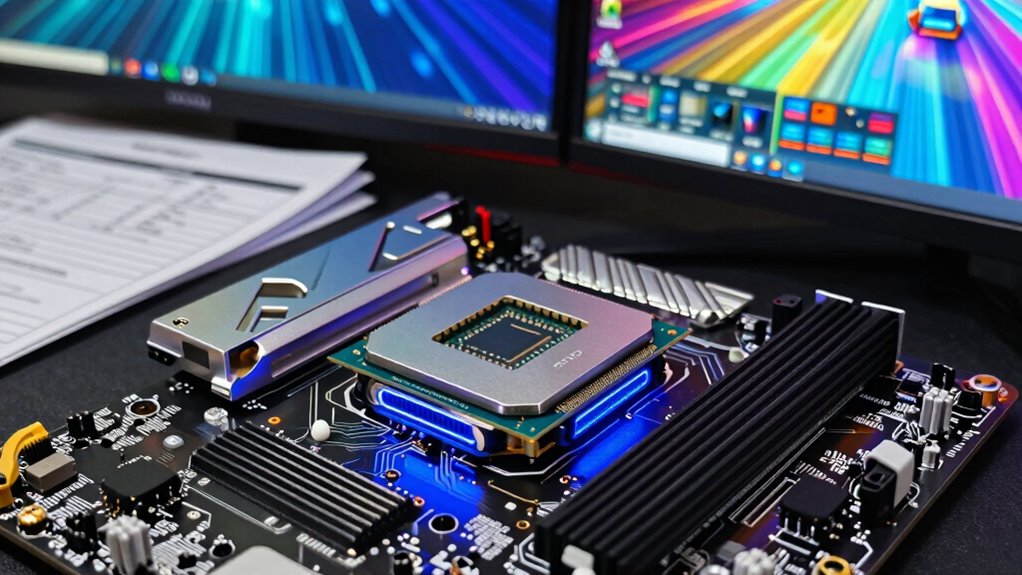
Have you ever wondered what sets a CPU apart when it’s built for productivity versus gaming? The answer lies in several key features, but two of the most important are overclocking potential and integrated graphics. When you’re choosing a CPU for productivity tasks, such as video editing, programming, or data analysis, you tend to look for processors with high core counts, large caches, and stable performance under sustained loads. Overclocking potential becomes less critical here because stability and efficiency are prioritized over raw speed. Additionally, the cooling system plays a vital role in maintaining performance and longevity of the CPU during prolonged workloads. You want a CPU that can handle heavy multitasking and demanding software without overheating or throttling. A well-designed thermal management system can significantly improve overall system stability and lifespan. You want a CPU that can handle heavy multitasking and demanding software without overheating or throttling. Integrated graphics, in this context, are often secondary since most productivity work relies on dedicated graphics cards or even just CPU power. However, having decent integrated graphics can be a bonus for light tasks or troubleshooting without sacrificing extra hardware costs. Additionally, understanding the emerging trends in digital publishing can influence how hardware is optimized for content creation and distribution.
On the other hand, if you’re into gaming, a CPU’s overclocking potential takes center stage. Overclocking allows you to push the processor beyond its stock speeds, maximizing frame rates and reducing latency, which can be essential for competitive gaming. You want a CPU that’s known for its overclocking headroom, such as certain models from AMD Ryzen or Intel Core K-series processors. These chips often come unlocked, giving you more flexibility to fine-tune performance. Integrated graphics, in gaming CPUs, are usually less relevant if you’re pairing your system with a dedicated GPU. But if gaming on a budget or doing casual gaming, a processor with capable integrated graphics can handle lighter titles without needing a separate graphics card. This can be a cost-effective solution, especially for gamers who aren’t chasing ultra settings or high resolutions.
Ultimately, the choice depends on what matters most to you. For productivity-focused tasks, stability, efficiency, and multi-core performance matter more than overclocking potential or integrated graphics. For gaming, boosting frame rates through overclocking, along with a good discrete GPU, makes a bigger difference. While integrated graphics can be a helpful feature in certain scenarios, they’re generally a secondary consideration compared to the core performance and overclocking capability. Knowing your priorities helps you select a CPU that aligns with your specific needs, whether for work or play.
high core count CPU for productivity
As an affiliate, we earn on qualifying purchases.
As an affiliate, we earn on qualifying purchases.
Frequently Asked Questions
How Do CPU Thermal Solutions Impact Performance?
Your CPU’s thermal solutions directly impact performance by controlling cooling efficiency. When cooling is effective, your CPU stays within safe temperature limits, preventing thermal throttling, which decreases processing speed to avoid overheating. Poor cooling leads to higher temperatures, causing the CPU to slow down and reduce performance. Investing in good cooling solutions ensures your CPU runs smoothly, maintaining maximum performance during intensive tasks or gaming sessions.
What Is the Role of Cache Size in CPU Efficiency?
Your CPU’s cache size is the superhero of efficiency, dramatically reducing wait times. Larger cache enables better cache optimization, allowing faster access to frequently used data, which speeds up processing. It plays a key role in the memory hierarchy, bridging the gap between the processor and main memory. When cache size is optimized, your CPU handles multitasking and intensive tasks more smoothly, boosting overall performance whether you’re working or gaming.
How Does CPU Overclocking Affect Longevity?
Overclocking your CPU can boost performance, but it may reduce its lifespan due to increased thermal degradation. Pushing your processor beyond stock speeds causes higher heat output, stressing the CPU’s components. This thermal stress accelerates wear and tear, potentially shortening overclocking lifespan. To mitigate this, make certain you have efficient cooling solutions and monitor temperatures regularly, balancing performance gains with the health of your CPU over time.
Are Integrated Graphics Sufficient for Casual Gaming?
Integrated graphics are like a reliable toolkit for casual gaming, enough to handle everyday titles at low to medium settings. If you’re into casual gaming, these graphics are usually sufficient, offering decent performance without the need for a dedicated GPU. They save space and money, making them perfect for light gaming sessions. However, for more demanding games or higher settings, a dedicated graphics card might be necessary for a smoother experience.
How Important Is Motherboard Compatibility for CPU Upgrades?
Motherboard compatibility is vital when upgrading your CPU, as it determines whether the new processor will fit and function properly. You need to check if your motherboard supports the specific CPU socket type and chipset. BIOS updates are often necessary to guarantee compatibility with newer CPUs. Ignoring these factors can lead to system instability or failure to boot, so always verify compatibility and update BIOS before upgrading your CPU.
As an affiliate, we earn on qualifying purchases.
Conclusion
Just like the legendary race between the tortoise and the hare, choosing the right CPU depends on your race. If you’re sprinting through gaming, prioritize high clock speeds and strong single-core performance. For productivity, think marathon—favor multi-core power and stability. Remember, no one CPU rules all. Your perfect match, much like Aesop’s wisdom, lies in understanding your needs. So, pick wisely, and let your CPU be the hero in your technological story.
CPU with integrated graphics for light tasks
As an affiliate, we earn on qualifying purchases.
As an affiliate, we earn on qualifying purchases.
best thermal management CPU cooler
As an affiliate, we earn on qualifying purchases.
As an affiliate, we earn on qualifying purchases.
Halloween Picks
halloween
As an affiliate, we earn on qualifying purchases.