
🔍 Read the full analysis: A Look At 6 Thunderbolt Docks For A More Capable Desk on ThorstenMeyerAI.com

Get the latest gadgets delivered free with Prime
- Fast, free delivery on millions of items
- Prime Video, Amazon Music and more included
- Member-only deals all year
TL;DR
A buyer’s guide from ThorstenMeyerAI.com compares six Thunderbolt docks, ranking Anker’s Prime 14-in-1 Thunderbolt 5 Dock first and outlining alternatives from Plugable and Dell. The guide says buyers should check their computer’s connection, monitor limits and charging needs rather than choosing by port count alone.
ThorstenMeyerAI.com has compared six Thunderbolt docks, naming the Anker Prime 14-in-1 Thunderbolt 5 Dock its top overall pick for buyers seeking newer-generation bandwidth and a broad set of connections, as detailed in the original analysis. The guide also assesses four Thunderbolt 4 models from Plugable and Dell, emphasizing that a dock’s listed ports do not guarantee a particular display or charging result on every computer.
The six products span Thunderbolt 5 and Thunderbolt 4. The guide ranks Anker’s Prime 14-in-1 first, describing its appeal as a combination of newer-generation bandwidth and a broad connection set. For more options, see this roundup of Thunderbolt docks. It does not provide benchmark results or establish that the dock will outperform the other models in every setup.
For Thunderbolt 4 users, the guide describes Plugable’s TBT-UDM as a cross-platform option and the Dell Pro SD25TB4 as a fit for buyers seeking a current Dell dock. A second Plugable model is positioned around 100W charging and dual-monitor use. The source does not identify that Plugable model by name in the supplied material.
The remaining choices are Dell’s WD19TB and WD19TBS. The guide distinguishes them by power configuration, citing a listed 180W adapter for the WD19TB and 130W Power Delivery. It advises buyers to check their laptop’s requirements rather than treating related model names or power figures as interchangeable.
The 6 picks
- 1
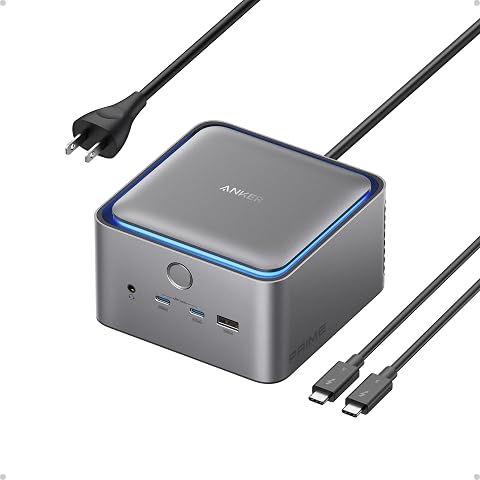 Anker Prime 14-in-1 Thunderbolt 5 Docking StationView on Amazon →
- 2
 Dell Pro Thunderbolt 4 Smart Dock SD25TB4 – USB-C Station 130W, 4 Displays 4K…View on Amazon →
- 3
 Plugable Thunderbolt 4 Dock with 100W Charging, Dual MonitorView on Amazon →
- 4
 Plugable Thunderbolt 4 Dock (TBT-UDM) for Mac and WindowsView on Amazon →
- 5
 Dell WD19TB Thunderbolt Docking Station with 180W AC AdapterView on Amazon →
- 6
 Dell Thunderbolt Dock WD19TBS with 130W Power DeliveryView on Amazon →
Match the Dock to Your Desk
The comparison matters because a dock sits between a computer and much of a desk setup: monitors, storage, networking and other peripherals may all depend on it. Choosing the wrong combination can leave a buyer with unused bandwidth, insufficient charging or a display arrangement the computer cannot support. The guide’s central practical point is to start with the host computer and connected devices, not the dock’s headline port count.
Thunderbolt 5 may offer more bandwidth headroom than Thunderbolt 4, but the computer must support the relevant connection to benefit from it. For someone with a Thunderbolt 4 laptop and ordinary office peripherals, a Thunderbolt 4 dock may be a better fit than paying for a newer generation. Likewise, charging figures need to be compared with the laptop’s power requirements, especially if the dock is meant to replace its charger.
Display support is also a system-level issue. The computer, operating system, dock and monitor connections all affect which screens can run and at what settings. Buyers who need two displays should confirm the exact configuration supported by their computer, rather than assuming that a dock’s multiple video connections settle the question.
Products Worth Considering

Samsung Odyssey G55C 32-Inch QHD 1000R Curved Gaming Monitor

Logitech MX Master 4 for Mac

Apple Watch SE 3 GPS 40mm Smartwatch
As an affiliate, we earn on qualifying purchases.
Six Models, Different Tradeoffs
The source ranks the docks by connection generation, charging, display support, port variety and intended use. It says Anker’s Thunderbolt 5 model leads for its generation and broad connection focus, while Plugable’s two Thunderbolt 4 options serve different priorities. Dell’s SD25TB4 is framed as the newer Dell-oriented choice; the WD19 models may suit buyers matching an existing Dell setup.
Those rankings are the source’s editorial judgments, not a reported laboratory test. The supplied material does not include prices, availability, complete port lists, measured performance results or a publication date. It also cautions that a product’s advertised capabilities do not determine what every computer can deliver. Host specifications, operating system and monitor inputs can change the outcome.
“A dock’s port count alone does not guarantee that every screen or peripheral will work as expected.”
— ThorstenMeyerAI.com buying guide
Compatibility Depends on the Computer
The supplied comparison does not specify the publication date, prices, full port-by-port specifications or test methods. It therefore does not support a direct value comparison or independent performance conclusions among the six docks. The second Plugable model is described by its 100W charging and dual-monitor focus but is not named in the supplied source text.
It is also not clear which exact monitor resolutions, refresh rates or operating-system configurations each dock supports. Those outcomes depend on the dock and the connected computer, and the source advises checking the laptop’s specifications and display limits before purchase. The listed 180W adapter and 130W Power Delivery for the WD19TB describe distinct power figures; buyers should verify how the dock’s configuration aligns with their particular laptop.
Check Specs Before Buying
The next step for buyers is to compare the dock’s specifications with the exact laptop model, operating system, monitors and devices they plan to connect. Confirm Thunderbolt support rather than relying on the shape of a USB-C port; check each monitor’s resolution, refresh rate and input; and verify whether the planned dual-display mode is supported.
Buyers should also compare the laptop maker’s recommended power supply with the dock’s delivered charging output, then list the ports they will use at the same time. The source provides no announced follow-up testing or product changes. Until more detailed specifications or hands-on results are available, its rankings are best treated as a starting point for a setup-specific compatibility check.
Key Questions
Which dock does the guide rank first?
The guide ranks the Anker Prime 14-in-1 Thunderbolt 5 Dock first overall, citing its Thunderbolt 5 positioning and broad connection focus. That is the source’s recommendation, not a claim that it is best for every computer.
Which Plugable dock is presented as the cross-platform choice?
The Plugable TBT-UDM is described as a strong fit for a Thunderbolt 4 setup and the cross-platform choice among Plugable’s two models. The other model is described as emphasizing 100W charging and dual-monitor use, but the supplied source does not name it.
Will a Thunderbolt dock support every monitor connected to it?
No. The guide says display results depend on the computer’s capabilities, operating system and monitor connections, as well as the dock. Buyers should check the exact display configuration their computer supports.
What should buyers check about charging?
Compare the laptop maker’s recommended power supply with the dock’s delivered charging output. The guide warns that an adapter rating and the power delivered to a laptop can be different figures, and that a demanding computer may need more power.
Does the comparison include independent performance testing?
The supplied material gives editorial rankings and buying criteria but does not include benchmark results, prices or a testing method. It should be read as a product-selection guide rather than a report of comparative laboratory measurements.
Source: ThorstenMeyerAI.com