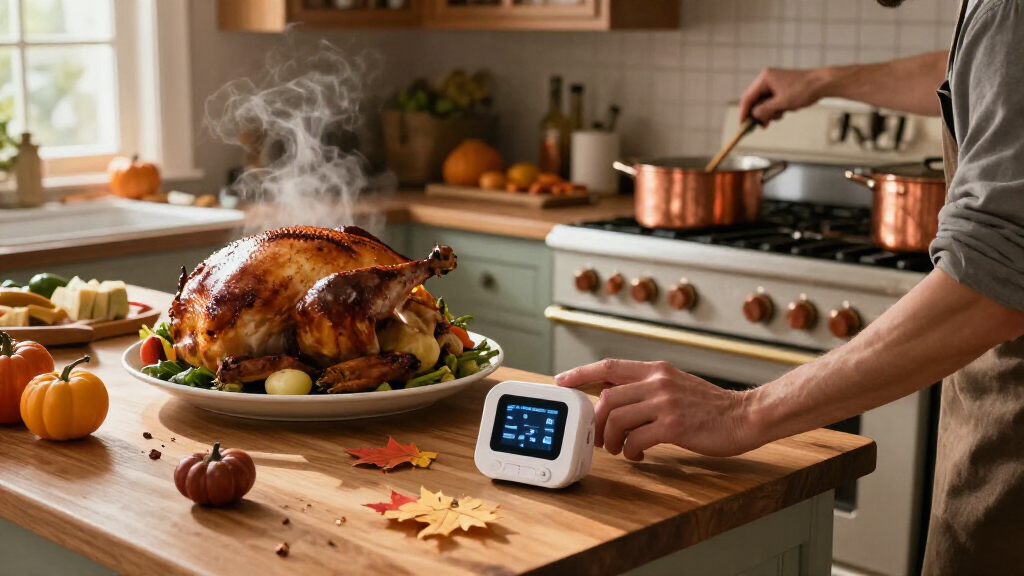

🔍 Read the full analysis: A Beginner’s Guide To AI-Powered Kitchen Timers For Thanksgiving on ThorstenMeyerAI.com

Get the latest gadgets delivered free with Prime
- Fast, free delivery on millions of items
- Prime Video, Amazon Music and more included
- Member-only deals all year
TL;DR
AI-powered kitchen timers can interpret spoken requests, label multiple timers and, in some products, suggest alerts from recipe steps. Their usefulness depends on accurate recognition, clear controls and reliable alerts; they cannot verify that food is safely cooked. The source guide recommends checking current features, offline behavior, privacy and cost before relying on one.
A consumer guide published by ThorstenMeyerAI.com describes ways AI-powered kitchen timers may help Thanksgiving cooks manage multiple dishes, including interpreting spoken requests, setting named timers and, in some products, suggesting alerts from recipe steps. The guide also identifies possible limits, including speech-recognition errors and inaccurate recipe interpretation, and notes that a timer cannot confirm food is safely cooked.
The guide uses AI-powered kitchen timer to describe a range of features rather than a standard capability. It says some devices interpret conversational requests to set or adjust timers, while others connect timers to a recipe service or smart display. The guide cautions that a Wi-Fi connection alone does not show that a product uses AI. It recommends checking manufacturers’ current feature lists for options such as naming timers, changing them by voice or generating suggestions from recipe steps.
For a holiday meal, the guide says timers may help keep several tasks distinct without repeatedly handling a phone. A cook could set separate timers for potatoes and vegetables, for example, and a reminder to check a sauce. It recommends checking whether alerts identify the relevant dish and whether the display or spoken confirmation makes the timer’s duration clear. It also advises confirming that one countdown can be adjusted without resetting others.
The guide warns that background noise, accents or ambiguous wording may affect speech recognition, potentially leading a system to mishear a duration or associate it with the wrong task. It advises reviewing recipe-based suggestions before starting them rather than treating them as an authoritative cooking schedule. Its suggested comparison points include alert reliability, offline behavior, privacy and cost, and it recommends keeping a basic phone or manual timer as a backup.
Check what a product actually does: voice control and Wi-Fi alone do not prove it uses AI.
Use clear timer names, review spoken commands, and confirm recipe-generated alerts before cooking.
Compare alert options, timer adjustments, offline use, privacy controls, and total cost.
Treat recipe timers as reminders to check; use a food thermometer when safe temperature matters.
Keeping Thanksgiving Timers Reliable
The guide frames multiple-timer organization as a possible benefit during Thanksgiving meal preparation, when several dishes may need attention at once. It says that benefit depends on requests being recognized correctly and alerts clearly identifying what needs attention. In the guide’s account, a product’s AI label alone does not establish that its controls will be dependable.
The guide also distinguishes a countdown from a food-safety check: an alert signals that time has elapsed but does not measure a turkey’s internal temperature or establish that a casserole is done. It advises cooks to follow trusted cooking instructions and use an appropriate thermometer to judge doneness. A timer is therefore a planning aid, not a safety check.
For purchase decisions, the guide recommends checking supported commands, confirmation and correction options, and whether a fallback is available. It does not compare specific products or establish that recipe-schedule features are more useful than basic timer controls.
Products Worth Considering

Logitech MX Keys S Combo Wireless Keyboard and Mouse, Graphite

Amazon Kindle Scribe (32GB) with Premium Pen, Tungsten (Like-New)

DJI Osmo 360 Motorcycle Handlebar POV Combo
As an affiliate, we earn on qualifying purchases.
What Timer Features Actually Do
The guide distinguishes flexible voice interpretation from simpler connected features. It describes basic smart timers as potentially responding to fixed commands or working through an app, while more conversational systems may handle requests to set separate timers or reminders for different tasks. It notes that specific capabilities depend on the product and may vary by software version, region, subscription or compatible device.
According to the guide, recipe-linked tools may identify durations in instructions and propose alerts, but it does not establish that any particular model reliably interprets all recipes. The guide’s account of broader market developments is based on information available through mid-2024, when conversational and generative AI features were being added to assistants, recipe services and smart displays. It is not a current product-by-product assessment; the guide advises shoppers to consult current documentation.
For use, the guide recommends naming timers after the food or task, confirming each duration and changing one timer at a time. It also advises checking whether pausing, extending or dismissing one alert affects other active countdowns.
What Buyers Still Need to Check
The source is a general consumer guide, not a test of named products. It provides no comparative measurements of recognition accuracy, alert reliability, offline performance, privacy practices or cost. The guide therefore does not establish what results users can expect from a particular device or kitchen setup.
The guide also does not verify which current products can accurately interpret multiple tasks, operate without internet access or convert recipe instructions into useful reminders. It notes that features may change with software updates or paid plans and recommends consulting manufacturers’ latest documentation. It names no specific models and does not independently verify manufacturers’ claims.
Checks Before the Holiday Meal
The guide recommends checking a device’s current documentation for supported timer commands, recipe functions, subscription requirements and behavior during an internet outage. It also suggests testing the timer in kitchen noise by setting several short, named timers, confirming their durations and labels, and checking whether pausing or extending one affects the others.
The guide advises using a timer alongside recipe instructions and a food thermometer, not in their place. It recommends keeping a phone or manual timer available in case the device loses its connection or misses an alert.
Key Questions
What does an AI-powered kitchen timer do?
Depending on the product, it may interpret spoken requests, set or label multiple timers, or suggest alerts based on recipe steps. The phrase does not describe one standard feature set, so check the device’s current documentation.
Can a kitchen timer tell whether Thanksgiving food is safely cooked?
No. A timer tracks elapsed time or issues reminders; it does not establish that food has reached a safe temperature. Follow trusted cooking guidance and use an appropriate food thermometer.
What should I do if the timer mishears a request?
Check the display or spoken confirmation before relying on the countdown. Use clear labels, adjust one timer at a time and keep a basic backup timer available.
Can recipe-based AI timers run a recipe automatically?
Some products may suggest alerts from recipe instructions, but the source guide advises reviewing those suggestions before starting. It does not establish that any particular product interprets every recipe accurately.
What should I compare before buying one?
Check timer controls and labels, alert reliability, offline behavior, privacy practices, subscription requirements and cost. Test voice recognition in realistic kitchen noise if possible.
Source: ThorstenMeyerAI.com