For great speaker setups, you should focus on positioning speakers at ear level and forming an equilateral triangle with your listening spot for music, ensuring clarity and natural sound. For movies, place surround speakers behind and beside you, with a well-aligned center channel for immersive sound. Acoustic treatments like rugs and diffusers improve both experiences. Fine-tuning placements and room acoustics is key. Keep exploring to discover how to optimize your setup even further.

Get the latest gadgets delivered free with Prime
- Fast, free delivery on millions of items
- Prime Video, Amazon Music and more included
- Member-only deals all year
Key Takeaways
- For music, prioritize speaker placement at ear level and forming an equilateral triangle for accurate imaging.
- For movies, surround sound speaker placement behind, beside, and in front of the listener creates immersive spatial effects.
- Room acoustics and treatments are essential for both, reducing reflections and enhancing clarity.
- Calibration and tuning ensure optimal sound distribution and minimize resonances for both music and movies.
- Subwoofer positioning differs: for music, focus on balanced low frequencies; for movies, emphasize deep, impactful bass for effects.
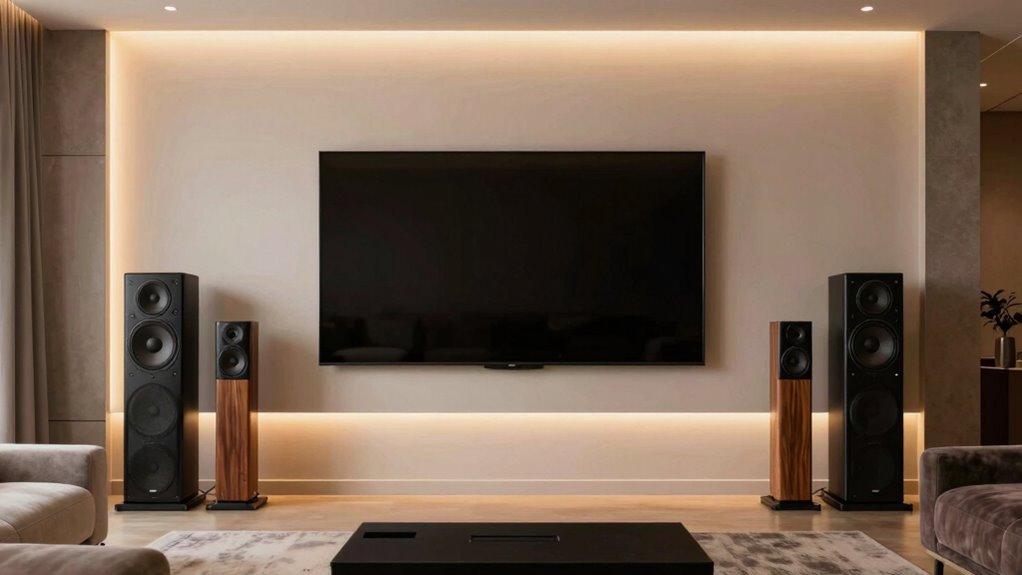
When setting up speakers for your home audio system, it’s important to understand that the ideal configuration differs depending on whether you primarily listen to music or watch movies. Your room’s acoustics and how you position your speakers play critical roles in creating the perfect sound experience. For music, you want clarity, detail, and a natural soundstage. This means placing your speakers where they can produce a balanced, even sound across the frequency spectrum. Typically, that involves positioning stereo speakers at ear level, forming an equilateral triangle with your listening position. The room’s acoustics influence how sound waves reflect and absorb, so you might need to experiment with speaker placement to minimize unwanted echoes or dead spots. Soft furnishings, rugs, and curtains help absorb excess sound and improve clarity, especially in rooms with hard surfaces. The goal is to create an environment where the sound feels intimate and immersive, with precise imaging that allows you to distinguish individual instruments and vocals. Understanding room acoustics and how they interact with your speaker placement can significantly enhance your listening experience. Additionally, considering speaker positioning to optimize sound distribution can make a noticeable difference in both music and movie setups. Paying attention to reflection points and how sound interacts with your room’s surfaces can help you fine-tune your setup for the best possible audio quality. Proper speaker calibration can also ensure that all speakers work together harmoniously for an optimal listening environment. Incorporating acoustic treatments can further improve sound quality by controlling reflections and resonances in your space.
When watching movies, your focus shifts to creating a surround sound environment that envelops you. Here, room acoustics and speaker placement become even more crucial. You want your speakers to deliver a dynamic, impactful sound that makes you feel part of the action. Placing speakers behind, beside, and in front of your listening area helps achieve this. Center channel speakers are essential for dialogue clarity—they should be directly in front of you, at ear level, aligned with your TV or screen. Surround speakers are best placed slightly behind and to the sides, angled toward your listening position to produce a sense of space and movement. Subwoofers add depth to low-frequency effects, so positioning them where they can fill the room evenly without causing boomy spots is key. Proper speaker placement minimizes sound reflections and echoes that could muddle the experience. Using acoustic treatments like bass traps or diffusers can further enhance clarity, especially when aiming for cinematic fidelity. Ultimately, your goal is to craft an environment where sound seamlessly integrates with the visuals, making movies feel more immersive and engaging.
Products Worth Considering

Sonos Era 100 Wireless Smart Speaker, Black

Bose SoundLink Flex Bluetooth Speaker (2nd Gen), Portable Waterproof Speaker, Black

Sonos Era 100 SL Compact Microphone-Free Speaker, Black
As an affiliate, we earn on qualifying purchases.
Frequently Asked Questions
How Do Room Acoustics Affect Speaker Placement for Music and Movies?
Room acoustics considerably influence your speaker placement for music and movies. The room shape affects sound reflection and absorption, so you should position speakers to minimize echoes and dead spots. Furniture placement also matters; avoid blocking speaker drivers or creating sound barriers. By adjusting your speakers based on these factors, you’ll achieve clearer sound, whether for immersive movies or detailed music, ensuring an ideal listening experience tailored to your space.
Is a Dedicated Subwoofer Necessary for Both Music and Movies?
A dedicated subwoofer is essential for both music and movies, and yes, it’s worth the investment. Proper subwoofer placement ensures deep, balanced bass, while considering power requirements guarantees it can handle loud scenes without distortion. Even if you think you don’t need one, the immersive experience of tight, punchy bass makes movies more thrilling and music richer. Don’t settle for less—your ears will thank you.
What Are the Best Speaker Types for Multi-Purpose Setups?
For a multi-purpose setup, you should choose versatile speakers like bookshelf or floor-standing models with sleek speaker aesthetics that blend into your space. Opt for wireless connectivity options, such as Bluetooth or Wi-Fi, to easily switch between devices and content. These speakers provide good sound quality for both music and movies, offering convenience and flexibility, while their stylish design guarantees they complement your home decor seamlessly.
How Does Speaker Impedance Impact Setup Choices?
Think of speaker impedance as the heartbeat of your setup, guiding amplifier compatibility and impedance matching. If your speakers have high impedance, you’ll need a powerful amplifier to drive them effectively; low impedance speakers demand an amp that can handle the load without distortion. Ignoring impedance can lead to poor sound quality or damage, so always match your speaker impedance with your amplifier’s specifications for a seamless, harmonious listening experience.
Can I Use the Same Speakers for Both High-Fidelity Music and Home Theater?
Yes, you can use the same speakers for both high-fidelity music and home theater, but you’ll need proper speaker calibration to optimize sound quality. Acoustic treatment in your room also plays a crucial role in achieving balanced audio for both purposes. Adjusting settings for different content ensures clear dialogue and rich music, making your setup versatile. Keep in mind, some speakers excel more in certain areas, so consider your priorities.
Conclusion
Whether you’re tuning your setup for music or movies, remember that the right speaker arrangement transforms your experience. Did you know that a proper home theater system can increase your room’s perceived size by up to 50%? So, invest the time to optimize your speakers—your ears will thank you. With the right setup, you’ll enjoy immersive soundscapes that bring your favorite tracks and films to life like never before.