
TL;DR

Get the latest gadgets delivered free — and shop member deals
- Fast, free delivery on millions of items
- Access to Prime Big Deal Days deals on October 6–7
- Prime Video, Amazon Music and more included
C12 and Thales have developed QuantumTrack, a hybrid quantum-classical method for multi-target radar tracking. The partners say it matched the best classical solver’s time-to-solution in a benchmark run on C12’s Callisto emulator; the project has reached TRL 5, with a demonstration on a physical processor planned as the next milestone.
C12 and Thales have developed QuantumTrack, a hybrid quantum-classical approach to tracking multiple targets with radar, and say it matched the time-to-solution of the best classical solver in their reported benchmark. The project won the 2026 Quantum Effects Award in the Quantum Computing Hardware category. Its results so far come from an emulator, and the partners’ next stated milestone is a demonstration on C12’s physical quantum processor.
The benchmark used Callisto, C12’s emulator, which the company says models the physical behavior of a processor with up to 20 qubits. C12 and Thales report that QuantumTrack produced results around 100 times faster than competing quantum annealers in that benchmark. That comparison is specific to the reported test; the source material does not provide a broader performance comparison across radar systems or operating conditions.
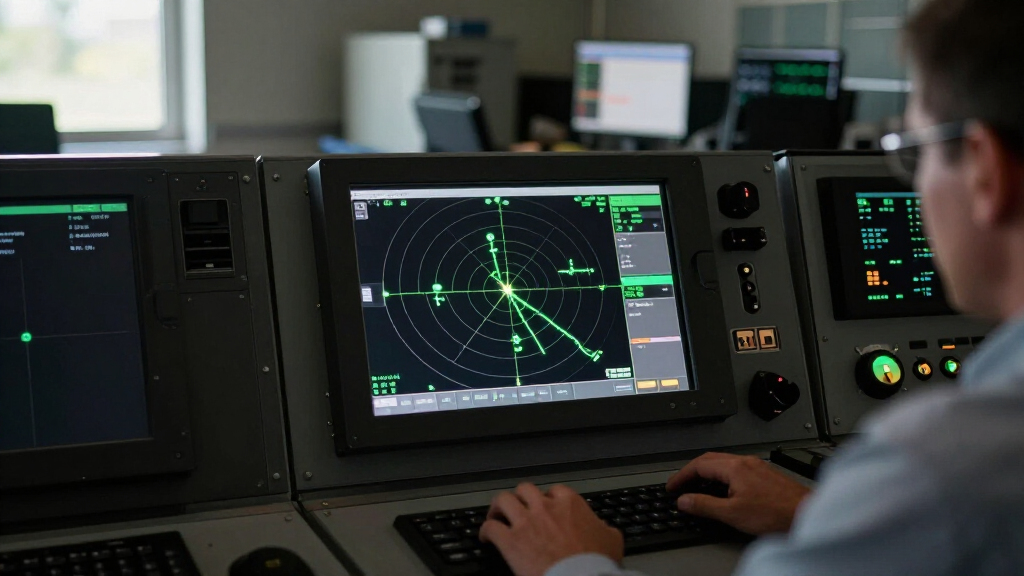
The method targets a difficult part of Multiple Hypothesis Tracking (MHT), a radar technique that evaluates possible ways to associate detections with existing target trajectories. Instead of putting the full tracking problem on quantum hardware, the partners split large instances into smaller subproblems sized for the processor. Those are solved through quantum annealing, then mapped back onto the original problem and merged.
The companies estimate that, with an active qubit reset protocol they have identified, total runtime could be about 50 milliseconds, including the time needed to break down the problem. They tested two representative radar scenarios with noisy measurements and clutter. The partners say the emulator accounted for processor errors and decoherence, but the reported timing remains an estimate based on emulation rather than a measurement from a physical chip.
Radar Tracking Under Heavy Loads
Radar systems must decide which detections belong to which moving objects, while accounting for noise and clutter. In a dense environment, many possible associations can compete. MHT keeps multiple candidate scenarios open before choosing the most likely one, but the number of combinations can grow rapidly as the number of tracked objects increases. The source describes the underlying problem as NP-hard and says classical solvers may prune candidate hypotheses to meet time limits.
If a quantum-assisted method can handle part of that calculation within operational timing constraints, it could give radar designers another option for demanding tracking workloads. C12 and Thales point to two areas where such workloads may grow: drone traffic management in civil airspace and defense systems facing dense or saturation threats. Their benchmark does not establish that QuantumTrack is ready for either setting. It indicates a development path the companies intend to test further.
The division of work reflects the partners’ stated co-design approach. C12 contributes its quantum hardware architecture and scientific expertise; Thales contributes the MHT algorithm, operational requirements and system integration experience. That combination matters because performance in an isolated computation is only one part of using a processor in radar equipment. The full workflow must fit the system’s timing, hardware and operating needs.
From MHT to a Quantum Emulator
MHT is used to maintain several candidate explanations for radar detections before selecting likely target tracks. According to the source report, classical systems limit the number of hypotheses they keep because evaluating every possible combination can become too demanding under real-time constraints. Pruning can discard possibilities that later scans might have helped resolve.
QuantumTrack applies quantum annealing to the selection of mutually compatible hypotheses, rather than attempting to run all of MHT on a quantum processor. The partners divide larger cases into processor-sized pieces and combine the results. This hybrid design is intended for near-term quantum devices, whose capacity is limited.
C12’s hardware uses spin qubits hosted in carbon nanotubes and coupled to a microwave resonator, an architecture the company calls spin-cQED. The source says the architecture offers high connectivity and can be electrically tuned between memory and operating modes, with the latter allowing the processor to act as a native quantum annealer. These are design features cited by the partners; the benchmark described in the report was conducted on Callisto, not on the physical processor.
The announcement is part of a longer collaboration between the French quantum computing company and Thales, a technology company working in aerospace, defense and cyber and digital systems. The partners are scheduled to present QuantumTrack at the Quantum Effects trade fair in Stuttgart on October 6, 2026.
“QuantumTrack shows that a quantum processor can take on a real-world operational problem with demanding real-time constraints.”
— Pierre Desjardins, C12 CEO and co-founder
Physical Chip Results Still Pending
The reported timing and solver comparisons come from Callisto, an emulator. The source does not report a completed benchmark on C12’s physical processor, nor does it provide detailed measurements such as scenario sizes, repeat counts or the full results for each test case. The reported comparison with competing quantum annealers is limited to the stated benchmark and does not establish performance across other workloads.
It is also not yet clear when the planned TRL 6 demonstration will take place, what performance it will achieve, or how it will test the method under operational radar conditions. The companies have described possible defense-system deployment as a target, but have not announced a deployed system, a customer commitment or a timeline for field use. The source also does not specify the product’s final configuration or how its estimated runtime would change when integrated with a radar system.
A Demonstration on C12’s Chip
The partners’ stated next milestone is a Technology Readiness Level 6 demonstration using C12’s physical processor. They have not given a date for that demonstration in the source material. A physical-chip result would help show whether the emulator benchmark carries over to the hardware and workflow the partners intend to develop.
C12 is developing a quantum annealing product for large-scale, real-time optimization, while Thales is expected to act as system integrator if the work advances toward radar deployment. The companies are targeting defense systems, but deployment remains a future objective. Their scheduled presentation at Quantum Effects in Stuttgart on October 6 is the next public event identified in the announcement.
Key Questions
What is QuantumTrack?
QuantumTrack is a hybrid quantum-classical method developed by C12 and Thales for multi-target radar tracking. It uses quantum annealing for part of the task of selecting compatible tracking hypotheses.
Did the benchmark run on a physical quantum processor?
No. The reported benchmark used Callisto, C12’s emulator. The partners say a demonstration on C12’s physical processor is the next milestone.
What performance did the partners report?
C12 and Thales say QuantumTrack matched the time-to-solution of the best classical solver in their benchmark and was around 100 times faster than competing quantum annealers in that test. They estimate end-to-end runtime at about 50 milliseconds with an active qubit reset protocol, including problem decomposition.
Is QuantumTrack ready for radar deployment?
The project has reached TRL 5, according to the source. The partners are targeting a TRL 6 demonstration on C12’s physical processor; no deployed radar system or deployment date has been announced.
Source: rss
Fall Picks
fall essentials
As an affiliate, we earn on qualifying purchases.