
🔍 Read the full analysis: How Rymvard Adds SAP HANA Memory To Data Center Capacity Planning on Rymvard

Get the latest gadgets delivered free — and shop member deals
- Fast, free delivery on millions of items
- Access to Prime Big Deal Days deals on October 6–7
- Prime Video, Amazon Music and more included
TL;DR
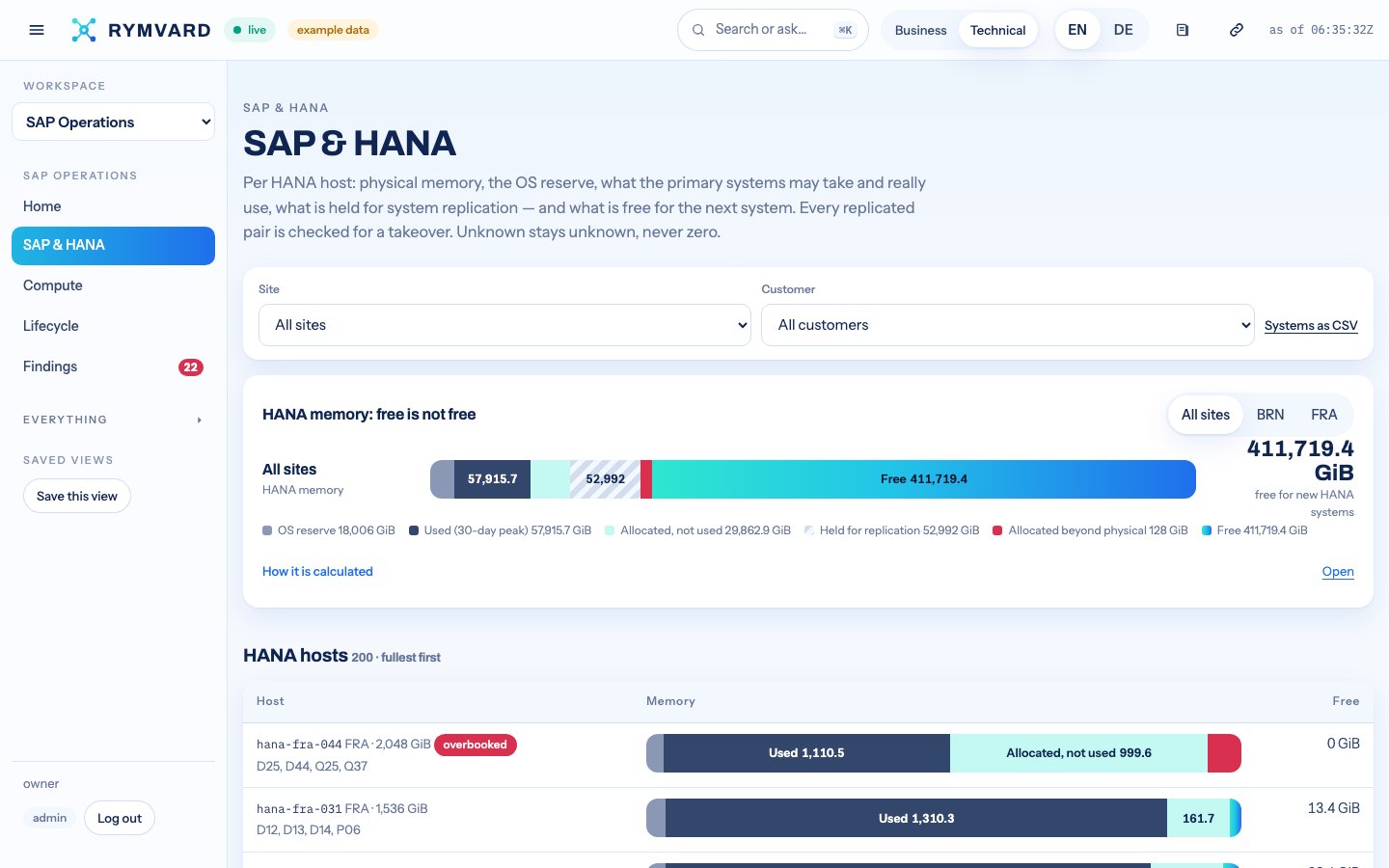
Rymvard released version 0.23 on Oct. 4, 2026, adding SAP HANA memory tracking and capacity planning for hosting providers and SAP operations teams. The company says the early-access product checks replication takeovers and connects to SAP through read-only interfaces; its reported test results came from a simulated landscape, not a customer deployment.
Rymvard released version 0.23 on Oct. 4 with support for SAP HANA hosting, adding memory accounting, replication takeover checks and placement planning to its data-center capacity ledger. The early-access release is aimed at SAP hosting providers and operations teams, where Rymvard says memory can be the first resource constraint for HANA workloads.
The release divides each HANA host’s physical memory into an operating-system reserve, system usage, allocated but unused memory, memory reserved for replicas at other sites, and memory that is genuinely free. Rymvard calculates system usage from a 30-day peak. Its default operating-system reserve is 10% of the first 64 GiB and 3% of the remainder, unless a host has a custom reserve. Allocations exceeding physical memory are reported as overbooking, rather than being obscured as negative free capacity.
For systems using HANA system replication, the product checks whether the secondary host can accommodate the primary’s allocation after a takeover. The system’s own replica is replaced in that calculation, and test or development workloads on the secondary may be treated as stoppable. Production systems belonging to other customers are not. Rymvard labels a takeover as fitting, fitting after specified systems are stopped, not fitting with a shortfall stated in GiB, or unknown.
Data freshness affects those results: a replication status older than one hour or memory data older than 24 hours produces an unknown result, not a passing one. Scale-out systems are assessed as a whole using their worst host pair. Rymvard also proposes a host and replication partner for new HANA systems, and turns probability-weighted planned go-lives into a projected memory runway by site and quarter.
Capacity planning · Early access · Oct. 4, 2026
How Rymvard Adds SAP HANA Memory to Data Center Capacity Planning
Version 0.23 brings host memory accounting, replication takeover checks and placement planning into a data center capacity ledger for SAP hosting providers and operations teams.
The operational question
Can the secondary host carry the load?
Rymvard aims to show whether memory that looks available can support a HANA workload during a host or site failure.
Read-only SAP connections01 / Memory ledger
One host, five memory buckets
The ledger separates reserved, used and committed memory so operators can see what is truly free. Allocations above physical memory appear as overbooking, rather than as negative free capacity.
Illustrative host allocation
Default OS reserve: 10% of the first 64 GiB, plus 3% of the remainder. Hosts can use a custom reserve.
System usage: calculated from the previous 30-day peak. The split makes committed memory visible alongside current usage.
Capacity warning: overbooked allocations are called out directly for planning.
02 / Failover check
From primary allocation to takeover result
The check compares a primary system’s allocation with the secondary host’s capacity after accounting for its systems and replication commitments.
Read the pair
Identify the HANA primary, secondary and their memory data.
Model takeover
Replace the system’s replica in the secondary capacity calculation.
Count stoppable work
Test and development systems may be stoppable; other customers’ production systems are not.
Report the fit
Scale-out landscapes are assessed as a whole using their worst host pair.
03 / Planning view
Turn capacity into an operating plan
Rymvard describes a set of views designed to connect current recovery exposure with future deployments and service planning.
Workspace indicators
Focus attention
Four measures: free HANA memory, production systems without replication, takeovers that would fail, and HANA hosts above 90% utilization.
New systems
Propose placement
Recommend a host and replication partner for incoming HANA systems, with existing commitments included in the capacity picture.
Future runway
Forecast by site
Probability-weighted planned go-lives become projected memory runway by site and quarter.
04 / Collection path
Read-only by design, according to Rymvard
The company says its product does not write to SAP. Collection is described through narrowly scoped operations, fixed monitoring queries and read-only landscape interfaces.
Four permitted operations
The site collector allows ListInstances, ListDatabases, GetDatabaseStatus and GetComputerSystem. Rymvard says other operations are refused.
Bounded queries
Six fixed SELECT statements, a 60-second limit per system and a maximum of eight systems queried at once.
60 SEC / SYSTEM · UP TO 8 SYSTEMS
Existing operations sources
Read-only interfaces can connect to SAP Focused Run, ServiceNow, SAP Solution Manager through its System Landscape Directory, and SAP LaMa.
No SAP writes claimed
Rymvard says its connections are read-only and that nothing is written to SAP.
05 / Evidence check
Simulation results, not customer results
Rymvard reports testing version 0.23 against a simulated estate. The company says displayed screens use an illustrative estate, and has not provided customer deployment results or independent validation.
The findings below describe that stated simulation. They do not establish performance in a live customer environment.
Early access
No named customer deployment, independently measured impact, broader release date, pricing list or supported SAP and HANA versions have been disclosed. Rymvard says pricing is agreed with early-access partners. Watch for live deployment evidence and environment support details.
Memory and Failover Capacity
The release addresses a planning gap for operators who need to know not only how much memory appears unused, but whether it can support a workload during a site or host failure. A nominally available secondary host may not have enough capacity once its existing systems and replication commitments are counted. By showing a takeover shortfall and identifying workloads that could be stopped, Rymvard’s model is intended to make that risk visible before an outage.
That information can also affect new system placement and expansion decisions. A memory runway organized by site and quarter gives teams a way to compare planned deployments against forecast capacity, while mirroring HANA instances into Rymvard’s compute view is intended to bring SAP memory into customer showback and lifecycle planning. These are product capabilities described by Rymvard; no customer results or independently measured operational impact were provided.
The workspace called SAP Operations opens with four indicators: free HANA memory, production systems without replication, takeovers that would fail, and HANA hosts above 90% utilization. Together, the measures focus attention on available capacity and recovery exposure rather than treating total installed memory as sufficient evidence of readiness.
As an affiliate, we earn on qualifying purchases.
How Rymvard Collects SAP Data
Rymvard says its SAP connections are read-only. A site collector communicates with SAP Host Agent over HTTPS and permits four operations: ListInstances, ListDatabases, GetDatabaseStatus and GetComputerSystem. The collector refuses other operations, according to the company. A separate connection queries HANA monitoring views using six fixed SELECT statements over TLS, with a 60-second limit per system and a maximum of eight systems queried at once.
For landscape information, Rymvard says it can use read-only interfaces from SAP Focused Run, ServiceNow, SAP Solution Manager through its System Landscape Directory, and SAP LaMa. The company says the product does not write to SAP. Rymvard also reports testing version 0.23 against a simulated estate comprising 200 HANA hosts, 161 systems and 39 replicated pairs. In that test, it identified one production system without replication, a takeover short by 512 GiB, a host overbooked by 128 GiB, and a replication in an error state.
Those figures describe the simulated test and do not establish performance in a live customer environment. Rymvard says the product is in early access and that the screens shown use an illustrative estate rather than a customer deployment. Scenarios described by the company likewise do not imply a named customer, site or operational outcome.
““Nothing is ever written to SAP.””
— Rymvard
data center capacity planning software
As an affiliate, we earn on qualifying purchases.
As an affiliate, we earn on qualifying purchases.
Customer Deployment Evidence
Rymvard has not provided customer deployment results, independent validation, or evidence that the simulated test outcomes have been reproduced in production. The company says the product is in early access, and the displayed screens are based on an illustrative estate. It has not named an early-access customer or shared operational outcomes from a live SAP environment.
Other details remain undisclosed, including how early-access availability will expand, what pricing will be, and which SAP or HANA versions are supported. Rymvard says it does not publish prices and instead agrees pricing with early-access partners. The reported test counts and findings should be read as results from the stated simulation, not as general performance guarantees.
SAP HANA replication takeover check tools
As an affiliate, we earn on qualifying purchases.
As an affiliate, we earn on qualifying purchases.
Early-Access Rollout Details
Rymvard says version 0.23 is running and available in early access. Prospective partners can contact the company to discuss access and pricing, which is set through partner agreements rather than a published price list. The company has not announced a broader release date or a schedule for future versions.
The next evidence to watch for is whether Rymvard reports customer deployments, confirms support details for particular SAP environments, or publishes results from live operations. Until then, the release establishes the functions the company says are available, while the reported accuracy and practical impact outside its simulated estate remain unverified.
Source: Rymvard
server memory capacity planning hardware
As an affiliate, we earn on qualifying purchases.
As an affiliate, we earn on qualifying purchases.
Key Questions
What does Rymvard version 0.23 add?
It adds SAP HANA memory capacity planning, including host-level memory accounting, replication takeover checks, placement proposals and site- and quarter-based memory runway estimates.
How does it assess a HANA replication takeover?
Rymvard compares the primary system’s allocation with capacity on the secondary host. It may count test and development systems as stoppable, but does not count other customers’ production systems that way. Results include fit, fit after named systems stop, a stated shortfall, or unknown.
Does Rymvard write data to SAP?
Rymvard says its SAP connections are read-only and that it does not write to SAP. Its described integrations use permitted SAP Host Agent operations, fixed monitoring queries and read-only landscape interfaces.
Were the reported test findings from a customer environment?
No. Rymvard says the figures came from a simulated landscape with 200 HANA hosts, 161 systems and 39 replicated pairs. The company says the product screens use an illustrative estate, not a customer deployment.
Is pricing available?
Rymvard says it does not publish prices. Pricing is agreed with early-access partners, and the company has not announced a general release date.
Source: Rymvard
Halloween Picks
halloween
As an affiliate, we earn on qualifying purchases.