🔍 Read the full analysis: 'Free Is Not Free': Why Data Center Capacity Needs More Than One Number on Rymvard

Get the latest gadgets delivered free with Prime
- Fast, free delivery on millions of items
- Prime Video, Amazon Music and more included
- Member-only deals all year
TL;DR
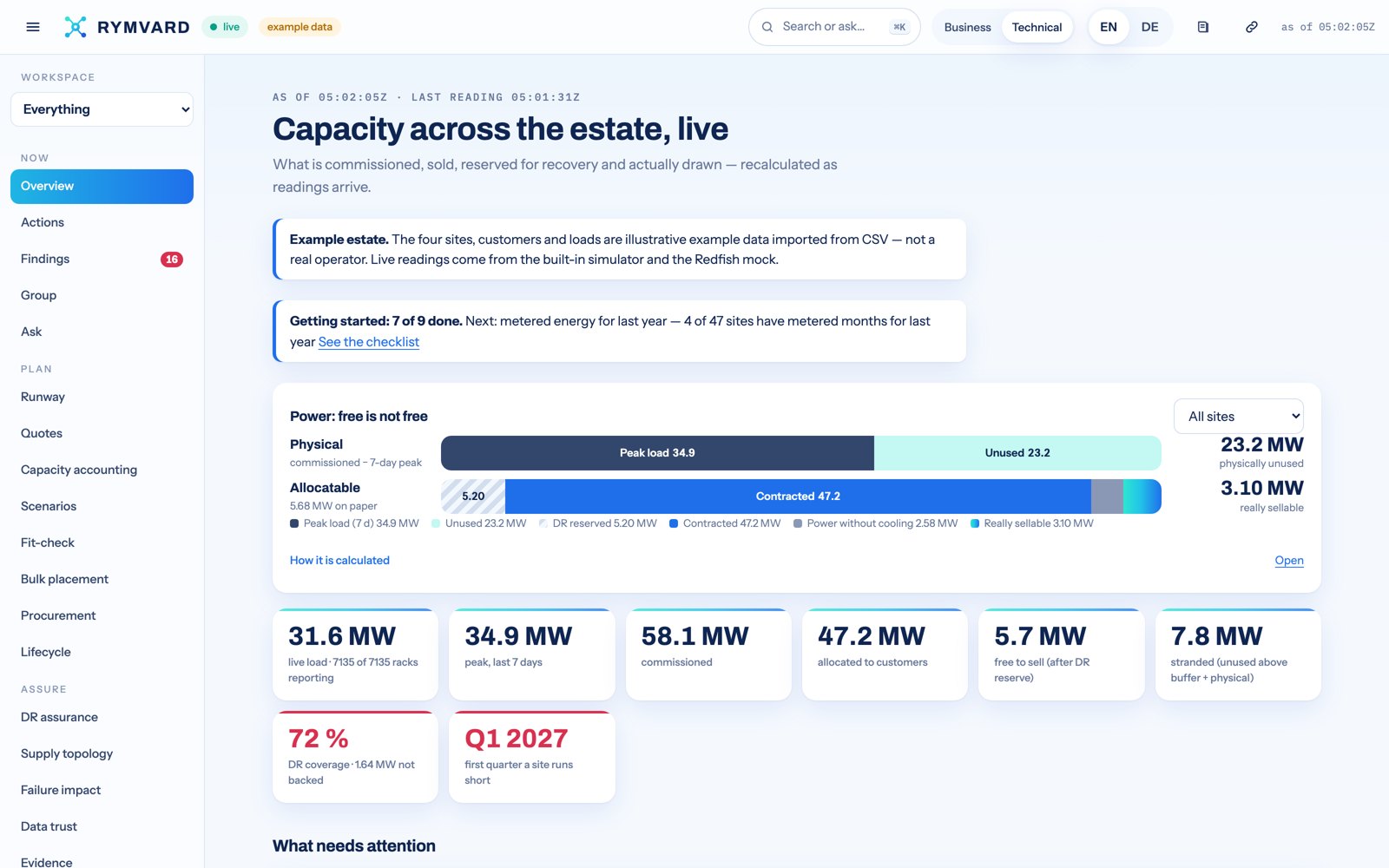
Rymvard says its early-access capacity ledger now breaks data center capacity into used, held, promised and genuinely free resources. On an illustrative estate, 23.2 MW is physically unused, but only 3.1 MW is sellable after reservations, contracts and cooling limits.
Rymvard says its data center capacity ledger now opens each workspace with a breakdown of resources that are used, held back, promised and genuinely free, addressing the gap between physically unused power and capacity a provider can actually sell. On an illustrative estate shown in the running product, 23.2 megawatts are unused, but only 3.1 MW are sellable after contracts, disaster-recovery reservations and power without cooling are accounted for, a distinction relevant to data center capacity operations.
The new overview separates power into two views. A physical bar compares the measured seven-day peak with commissioned capacity. An allocatable bar accounts for contracted power, capacity reserved for disaster recovery, and power that lacks cooling, leaving the amount Rymvard classifies as sellable. The two figures answer different questions: how much capacity is not currently being used, and how much can be committed to another customer.
Rymvard says the same style of overview is available for compute resources, including vCPU, memory and storage, as well as HANA memory, contracts compared with measured use, energy and recovery. Where a bar lacks data, the interface gives a reason rather than displaying a zero. That distinction matters because missing information does not necessarily mean that a resource has no capacity.
The screens are from a running product, but Rymvard says the example estate is illustrative and is not a customer deployment. Scenarios shown do not imply a particular customer, site or outcome. The company describes the product as being in early access; it has not published prices and says terms are agreed with early-access partners.
Capacity ledger · Early access
“Free Is Not Free”: Why Data Center Capacity Needs More Than One Number
Rymvard says its ledger separates used, held, promised and genuinely free resources. In an illustrative estate, 23.2 MW sits unused—but only 3.1 MW is sellable after reservations, contracts and cooling limits.
Idle power is not the same as capacity for sale
The physical view compares a seven-day measured peak with commissioned capacity. The allocatable view factors in commitments and operating limits to show what Rymvard classifies as sellable.
One overview, several resource types
Rymvard says the workspace overview extends the same category-based view beyond power. The product description does not specify the calculation or measurement method for every resource.
vCPU and memory
Compare tracked resources with use, reservations and commitments.
Storage and HANA memory
See resource categories alongside the wider capacity picture.
Energy and recovery
Review energy and continuity resources with contracts versus measured use.
Missing data should have a reason
“23.2 MW are physically unused, but only 3.1 MW are really sellable after contracts, recovery reservations and power without cooling.”
Rymvard · illustrative example
“A bar without data shows the reason instead of a zero.”
Rymvard · interface description
What the example establishes—and what it does not
The running product screens demonstrate how categories are presented. Rymvard says the estate is illustrative and does not represent a named customer, facility or outcome.
Shown in the announcement
A ledger overview, a distinction between physical headroom and allocatable power, and additional tracked resource categories. Rymvard describes the product as being in early access.
Still not established
No customer case study, independent validation, published pricing, refresh schedule or general-release date is provided. The calculation details for every category are also unspecified.
Before treating a figure as available
For an operational assessment, ask how measurements, reservations, contracts and cooling limits are represented for the facilities in scope—and what supports the resulting allocatable number.
How fresh are the measurements?
Confirm coverage, update frequency and how missing values are explained.
How are holds verified?
Understand how recovery reserves and contract obligations enter the ledger.
What supports the sellable figure?
Review the calculation against site-specific power and cooling constraints.
The Difference Between Idle and Sellable Power
A single capacity total can overstate what a data center can offer. Power may be physically available while already committed under contract, set aside for recovery, or unusable because the necessary cooling is not available. Rymvard’s example makes that distinction concrete: the estate has 23.2 MW of physically unused power, yet the ledger identifies only 3.1 MW as sellable under its stated accounting.
For operators, that separation can help make capacity planning and sales discussions more grounded in operational constraints, rather than relying on a headline total. For customers evaluating whether a provider can meet a new demand, the relevant figure may be allocatable capacity rather than power that is simply not drawing load today. The tool’s value depends on the accuracy and timeliness of the underlying measurements and reservations; Rymvard has not supplied customer results or independent validation.
The same principle applies beyond electricity. Compute, storage, memory and recovery resources can be in use, reserved, contractually committed or missing measurements. Showing the reason when data is unavailable can prevent an empty display from being mistaken for a confirmed zero. The overview is a way to make those categories visible, not evidence by itself that a particular site has additional capacity or can deliver it.
Products Worth Considering

Jackery HomePower 3600 Plus Portable Power Station

Samsung 32 Odyssey G5 QHD Gaming Monitor

LG 27GS60QC-B Ultragear 27-inch Curved Gaming Monitor (QHD, 180Hz, 1ms, 1000R)
As an affiliate, we earn on qualifying purchases.
How the Ledger Classifies Capacity
Data center capacity is often discussed through physical limits such as commissioned power, but that measure does not by itself describe what remains available for a new commitment. A facility may have equipment installed and power capacity commissioned while some portion is already promised, reserved for continuity planning or constrained by supporting infrastructure. Rymvard’s ledger puts these categories alongside the measured peak so readers can distinguish installed headroom from commercially available capacity.
In the power view, the measured peak covers a seven-day window and is compared with commissioned capacity. The separate allocatable view subtracts or identifies commitments and constraints, including contracts, disaster-recovery reserves and power without cooling. Rymvard also applies the overview format to other tracked categories, though the supplied product description does not specify the formulas or measurement methods used for each one.
The announcement describes a product status rather than a customer launch or a reported outcome: Rymvard says the ledger is running and in early access. Its example figures are explicitly illustrative, so they should not be read as measurements from a named facility or as a typical result across data centers.
“23.2 MW are physically unused, but only 3.1 MW are really sellable after contracts, recovery reservations and power without cooling.”
— Rymvard
What the Example Does Not Establish
The 23.2 MW and 3.1 MW figures come from an illustrative estate, and Rymvard says no customer, site or outcome is implied. The company has not provided a customer case study, independent assessment, or comparison showing how the ledger changes capacity decisions. It is also unclear from the product description how often all underlying measurements are refreshed, how reservations are entered and verified, or how the sellable figure is calculated across different facility configurations.
Rymvard has not published pricing, saying early-access partner terms are agreed individually. The number of early-access partners, the duration of the program and the timing of broader availability are not stated. The product is described as running now, but further information would be needed to assess adoption, performance and results in operational customer environments.
Early Access and Customer Evidence
Rymvard says interested organizations can discuss participation in its early-access program, with pricing arranged directly rather than published. The company has not announced a general-release date or a timetable for additional product milestones. A next step for readers evaluating the tool would be to ask how measurements, commitments and cooling constraints are represented for their own facilities, and what evidence supports the resulting allocatable figures.
Until customer deployments or independently documented results are available, the example should be treated as an illustration of the ledger’s categories, not proof of a particular commercial or operational outcome.
Source: Rymvard
Key Questions
What is Rymvard announcing?
Rymvard says its capacity ledger now opens each workspace with an overview separating used, held-back, promised and genuinely free resources. The product is running in early access.
Why is physically unused power different from sellable power?
Some power that is not currently being used may already be contracted, reserved for disaster recovery, or lack cooling. Rymvard’s ledger accounts for those constraints when showing what it considers sellable.
Are the 23.2 MW and 3.1 MW figures from a customer site?
No. Rymvard describes them as figures from an illustrative example estate and says they do not imply a customer, site or outcome.
Which resources does the overview cover?
Rymvard says the overview also covers vCPU, memory, storage, HANA memory, contracts against measured use, energy and recovery. The product description does not detail the calculation methods for every category.
Is Rymvard available, and what does it cost?
Rymvard says the product is running in early access. It has not published prices and says pricing is agreed with early-access partners; a wider release date has not been provided.
Source: Rymvard