📊 Full opportunity report: Best Quiet Case Fans + the Airflow Setup That Actually Works on ThorstenMeyerAI.com — validation score, market gap, and execution plan.

Get the latest gadgets delivered free with Prime
- Fast, free delivery on millions of items
- Prime Video, Amazon Music and more included
- Member-only deals all year
TL;DR
This article identifies the best quiet case fans for 2026 and explains the airflow setup that ensures efficient cooling without excessive noise. It emphasizes larger, slower fans and proper placement for optimal results.
In 2026, the most effective approach to building quiet, high-performance PC cases involves using larger fans that operate at lower RPMs and configuring airflow to maximize cooling efficiency while minimizing noise, according to recent expert recommendations.
The article highlights that larger case fans, specifically 140mm models, moving air slowly at around 800 RPM, produce significantly less noise than smaller, faster fans, while providing comparable cooling performance. Notably, the Noctua NF-A12x25 and NF-A14 are considered top-tier for their engineering quality, airflow, and quiet operation, though they come at a premium price. For budget-conscious builders, Arctic P12 Pro and P14 fans offer nearly similar performance at a fraction of the cost, making them excellent value options. Additionally, fans designed for static pressure, such as the Arctic P12 Pro and Noctua NF-F12, are preferred for radiator cooling or dense heatsinks, where airflow resistance is higher. Proper fan placement and tuning—favoring intake and exhaust with large, slow-moving fans—are essential to achieving an effective, quiet airflow setup. This approach counters the misconception that high airflow must come with high noise levels, demonstrating that well-chosen, properly configured fans can deliver both.Best quiet case fans
+ the airflow that works.
The best fan won’t help if it’s pointed the wrong way. The whole recipe: big fans, running slowly, in a clean front-to-back path, with slightly more intake than exhaust. Build a config in Part 2 and watch the pressure balance respond.
Why Proper Fan Selection and Setup Matter in 2026
Implementing the right fan sizes and airflow configurations significantly reduces noise levels in high-performance workstations without sacrificing cooling efficiency. This is especially important for AI and data science rigs where sustained, reliable cooling is critical. Using larger, slower fans and strategic placement allows builders to create quieter environments, improving user comfort and productivity while maintaining system stability. As noise reduction remains a priority for many users, understanding these principles is vital for designing effective, quiet systems in 2026.As an affiliate, we earn on qualifying purchases.
Advances in Fan Technology and Cooling Strategies for 2026
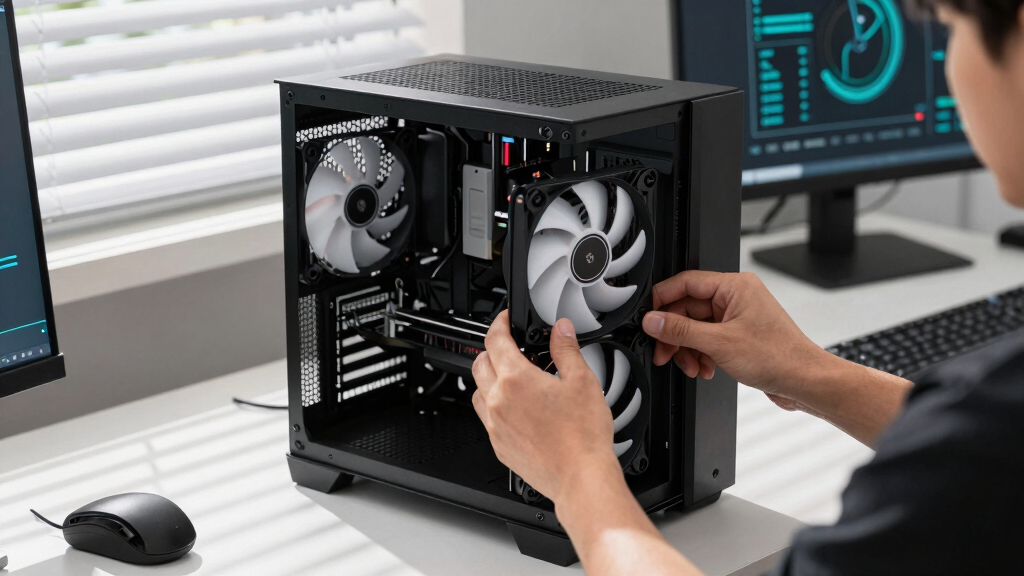
In recent years, the focus on quiet PC building has shifted toward larger fans operating at lower RPMs, which move the same amount of air as smaller, faster fans but generate less noise. The Noctua NF-A12x25, launched in 2024, set a new standard for engineering quality, combining high airflow with near-silent operation. Simultaneously, budget-friendly options like Arctic P12 Pro and P14 have gained popularity for delivering high performance at a lower cost. Proper airflow setup—placing large intake fans at the front and exhaust fans at the rear and top—has been reaffirmed as the most effective method for cooling high-power systems, especially when paired with fan curves that keep RPMs low. These developments build on previous research emphasizing that moving air slowly and steadily is the key to achieving both silence and effective cooling in high-performance PC builds."Big and slow beats small and fast — a larger fan moving air at lower RPMs offers both quiet operation and excellent cooling in high-performance systems."
— Thorsten Meyer, PC cooling expert
As an affiliate, we earn on qualifying purchases.
Outstanding Questions About Long-Term Performance and Compatibility
While these fans and airflow principles are proven effective in 2026, long-term durability and compatibility across diverse case models are still being tested. Variations in case design, dust filters, and ambient conditions may influence actual performance and noise levels, and some users report that fan curves need fine-tuning for optimal results. Further real-world testing is ongoing to confirm the universal applicability of these recommendations across different system configurations.low noise computer fans for radiator
As an affiliate, we earn on qualifying purchases.
As an affiliate, we earn on qualifying purchases.
Next Steps for Building Quiet, Well-Cooled Systems in 2026
Manufacturers are expected to release new fan models with improved bearings and acoustics, further enhancing quiet operation. System builders should focus on applying these airflow principles and experiment with fan curves to optimize noise and cooling. Ongoing testing and user feedback will help refine best practices, and future updates may include integrated fan control solutions or case designs optimized for large, slow-moving fans.large slow case fans for gaming PC
As an affiliate, we earn on qualifying purchases.
As an affiliate, we earn on qualifying purchases.
Key Questions
Why are larger fans better for quiet PC builds?
Larger fans move the same amount of air at lower RPMs, which significantly reduces noise levels while maintaining effective cooling.
Should I prioritize airflow or static pressure fans for my case?
Use airflow fans for case intake and exhaust, and static pressure fans for radiators or dense heatsinks where airflow resistance is higher.
Can I use budget fans and still achieve quiet operation?
Yes, models like the Arctic P12 Pro and P14 offer high performance at a lower cost, especially when paired with proper airflow setup and fan tuning.
How important is fan placement in achieving quiet cooling?
Strategic placement of large intake fans at the front and exhaust fans at the rear and top, combined with low RPM fan curves, is crucial for effective, quiet airflow.
Are these recommendations applicable to all PC cases?
While most modern cases support 140mm fans, compatibility varies. Confirm your case's fan size support and airflow design before applying these principles.
Source: ThorstenMeyerAI.com
Halloween Picks
halloween
As an affiliate, we earn on qualifying purchases.