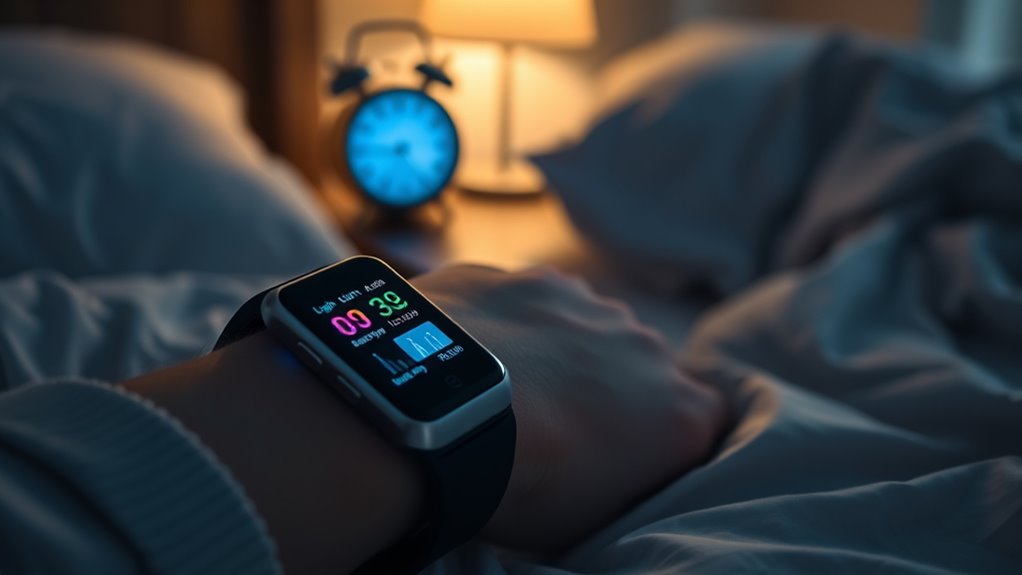
Fitness trackers monitor your sleep by using sensors like accelerometers to detect your movements and heart rate monitors to gauge how your body changes during sleep. They analyze this data to estimate sleep stages, such as light, deep, and REM sleep, providing you with insights into your sleep quality. While not as precise as clinical studies, they help identify patterns and improvements. Keep exploring to discover how these insights can boost your sleep health even further.
Listen free for 30 days with Audible
Thousands of audiobooks and originals — cancel anytime.
As an affiliate, we earn on qualifying purchases.
Key Takeaways
- Fitness trackers use sensors like accelerometers and heart rate monitors to detect movement and physiological changes during sleep.
- They analyze movement patterns and heart rate variability to differentiate sleep stages such as light, deep, and REM sleep.
- Algorithms combine movement and heart rate data to estimate sleep quality and stage transitions throughout the night.
- While less precise than clinical sleep studies, trackers provide valuable trend insights into sleep patterns and issues.
- These devices help users improve sleep habits by offering data-driven feedback on sleep duration and quality.

Have you ever wondered how well you’re actually sleeping? Many people assume that a night’s rest is simply about the number of hours they spend in bed, but sleep quality is much more complex. Fitness trackers have become popular tools for monitoring sleep, but how do they do it? These devices track various bio-signals to give you insights into your sleep stages and overall sleep quality, helping you understand how restful your nights truly are.
Most fitness trackers use sensors like accelerometers to detect movement. When you’re tossing and turning, these sensors pick up your body’s movements, allowing the device to estimate when you’re asleep or awake. However, movement alone doesn’t tell the whole story of sleep quality. To get a clearer picture, many trackers also incorporate heart rate monitors. Your heart rate varies throughout the night, decreasing during deep sleep stages and increasing during lighter sleep or periods of wakefulness. By analyzing these heart rate patterns alongside movement data, trackers can differentiate between light sleep, deep sleep, and REM sleep — the key sleep stages that influence how restorative your sleep is.
Many trackers combine movement and heart rate data to identify sleep stages and improve sleep insights.
The technology behind sleep staging in fitness trackers isn’t perfect, but it’s quite sophisticated. They use algorithms that combine movement data and heart rate variability to estimate which sleep stage you’re in at any given time. This process is somewhat similar to the methods used in clinical sleep studies, but on a more accessible and less invasive scale. These algorithms analyze trends over the course of the night, providing a sleep score or breakdown that indicates how much time you spent in each sleep stage. This information helps you understand not just how long you slept, but how well you rested.
Additionally, understanding the importance of natural sleep cycles can help you interpret your sleep data more effectively. Knowing your sleep stages and overall sleep quality can be enlightening. It allows you to identify patterns—perhaps you’re waking up frequently during the night or spending too little time in deep sleep. With this data, you can make adjustments to your routines, like changing your bedtime or reducing caffeine intake, to improve your sleep quality. Keep in mind, though, that while fitness trackers provide valuable insights, they aren’t as precise as clinical sleep studies. Still, they’re useful tools for spotting trends and making informed choices to enhance your sleep health.
In the end, sleep tracking gives you a window into your nightly rest, revealing how your sleep stages fluctuate and how those changes impact your overall sleep quality. With consistent use, you can learn to optimize your sleep habits and wake up feeling more refreshed and energized each day.
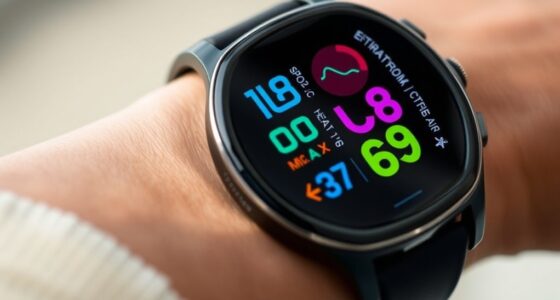
fitness tracker with sleep monitoring
As an affiliate, we earn on qualifying purchases.
As an affiliate, we earn on qualifying purchases.
Frequently Asked Questions
Can Sleep Trackers Detect Sleep Disorders Accurately?
Sleep trackers can’t detect sleep disorders with complete medical accuracy, but they can give you useful insights. While some devices have undergone clinical validation, their results aren’t a substitute for professional diagnosis. If you suspect a sleep disorder, you should consult a healthcare provider. Use sleep trackers as a helpful tool for monitoring trends, but remember, they’re not a replacement for clinical evaluation or medical accuracy.
How Do Trackers Differentiate Between Light and Deep Sleep Stages?
Did you know that your tracker can distinguish sleep stages with over 80% accuracy? It does this by analyzing brainwave patterns through sensors and monitoring heart rate variability. Light sleep shows different brainwave activity and a steady heart rate, while deep sleep features slower brainwaves and greater heart rate variability. Your device combines these signals to identify when you’re in light or deep sleep, helping you understand your sleep quality better.
Do Different Brands Use the Same Technology for Sleep Monitoring?
Different brands don’t use exactly the same technology for sleep monitoring, so sensor accuracy varies. You’ll find some brands rely heavily on accelerometers, while others incorporate heart rate sensors or even skin temperature. When comparing brands, consider how their sensor accuracy impacts your sleep data. A higher-quality sensor generally means more reliable sleep tracking. So, do your research and compare features to find the best fit for your sleep insights.
How Does Movement Affect the Accuracy of Sleep Data?
Movement acts like a storm cloud, disrupting the clear sky of your sleep data. When you move excessively, movement interference can skew results, making it seem like you’re awake or restless when you’re not. The sensor sensitivity varies across devices, so slight movements may or may not be recorded accurately. To improve accuracy, try to stay still during sleep, allowing the sensor to capture your true rest patterns without interference.
Are There Privacy Concerns With Sleep Tracking Data Collection?
Yes, there are privacy concerns with sleep tracking data collection. You should be aware of data security measures, as your personal sleep information could be vulnerable if not properly protected. Always check if the device or app requires your explicit user consent before collecting data. Stay informed about how your data is stored, shared, and used to guarantee your privacy is maintained and your rights are protected.
As an affiliate, we earn on qualifying purchases.
Conclusion
So, now you see how your fitness tracker becomes a silent sentinel, revealing your sleep secrets each night. It’s like having a personal sleep detective, uncovering the mysteries behind your restless nights and invigorating mornings. Remember, understanding these insights isn’t just about numbers—it’s about accessing better rest and a healthier you. Don’t let your sleep slip away unnoticed; embrace the technology and take charge of your nights, turning dreams into reality.
best sleep tracker for detailed sleep stages
As an affiliate, we earn on qualifying purchases.
As an affiliate, we earn on qualifying purchases.
wearable sleep monitor with heart rate
As an affiliate, we earn on qualifying purchases.
As an affiliate, we earn on qualifying purchases.
Flea & tick season Picks
flea and tick prevention
As an affiliate, we earn on qualifying purchases.