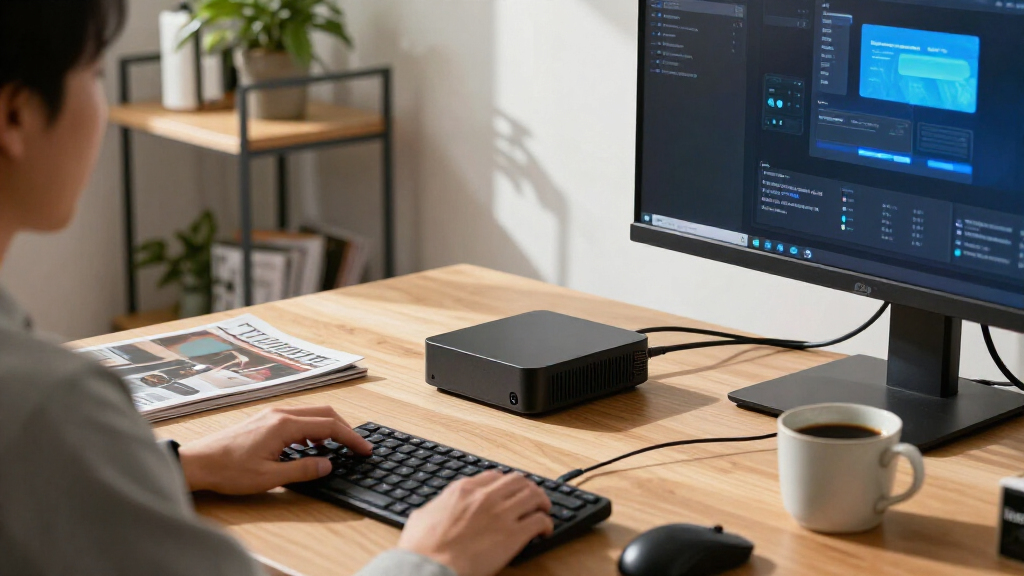
🔍 Read the full analysis: Looking For Local AI Hardware? 10 Mini PCs For 2027 on ThorstenMeyerAI.com

Get the latest gadgets delivered free with Prime
- Fast, free delivery on millions of items
- Prime Video, Amazon Music and more included
- Member-only deals all year
TL;DR
A ThorstenMeyerAI.com buyer’s guide compares 10 mini PCs for local AI and general computing, ranking the MINISFORUM MS-S1 MAX highest for demanding workloads based on its listed Ryzen AI Max+ 395, 64GB memory and 2TB SSD. The guide also highlights configuration gaps and cautions that processor labels alone do not establish how well a system will run a particular model or application.
ThorstenMeyerAI.com has published a buyer’s guide comparing 10 mini PCs for local AI. It ranks the MINISFORUM MS-S1 MAX highest for demanding workloads, citing a listed Ryzen AI Max+ 395 processor, 64GB of memory and a 2TB SSD. The comparison discusses memory requirements for running AI models locally. It does not provide benchmark results or establish that every listed system is suitable for every AI application.
The guide ranks systems according to how clearly their stated hardware supports AI-related work, while also weighing everyday usability, storage and configuration detail, much like this comparison of AI PCs for local AI and everyday work. It calls the GEEKOM A9 Max a more balanced high-performance option, listing a Ryzen AI 9 HX 470 and 32GB of memory. That is half the memory capacity specified for the MS-S1 MAX, but the source does not report comparable performance tests.
The GMKtec K17 is presented as a newer, lower-power option for buyers willing to accept less memory. The source also compares two systems with a Ryzen AI Max+ 395: the MS-S1 MAX has a stated 64GB of memory and 2TB SSD, while the GMKtec EVO-X2 listing lacks those configuration details. The guide says that missing specifications reduce confidence in the comparison, rather than treating the two machines as equivalent based on processor alone.
Other listed options include multiple systems with Intel Core Ultra 9 185H hardware and the GEEKOM A5, which the guide describes as better suited to basic desktop work than demanding local AI. It identifies the A5’s Ryzen 7 7730U processor and DDR4 memory as reasons it ranks lower for AI-focused use. The source notes that GEEKOM IT13 MAX versions list different memory types and advises buyers to confirm the exact configuration.
The 10 picks
- 1
 MINISFORUM MS-S1 MAX Mini AI Workstation PC, Ryzen AI Max+ 395, 64GB LPDDR5x,…View on Amazon →
- 2
 GMKtec EVO-X2 AI Mini PC with AMD Ryzen AI Max+ 395View on Amazon →
- 3
 GEEKOM A9 Max Mini PC with AMD Ryzen AI 9 HX 470, 32GB DDR5 RAM, and 2TB SSDView on Amazon →
- 4
 GEEKOM IT15 Mini PC, Intel Core Ultra 9 285H, 32GB DDR5 RAM, 1TB NVMe SSDView on Amazon →
- 5
 ACEMAGIC F5A Top AI Mini PC with AMD Ryzen AI 9 HX 470View on Amazon →
- 6
 ACEMAGIC Retro X5 Mini Gaming PC with AMD Ryzen AI 9 365, 32GB RAM and 1TB SSDView on Amazon →
- 7
 GEEKOM IT13 MAX AI Mini PC 2026, Intel Ultra 9 185H, 24GB LPDDR5, 500GB SSDView on Amazon →
- 8
 GEEKOM IT13 MAX Mini PC with Intel Core Ultra 9 185H, 24GB RAM, 512GB SSDView on Amazon →
- 9
 GMKtec K17 AI Mini PC – Intel Core Ultra 5 226V, 16GB LPDDR5X, Intel Arc 130V…View on Amazon →
- 10
 GEEKOM A5 Mini PC with AMD Ryzen 7 7730U, 16GB RAM, 500GB SSDView on Amazon →
Memory Shapes Local AI Choices
The comparison notes that a computer’s suitability for local AI depends on more than its processor name. Memory capacity, storage and software support can affect whether a local model or creative workload fits a buyer’s requirements. A system may be constrained if it lacks sufficient memory. A larger SSD provides more room for software, datasets and model files, but neither specification alone guarantees faster AI performance.
The guide says cloud-based AI services generally do their processing remotely, so users who mainly access web assistants may have different hardware requirements from those seeking offline processing or local data storage. These are workload considerations; the comparison does not provide measured results.
Products Worth Considering

Jackery Explorer 1000 v2 Portable Power Station

Sonos Roam Portable Bluetooth and Wi-Fi Speaker, Black

Samsung Odyssey G55C 32-Inch QHD 1000R Curved Gaming Monitor
As an affiliate, we earn on qualifying purchases.
How the Guide Compares Systems
The source says it prioritizes clearly specified processors, memory and storage, then considers everyday usability and system demands. It distinguishes AI-capable hardware from systems aimed mainly at general computing and lowers the standing of models whose listings leave key configuration details uncertain. The article does not identify a testing lab, disclose benchmark procedures or provide a complete technical specification sheet for all 10 products.
Its advice is to start with the intended work: occasional cloud-based AI, local model use, image generation, video work and office tasks place different demands on a computer. Buyers are also told to check whether memory is upgradeable, whether storage can be expanded, and whether the software they plan to use supports the processor, graphics hardware and relevant acceleration frameworks.
“The MINISFORUM MS-S1 MAX leads for demanding local workloads in this lineup, pairing a Ryzen AI Max+ 395 with 64GB memory and a 2TB SSD.”
— ThorstenMeyerAI.com
Specifications and Testing Gaps
The source material does not give a publication date, prices, availability by market, independent benchmark scores or a complete model-by-model list of specifications. It also does not establish the performance of any of the 10 systems on named AI models or applications. The guide’s “best” and “balanced” labels are its own recommendations, not independently verified rankings.
Some product configurations are explicitly unclear. In particular, the GMKtec EVO-X2 listing does not specify memory or SSD capacity, and the GEEKOM IT13 MAX versions are described as having different listed memory types. The source does not say whether those details vary by retailer, region or specific configuration. Buyers should verify the exact unit and its upgrade options before purchase.
Verify Before You Buy
The guide advises readers to match a specific system to the software and workloads they plan to run, then confirm the full configuration with the manufacturer or seller. Details to check include installed and maximum memory, whether memory is replaceable, SSD capacity and expansion, operating-system and driver support, and any stated requirements for the intended AI tools.
Because the source supplies no prices, availability dates or future product announcements, it does not establish when these systems will be sold as 2027 recommendations or whether configurations will change. A more conclusive comparison would require verified retail specifications and testing across named workloads. The source’s ranking is based on listed hardware and is not a performance guarantee.
Key Questions
Which mini PC does the guide rank highest for local AI?
ThorstenMeyerAI.com names the MINISFORUM MS-S1 MAX its top pick for demanding local workloads, citing its listed Ryzen AI Max+ 395, 64GB of memory and 2TB SSD. The source does not provide benchmark results to verify that ranking independently.
What makes the GEEKOM A9 Max a different option?
The guide calls it a more balanced high-performance choice and lists a Ryzen AI 9 HX 470 and 32GB of memory. It has half the memory listed for the MS-S1 MAX, but the source does not provide comparative workload testing.
Does a mini PC with an AI-capable processor guarantee good local AI performance?
No. The guide says buyers should also check memory capacity, graphics capability, software compatibility and model requirements. A processor specification by itself does not show whether a particular application will run well.
Why does the guide flag the GMKtec EVO-X2 listing?
Although it lists the same Ryzen AI Max+ 395 processor as the MS-S1 MAX, the source does not specify the EVO-X2’s memory capacity or SSD size. The missing details make it difficult to compare the configurations directly.
Source: ThorstenMeyerAI.com