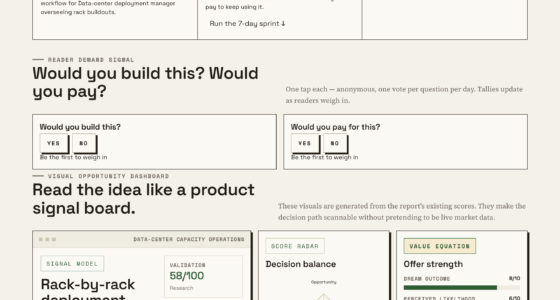

📊 Full opportunity report: The Door: Why the Interface Is Worth More Than the Model on ThorstenMeyerAI.com — validation score, market gap, and execution plan.

Get the latest gadgets delivered free with Prime
- Fast, free delivery on millions of items
- Prime Video, Amazon Music and more included
- Member-only deals all year
TL;DR
SpaceX acquired a coding interface platform for $60 billion, emphasizing that control over the user interface is now more valuable than the underlying AI models. This shift impacts distribution, data, and market dominance.
SpaceX’s recent $60 billion acquisition of a coding interface platform demonstrates a pivotal shift in AI industry dynamics, prioritizing control over the user interface rather than the AI models themselves. This move underscores the growing importance of the interface as the primary point of interaction and distribution, affecting how demand is routed and data is captured.
The platform acquired by SpaceX, called Cursor, built a profitable coding interface on top of various AI models, generating approximately $4 billion in annualized revenue. Despite the underlying models being rentable and commoditized, the interface — the surface where developers and users interact — remained unique and non-commoditized.
According to industry sources, SpaceX’s purchase centered on owning this interface, which streams user data, influences demand routing, and establishes the default model for users. This strategic move reflects a broader industry trend where the interface is becoming the most valuable asset, surpassing the AI models themselves.
The Door: Worth More Than the Model
SpaceX paid $60B for a coding tool — not a model. As the model commoditizes, the surface the human touches captures the value: the default, the habit, the data, and the choice of which model gets called.
Perplexity
The most valuable chokepoint — and, strangely, the most winnable. You can’t bootstrap a gigawatt or a 555K-GPU cluster, but a small team can still build the door (Cursor was a few founders on rented models). Own the interface and the user relationship even if you rent everything underneath — and never let a platform’s default be your only door to your users.
Implications of Interface Ownership in AI Dominance
This development highlights a fundamental shift: control over the user interface and distribution channels now determines market power in AI and software. By owning the interface, companies can influence user habits, data flow, and model demand routing, creating a significant competitive advantage. This trend may reshape industry dynamics, favoring firms that control the surface over those that develop the underlying models.
As an affiliate, we earn on qualifying purchases.
The Rise of Interface as the Strategic Asset
Over the past three years, the AI industry has increasingly viewed the model as a commodity, with prices for hardware and weights declining and open weights lagging behind frontier models. Meanwhile, the interface — the point where users interact with AI — has remained relatively non-commoditized and highly valuable.
Recent moves by major players, including OpenAI, Google, and Microsoft, to embed AI into browsers and OS-level features, reinforce the importance of owning the interface. The acquisition of Cursor by SpaceX exemplifies this trend, where the platform’s interface is the key to demand routing and data collection, rather than the underlying AI models.
“Our investment in this platform reflects a belief that the interface is the new frontier in AI distribution.”
— A SpaceX spokesperson
As an affiliate, we earn on qualifying purchases.
Unclear Aspects of the Interface Ownership Shift
While the importance of interface ownership is clear, it remains uncertain how this will evolve in terms of regulatory challenges, potential monopolistic behaviors, and the actual impact on AI model innovation. It is also not yet confirmed how widespread this strategy will become across the industry and whether other large firms will follow suit.
As an affiliate, we earn on qualifying purchases.
Future Developments in Interface Control and Industry Competition
Industry observers expect increased consolidation around dominant interfaces, with more companies investing in or acquiring platforms that control user habits and data. Regulatory scrutiny may also intensify, focusing on the monopolistic potential of interface owners. Additionally, the development of new standards and legal frameworks for agent interactions and data sharing will likely shape the next phase of this shift.
As an affiliate, we earn on qualifying purchases.
Key Questions
Why is owning the interface more valuable than developing AI models?
Owning the interface allows control over user habits, data collection, demand routing, and default settings, which collectively create a more durable competitive advantage than the models themselves, which are increasingly commoditized.
How did SpaceX’s acquisition of Cursor demonstrate this shift?
SpaceX bought a profitable, non-commoditized interface platform that streams user data and influences which models are used, highlighting that the real value lies in the surface where users interact, not just the underlying AI.
Could this trend lead to monopolies in AI and software?
Yes, control over dominant interfaces can concentrate power and data, potentially leading to monopolistic behaviors unless regulatory measures intervene.
What are the risks for smaller players in this landscape?
Smaller firms may find it difficult to compete for interface ownership, which is becoming the key battleground, potentially limiting innovation and diversity in AI services.
What happens if regulations restrict interface control?
Regulatory actions could force interface owners to share data or open their platforms, which might reduce the strategic advantage but could also foster more competition and innovation.
Source: ThorstenMeyerAI.com
Halloween Picks
halloween
As an affiliate, we earn on qualifying purchases.