
🔍 Read the full analysis: OpenAI's Robotics Team Breaks Apart As Runway Opens Praxis-1 on ThorstenMeyerAI.com

Get the latest gadgets delivered free with Prime
- Fast, free delivery on millions of items
- Prime Video, Amazon Music and more included
- Member-only deals all year
TL;DR
OpenAI has disbanded its stand-alone robotics team and moved its researchers into other parts of the company, saying general-purpose models can now be applied directly to robotics. Runway has released Praxis-1, an open-weight model designed for robot control; published comparisons point to a trade-off between task success in simulation and response speed.
OpenAI has broken up its stand-alone robotics team and moved its researchers into other company groups, while Runway released Praxis-1, an open-weight model built specifically for robot control. The moves sharpen a debate over whether general-purpose AI models can operate robots effectively or whether dedicated, faster systems remain necessary.
Fortune reported on November 13 that OpenAI confirmed the reorganization after being asked about it. Its robotics researchers now sit within the main research organization under Chief Research Officer Mark Chen; applied robotics and hardware teams moved to the Applied organization, led by President Greg Brockman. An OpenAI booth listed at the CoRL robotics conference in Austin was empty when Fortune visited. OpenAI has not published its own announcement about the change.
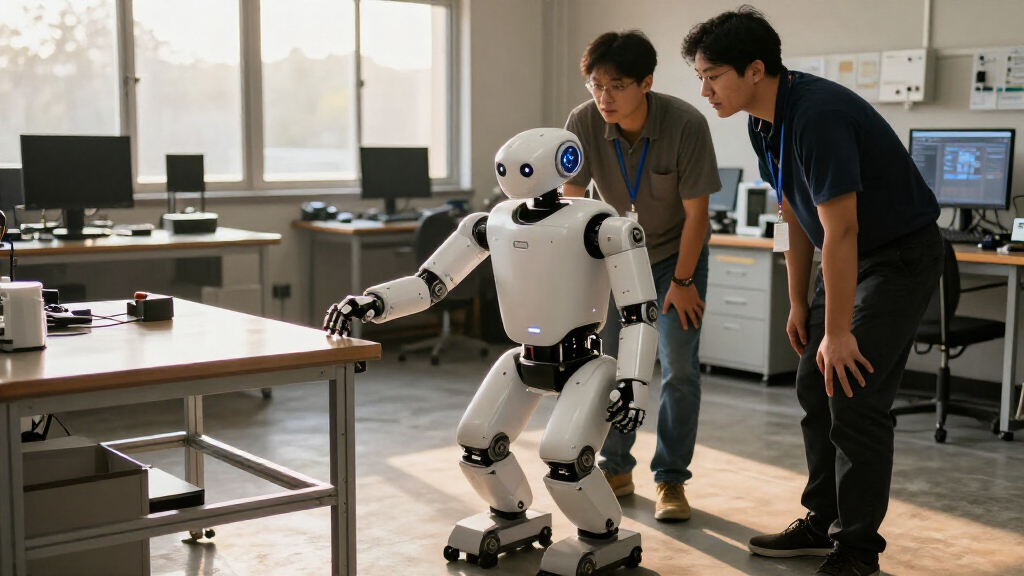
OpenAI’s spokesperson told Fortune that the move reflects a change in how the company expects to build robotics capabilities, not a retreat from the field. The company said its frontier general-purpose models, including GPT-6 Astra, have demonstrated that they can be applied directly to robotics. Earlier in the year, researchers had expected to build on video models such as Sora. Fortune quoted the spokesperson as saying robotics “remains a core part of OpenAI’s long-term vision” and that OpenAI “remains committed to bringing general-purpose robots into the world.”
Runway released Praxis-1 two days before the report. The company describes it as a 27-billion-parameter “world action model” and offers its weights and fine-tuning code under the Apache 2.0 license, which permits commercial use under that license’s terms. On RoboLab-120, a simulated benchmark of 120 tabletop tasks, Praxis-1 scored 46.2%, according to the reported results. That was the highest score among the benchmark’s world action models and open-source robot models, and fifth overall. Its calls took about 0.55 to 0.6 seconds while producing 1.6 seconds of motion.
Robot control loop · explainer
Who decides the robot’s next move?
Every robot repeats one loop: cameras see, a model decides, the arm moves. The two bets in this story put a different kind of model into the decide step.
Option 1
A general model in the loop
Example: GPT-6 Astra in NVIDIA’s simulation study
18.56 s per model call on average in the direct set-up. Inference was 97.0% of the estimated episode time; the simulation paused while the model was thinking.
Option 2
A specialist robot model in the loop
Example: Runway’s Praxis-1, a world action model with open weights
About 0.55–0.6 s per call on one H100 server, and each call returns 1.6 s of motion. Needs fine-tuning data for each robot.
General model plans the next stepslow, outside the loop
Option 3 · illustrative
Both, in two layers
The idea Runway and the NVIDIA researchers both describe
Runway calls the two approaches “complementary”: an agent plans, a fast policy carries out each step. NVIDIA’s authors say the best way to combine them “remains an open question”.
Sources: NVIDIA Seattle Robotics Lab, “Astranomy” study of GPT-6 Astra, Oct 14, 2026 (simulation, direct set-up); Runway, Praxis-1 technical report, Nov 2026 (one H100 server). Loops and timelines are schematic; the two figures come from different set-ups, not from a head-to-head test.
Graphic: Powered by Thorsten Meyer AI
Speed Versus Simulation Success
The results describe a practical tension for robotics developers: a model may perform well on simulated tasks but still respond too slowly to control a robot in real time. In an NVIDIA Robotics Lab study cited by Fortune, a GPT-6 Astra agent reached a 74.8% success rate on RoboLab-120 in an agentic setup. The study’s direct setup averaged 18.56 seconds per model call, however, with the simulation paused while the model processed its response. Those conditions differ from continuous control in a physical setting.
Praxis-1’s lower benchmark score does not by itself show how it compares across every robot, task, or deployment condition. Its reported faster calls and open weights could make it useful to developers who need to adapt a model and test it on their own systems. The central question is not settled by one benchmark: general models may help with broader reasoning, while specialized policies may offer quicker control. Runway itself has described the approaches as “complementary.”
For OpenAI, the reorganization brings robotics research closer to its general-model and applied teams. That could make it easier to use capabilities developed elsewhere in the company, but it also means the former stand-alone group no longer operates as a separate team. The change matters to researchers and robotics companies because it reflects competing strategies for turning AI advances into systems that can act reliably in the physical world.
Products Worth Considering

LG UltraGear 32GX870A-B 32-inch 4K UHD OLED Dual-Mode Gaming Monitor

Logitech MX Keys S Combo Wireless Keyboard and Mouse, Graphite

Amazon Kindle Scribe (32GB) with Premium Pen, Tungsten (Like-New)
As an affiliate, we earn on qualifying purchases.
OpenAI’s Shifting Robotics Strategy
OpenAI previously closed a stand-alone robotics team in 2020. Fortune reported that co-founder Wojciech Zaremba later pointed to limited robot data and a more efficient route to artificial general intelligence through other methods. The company rebuilt a robotics team in 2024 and partnered with humanoid-robot maker Figure. Figure said in February 2025 that it would develop its own robot AI, ending that partnership.
OpenAI has also said it is developing a humanoid robot. Fortune reported that CEO Sam Altman had targeted a first public demonstration in 2027; that is a stated target, not confirmation that a demonstration has been scheduled or will occur. The outlet also cited pressure on OpenAI to control costs and focus on core products as business background, but the reason OpenAI gave for the reorganization was its view that general-purpose models can now be applied directly to robotics.
The NVIDIA researchers’ RoboLab-120 study was published on October 14, 2026, as a CoRL 2026 late-breaking result, according to the source reporting. It tested GPT-6 Astra as a robot policy using camera images, robot information and a control interface, without robot-specific training. The agentic setup’s 74.8% score was reported as 23.8 percentage points above the leaderboard’s best policy, Lakeside. These are results in simulation, not evidence that the system has achieved the same performance on physical robots.
Limits of the Available Evidence
OpenAI has not issued a public statement detailing the reorganization, and the reporting does not specify how many people were moved, whether any roles were cut, or what projects the teams will pursue next. The company’s explanation is attributed to a spokesperson speaking to Fortune. The effect of the change on OpenAI’s robot development plans is not yet clear.
The published performance figures also do not settle how the models will behave on physical robots. The GPT-6 Astra results cited here come from simulation, and the stated response times depend on the tested setup. Runway’s comparison on its own robot—where it said GPT-6 Astra took 15.6 times longer than Praxis-1 to complete three tasks and cost 51 times more per completed task—was a company-run test. The report does not provide enough detail to treat those figures as a broad, independent comparison across systems.
It remains unclear whether OpenAI will publish its own robotics results, how Praxis-1 performs on robots beyond Runway’s tests, and whether the two kinds of models will be combined in deployed systems. The source material reports no direct public response from OpenAI to Runway’s release.
Robot Tests Beyond Simulation
The next useful evidence will come from tests on physical robots that report task success, response speed, operating costs and reliability under comparable conditions. OpenAI’s stated aim of a public humanoid-robot demonstration in 2027 is a potential milestone, but it remains a company target reported by Fortune rather than a confirmed event date.
Runway has made Praxis-1’s weights and fine-tuning code available under Apache 2.0, giving outside developers a way to examine and adapt the model. Further reporting and published evaluations may show how it performs across different hardware and tasks. For now, OpenAI’s restructuring and Runway’s release mark two different organizational and technical approaches; neither establishes that general-purpose models or specialist robot models are the definitive solution.
Key Questions
What happened to OpenAI’s robotics team?
Fortune reported that OpenAI confirmed it had ended the team’s stand-alone structure. Robotics researchers moved into the main research organization under Mark Chen, while applied robotics and hardware staff moved to the Applied organization under Greg Brockman. OpenAI has not published a separate announcement with further details.
What is Runway’s Praxis-1?
Praxis-1 is a 27-billion-parameter model Runway describes as a “world action model” for robot control. The company released its weights and fine-tuning code under the Apache 2.0 license, which allows commercial use subject to the license’s terms.
Does GPT-6 Astra outperform Praxis-1?
There is no single answer in the reported evidence. GPT-6 Astra scored 74.8% in an agentic RoboLab-120 simulation setup, while Praxis-1 scored 46.2% on the benchmark. The reported tests used different model approaches, and the figures do not establish performance across physical robots or all tasks.
Why did OpenAI reorganize the team?
An OpenAI spokesperson told Fortune that general-purpose models, including GPT-6 Astra, have shown they can be applied directly to robotics. The company characterized the change as a commitment to robotics, not a retreat. Fortune also noted cost pressures as business background, but OpenAI’s stated explanation was the capabilities of its general models.
When will OpenAI show its humanoid robot?
Fortune reported that Sam Altman had targeted a first public demonstration in 2027. The available reporting does not give a specific date or confirm that the demonstration is scheduled.
Source: ThorstenMeyerAI.com