
🔍 Read the full analysis: NVIDIA Warp Vs. MjWarp: Using Both In Robotics Simulation And Learning on ThorstenMeyerAI.com

Get the latest gadgets delivered free — and shop member deals
- Fast, free delivery on millions of items
- Access to Prime Big Deal Days deals on October 6–7
- Prime Video, Amazon Music and more included
TL;DR
Hugging Face’s second article in its State of Simulation for Physical AI series shows how to prepare an SO-101 follower arm simulation for MuJoCo Warp (MJWarp), with up to 2,048 parallel environments. The tutorial demonstrates setup and scale, but does not report a measured speedup or train a robot policy.
Hugging Face’s second State of Simulation for Physical AI article demonstrates preparing an SO-101 follower arm in MuJoCo Warp (MJWarp) and scaling the scene to as many as 2,048 parallel environments, building on the original analysis of Warp and MJWarp. The walkthrough covers simulation setup and GPU execution; it does not train a robot policy or provide a measured speed comparison.
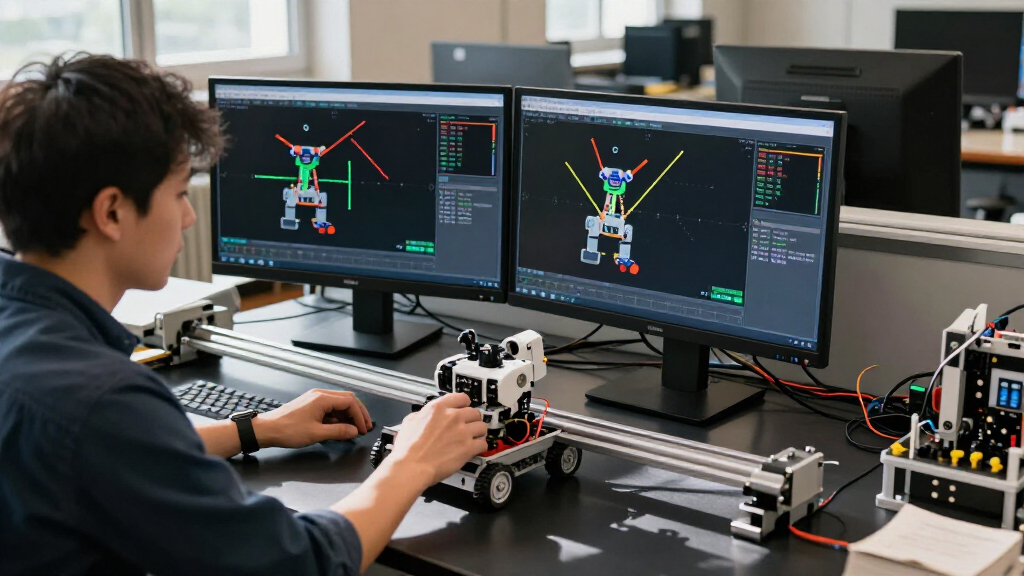
The guide describes a workflow in which MuJoCo loads and compiles the MJCF robot model, while MJWarp implements compatible MuJoCo physics using NVIDIA Warp kernels compiled for NVIDIA GPUs. The example uses an SO-101 model and task geometry from Menagerie or Robot Studio assets. Its main demonstration is running multiple copies of a compatible scene in batches.
Hugging Face frames the work as environment preparation and scaling, rather than a complete learning pipeline. The article explains that Warp code specifies parallel work and is compiled for execution; a first kernel launch builds and caches a native module, with later launches reusing it. It also warns that copying a CUDA array into NumPy synchronizes execution and transfers data to the CPU. Warp adapters or DLPack-compatible sharing can keep data on the device.
The article’s practical guidance depends on the task. It points to CPU MuJoCo for single-robot model-predictive control or teleoperation, MJWarp or mjlab for MuJoCo physics throughput, and MuJoCo Playground or MJX with the Warp implementation for JAX-oriented training recipes. It directs readers seeking a broader multi-solver API and Isaac Lab integration to a later installment about Newton.
When Batched Simulation Helps
Running many simulation worlds at once can help robotics teams evaluate different starting states or candidate actions in workloads that need large amounts of experience. The 2,048-environment demonstration gives readers a concrete scale target and a path from a familiar MuJoCo model to batched GPU simulation.
That scale figure does not establish how quickly the worlds advance or whether the workflow improves learning outcomes. Without a throughput comparison, hardware details, or policy-training results, teams cannot infer the speed, cost, or learning benefit for their own tasks. The tutorial is useful as an implementation guide, while performance decisions still require measurements on the relevant scenes and hardware.
Top picks for "nvidia warp mjwarp"
As an affiliate, we earn on qualifying purchases.
From MuJoCo to Warp
MuJoCo is used for robot simulation and control, including workloads that can distribute sampling across CPU cores. Warp is NVIDIA’s framework for writing kernels that execute on GPUs or CPUs. MJWarp combines that execution framework with compatible MuJoCo physics to batch simulation work on NVIDIA GPUs.
This is the second article in Hugging Face’s series on simulation for physical AI, following an earlier overview of robot simulation. The series is intended to continue with Newton and Isaac Lab, covering additional integration layers. The supplied source material does not provide a publication date for this installment.
“Here, we prepare and scale the simulation environment; we do not train a policy.”
— Hugging Face, describing the tutorial’s scope
Benchmark and Compatibility Gaps
The supplied material does not specify the GPU model, simulation rate, workload settings, or comparison baseline behind the 2,048-environment figure. It is unclear how performance varies with different robot scenes, contact conditions, or hardware. The article discusses compatible models, but does not establish that every MuJoCo model works with MJWarp unchanged.
There are also no policy-training results, task success rates, or learning comparisons. Warp offers features such as autodifferentiation and deterministic execution, but the source does not claim that every MJWarp rollout is differentiable or deterministic by default. The effect of those capabilities on this particular example remains unspecified.
Newton and Isaac Lab Ahead
Hugging Face says later articles will cover Newton and Isaac Lab, extending the series to multi-solver APIs, USD, sensors, managers, and training loops. Those installments are expected to address how prepared simulation scenes connect to broader robotics and learning systems.
For teams considering MJWarp, useful next evidence would include reproducible throughput measurements with hardware and task details, guidance on model compatibility, and results from an actual policy-training run. Those measurements and results are not included in the supplied material.
Key Questions
What does Hugging Face demonstrate?
The article shows how to prepare an SO-101 follower arm simulation in MuJoCo Warp and scale it to as many as 2,048 parallel environments.
Does the tutorial report a speedup?
No measured speedup is provided. The supplied material does not give the hardware, simulation rate, or comparison baseline needed to evaluate performance.
Does the walkthrough train a robot policy?
No. Hugging Face describes the article as a guide to preparing and scaling a simulation environment, not training a policy.
When might teams use MJWarp?
MJWarp may suit workloads that benefit from advancing many compatible simulation worlds in batches on NVIDIA GPUs. Whether it helps a particular task depends on the scene, hardware, and workload, which the tutorial does not benchmark.
Primary source: Hugging Face · via ThorstenMeyerAI.com
Fall Picks
fall essentials
As an affiliate, we earn on qualifying purchases.