
TL;DR
In 2026, the old assumption that a DIY AI workstation is cheaper is no longer reliable, according to Thorsten Meyer AI’s workstation guide and current component-price reporting. Prebuilt systems can reduce deployment time and hardware risk through burn-in testing, tuned cooling and support, while DIY still gives buyers more control over parts, software and upgrades. Buyers should compare live quotes for the same configuration.
The build-versus-buy decision for AI workstations has changed in 2026, as RAM, GPU and SSD shortages have weakened the old assumption that a self-built machine is always cheaper, according to Thorsten Meyer AI’s latest workstation guide and current vendor materials. The shift matters for developers, researchers and small teams deciding whether to spend time sourcing parts or pay for a validated prebuilt system.
Thorsten Meyer AI says the old rule that DIY is cheaper has broken for many configurations. Its guide cites shortages in RAM, GPUs and SSDs and says some vendors that bought inventory earlier, or buy in bulk, can quote systems near or below current street pricing for matched parts.
Vendor materials support part of the buy-side case. Puget Systems describes a burn-in process that stresses completed systems before shipping and checks temperatures and power draw during quality control. BIZON markets AI workstations as turnkey systems with preinstalled frameworks, water cooling and warranty options of up to five years, while Lambda has promoted liquid-cooled desktops for AI and machine learning workloads.
The DIY case is still intact for buyers who need exact component selection, tighter security control, repair autonomy or staged upgrades. The current decision is less about sticker price alone and more about total cost, including sourcing time, setup, troubleshooting, software configuration, power, noise, warranty handling and staff time.
Why It Matters
The shift matters because local AI work is moving from hobby use into teams running inference, fine-tuning, data preparation and privacy-sensitive experiments on desks or in small labs. A system that throttles, fails under sustained load or takes weeks to stabilize can delay a project even if the parts list appears cheaper.
For businesses, prebuilt workstations move some risk to a vendor through validation and support. For individual builders and research groups, DIY keeps the learning value and control, but the buyer also becomes the integrator responsible for BIOS settings, fan curves, driver conflicts and replacement parts.
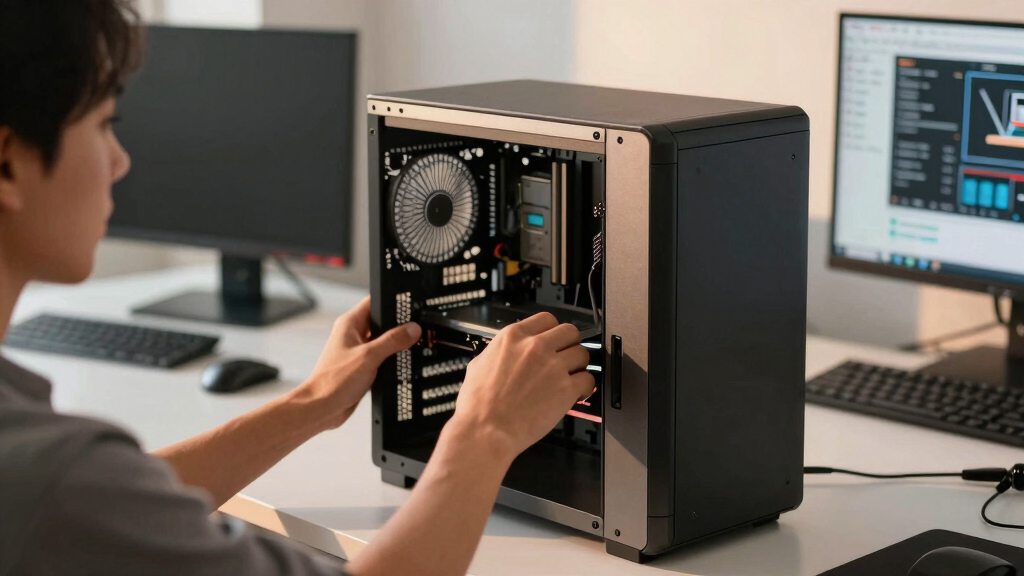
prebuilt AI workstation with GPU
As an affiliate, we earn on qualifying purchases.
As an affiliate, we earn on qualifying purchases.
Background
The price pressure cited by Thorsten Meyer AI fits wider 2026 reporting. PC Gamer reported on May 28, 2026, that Team Group expected DRAM and NAND supply to remain tight as AI server demand absorbs memory production. Windows Central reported in February 2026 that data centers were projected to consume 70% of global memory in 2026 and cited forecasts for further price increases.
The market also includes compact or integrated alternatives. Apple said its 2025 Mac Studio with M3 Ultra supports up to an 80-core GPU, a 32-core Neural Engine and more than 800GB/s of unified memory bandwidth, making it a prebuilt option for some local AI work. That does not replace multi-GPU CUDA workstations for every workflow, but it widens the choices buyers compare.
“You can no longer assume DIY is the bargain.”
— Thorsten Meyer AI workstation guide
“Price both, today, for your exact config.”
— Thorsten Meyer AI workstation guide
“A ‘burn-in’ process stresses the components in a system”
— Puget Systems burn-in documentation
“pre-installed with deep learning frameworks and water cooling”
— BIZON AI workstation page
As an affiliate, we earn on qualifying purchases.
What Remains Unclear
It is not yet clear how long component shortages will last, which vendors still hold inventory at older costs, or when retail GPU, RAM and SSD pricing will settle. The Thorsten Meyer AI guide says to price both paths for the exact configuration because quotes, lead times and warranty terms can change quickly.
It is also uncertain whether a prebuilt system will be the better fit for every AI workload. Software stack, required VRAM, number of GPUs, operating system, data security rules and expected upgrade cadence can flip the decision.
As an affiliate, we earn on qualifying purchases.
What’s Next
Buyers comparing systems should request a same-day parts list and vendor quote for the same CPU, GPU, RAM, storage and cooling target, then compare delivery date, burn-in policy, warranty length, return terms and support scope. The next practical milestone is a refreshed quote before purchase, because 2026 component prices are changing too quickly for older build lists to be reliable.
As an affiliate, we earn on qualifying purchases.
Key Questions
Is building an AI workstation still cheaper in 2026?
Sometimes, but it is no longer a safe assumption. Thorsten Meyer AI says shortages have lifted DIY part costs enough that prebuilt vendors can match or beat some self-build totals, especially when they bought inventory earlier or quote at volume.
When does a prebuilt AI workstation make more sense?
When deployment speed, support, thermals, warranty coverage and lower setup risk matter more than exact part control. Prebuilt systems are better suited to teams that need a machine working quickly and cannot spend days or weeks tuning cooling, drivers and BIOS settings.
When should a buyer build instead?
A self-build can make sense when the buyer needs exact hardware choices, strict data handling control, easier part swaps, a staged upgrade path or the hands-on knowledge that comes from building and tuning the system.
What is the hybrid approach?
The hybrid approach pairs a validated base system with selected upgrades or later expansion. It can give buyers vendor testing and support at purchase time while preserving some room for custom storage, memory, networking or GPUs.
Source: Thorsten Meyer AI