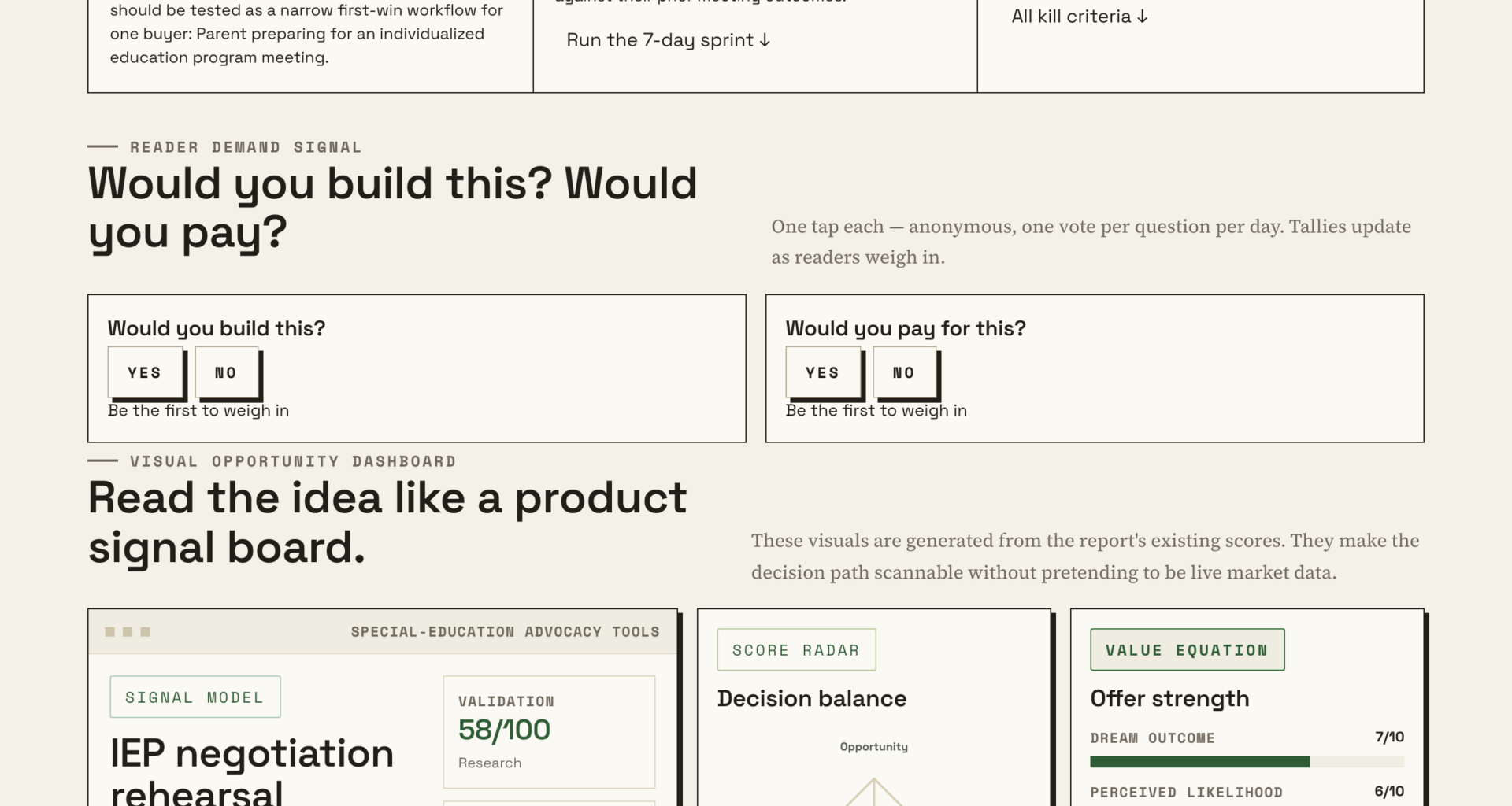

📊 Full opportunity report: What To Expect From An IEP Negotiation Rehearsal Simulator on IdeaNavigator AI — validation score, market gap, and execution plan.

Get the latest gadgets delivered free — and shop member deals
- Fast, free delivery on millions of items
- Access to Prime Big Deal Days deals on October 6–7
- Prime Video, Amazon Music and more included
A product blueprint published by IdeaNavigator AI proposes an AI-powered rehearsal simulator that would let parents of children with disabilities practice their individualized education program (IEP) meetings before walking into the real ones — including simulated pushback from a school team that behaves like the professionals sitting across the table. The proposal targets a single narrow buyer: a parent preparing for an upcoming IEP meeting, and it stakes its case on two converging trends: large language models are now capable of realistic role-play, and special-education meetings are becoming more adversarial as identification rates rise and district resources tighten.

The concept, described by IdeaNavigator AI as a “narrow first-win workflow,” would work in three stages. First, a parent uploads their child’s current IEP and evaluation reports. Second, the simulator translates the documents into plain-language explanations of the family’s entitlements and generates a request list, with each request tied to its legal grounding. Third, the tool role-plays the meeting itself — playing the part of the school team — including what the blueprint calls realistic pushback, repeating the rehearsal until the parent can hold their positions under pressure.
The problem the proposal aims to solve is described in blunt terms: parents typically enter IEP meetings facing a table of professionals who are fluent in the process and the jargon, while the parents often do not know what to ask for, what the school is legally required to provide, or how to push back when a request is denied. The one existing escape hatch — hiring a special-education advocate at $150 or more per hour — is priced out of reach for many families, according to the analysis.
The blueprint also sketches a business model: either per-meeting-prep pricing for families facing a single meeting, or an annual family subscription that covers the full IEP cycle, which typically includes an annual review, reevaluations, and any dispute-triggered meetings in between. The proposed market category is special-education advocacy tools.
Why Parents Might Want This Tool
IEP meetings carry high stakes: the documents produced in that room determine the services, accommodations, and placement a child receives for the entire school year. Under the Individuals with Disabilities Education Act (IDEA), parents are formally equal members of the IEP team, but in practice the information and process asymmetry is large. A parent who does not know the vocabulary of accommodations, related services, or measurable goals has limited ability to negotiate over them.
If such a simulator worked as described, it would shift some of that preparation burden from paid professionals to software. The proposal’s framing — rehearsing until the parent can hold their positions against realistic pushback — targets the specific moment where parents most often lose ground: when a school team declines a request and the parent does not know whether the refusal is lawful, negotiable, or final.
The timing argument also matters. According to the analysis, special-education identification rates keep climbing while district resources tighten, a combination that tends to make meetings more adversarial because districts have stronger incentives to limit costly services at the same moment more families are requesting them.
The Current Market Gap
Parents preparing for IEP meetings today can draw on a fragmented set of resources: free guides from disability organizations, state parent-training centers, commercial books and courses, and paid advocates or special-education attorneys. None of these offer interactive rehearsal of the meeting itself. Advocates who attend meetings in person typically charge $150 or more per hour, according to the IdeaNavigator AI analysis, which makes sustained professional support unrealistic for many households.
At the same time, the underlying technology has changed. Modern large language models can sustain role-play conversations that stay in character, respond to unpredictable arguments, and apply pressure the way an opposing party would — capabilities that earlier chatbots could not reliably deliver. The blueprint argues this is the “why now”: the simulation quality finally matches the task, while the adversarial pressure on families is increasing rather than decreasing.
What the Blueprint Leaves Unproven
The simulator described here is a proposal, not a shipping product. No company, developer, or launch date is identified in the analysis, and no prototype has been built or tested. Every functional claim — the plain-language entitlement explanations, the legally grounded request lists, the realism of the role-play — is a design goal rather than a demonstrated capability.
The most consequential open question is legal accuracy. A tool that misstates what a school must legally provide could leave parents worse off: confident, but wrong, in the actual meeting. The blueprint does not specify how legal grounding would be kept current across states, since special-education law is federal but implementation varies by state and district. It also does not address privacy: uploaded IEPs and evaluation reports are sensitive children’s records, and the proposal says nothing about how that data would be handled, stored, or protected.
Finally, there is no evidence yet that rehearsal improves outcomes. That question is exactly what the proposed validation study is designed to answer, and until it runs, the effectiveness claim remains untested.
The Forty-Parent Validation Test
The blueprint’s own next step is a concrete validation study: prep forty parents before their real IEP meetings and then measure the requested-versus-received services each family obtains, compared against the outcomes of their own prior meetings. This is a paired-outcome design — each family serves as their own baseline — which controls for some variation in district, disability category, and negotiation history.
For the concept to advance, a builder would need to produce a working prototype covering the full workflow — document upload, entitlement explanation, request generation, and role-play — and recruit the forty families. The pricing decision between per-meeting and subscription models would likely follow the validation results rather than precede them. If the study showed families measurably securing more of their requested services after rehearsal, the concept would have its first outcome-based evidence; if it showed no difference, the core value proposition would need to be rethought. No timeline for any of these steps has been announced.
Source: IdeaNavigator AI
Key Questions
Is this IEP simulator available to parents today?
No. It is a product concept described in an analysis by IdeaNavigator AI. No prototype, company, or launch date has been announced.
How would the simulator actually work?
According to the blueprint, a parent uploads the child’s current IEP and evaluation reports, receives plain-language explanations of entitlements and a legally grounded request list, and then role-plays the meeting with an AI playing the school team — including pushback — until they can hold their positions.
How would anyone know the simulator actually helps?
The proposed validation would prepare forty parents before real IEP meetings and compare the services they receive against what they requested, measured against each family’s own prior meeting outcomes.
How would it compare cost-wise to hiring an advocate?
Advates typically cost $150 or more per hour, according to the analysis. The simulator would be priced either per meeting preparation or as an annual family subscription covering the full IEP cycle; specific prices have not been set.
What are the main risks with this idea?
The unproven risks include legal accuracy of the tool’s guidance, privacy handling of sensitive children’s records, the realism of the role-play, and the lack of any evidence so far that rehearsal improves meeting outcomes.
Source: IdeaNavigator AI
Fall Picks
fall essentials
As an affiliate, we earn on qualifying purchases.