
📊 Full opportunity report: A Clearer Way To Evaluate Advice On Your Inheritance on IdeaNavigator AI — validation score, market gap, and execution plan.

Get the latest gadgets delivered free — and shop member deals
- Fast, free delivery on millions of items
- Access to Prime Big Deal Days deals on October 6–7
- Prime Video, Amazon Music and more included
TL;DR
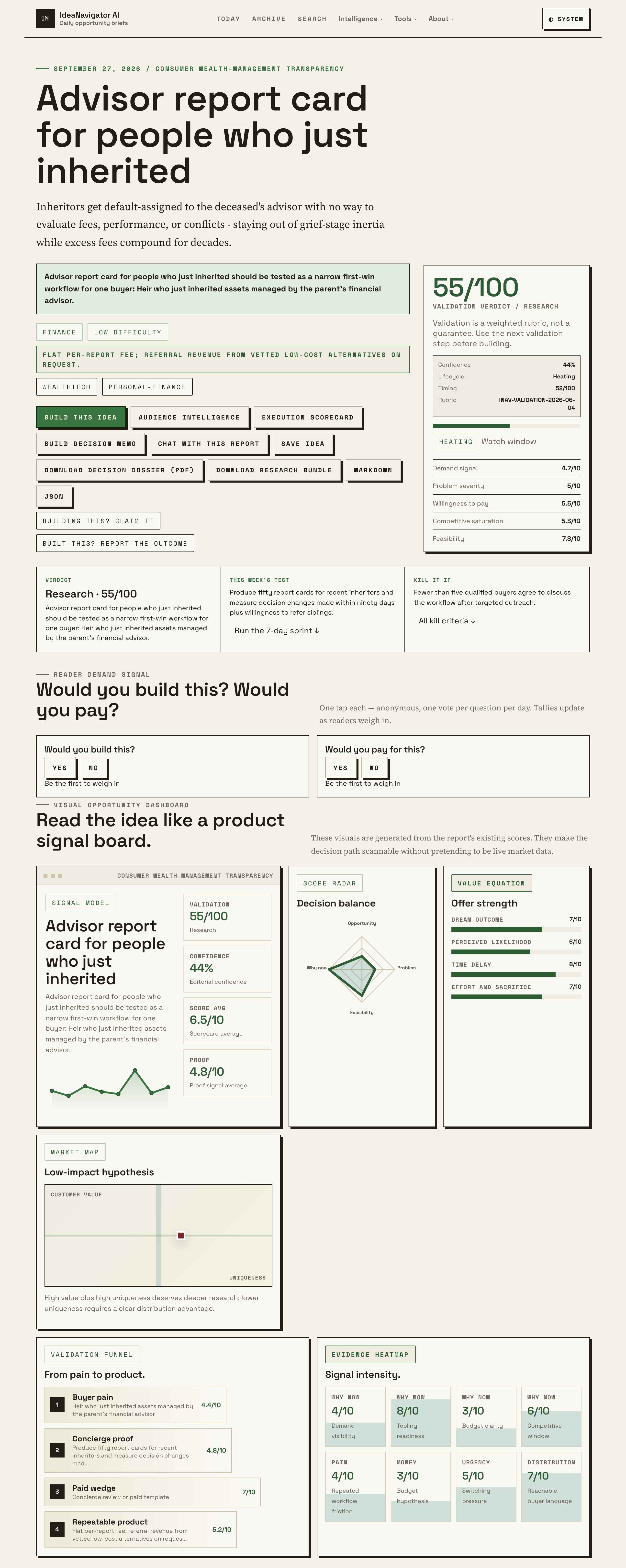
IdeaNavigator AI has outlined a proposed report card for people who inherit assets managed by a parent’s financial adviser. The concept would analyze statements and public disclosures, then offer guidance on whether to stay, negotiate or switch; no product launch or validation results are reported.
IdeaNavigator AI has proposed a paid report card to help people who have recently inherited assets evaluate the financial adviser managing them. The planned service would examine account statements and public regulatory disclosures, then offer stay, negotiate or switch guidance; there is no reported launch, completed test or evidence yet that the approach changes decisions.
The proposal targets one specific situation: an heir receives assets that were already managed by the deceased parent’s adviser. IdeaNavigator AI describes a risk that the heir may remain with that adviser by default, without a clear way to assess fees, performance or conflicts. The material does not establish how often this happens or quantify the financial effect.
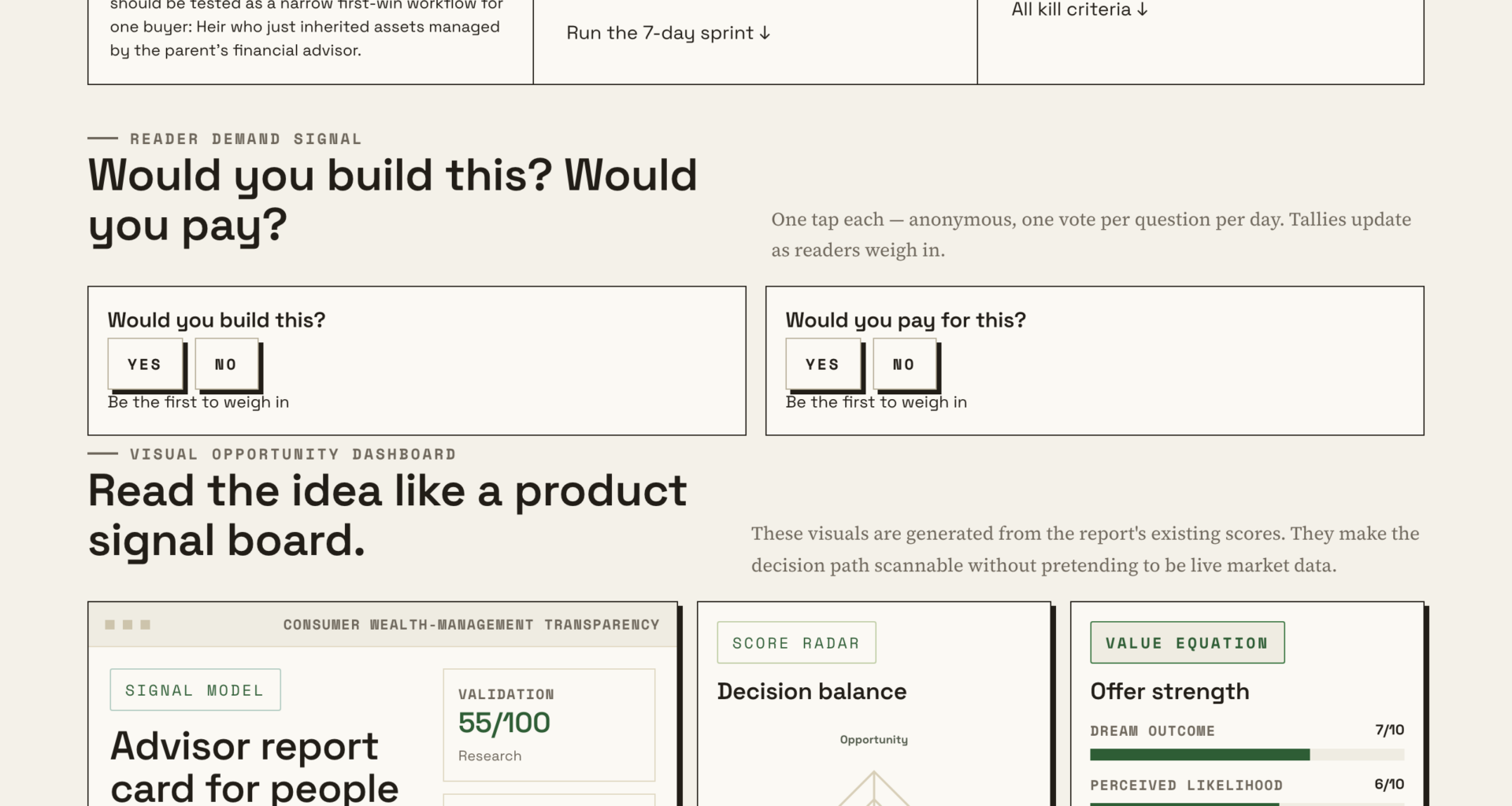
For an initial version, a user would enter the adviser’s name and upload account statements. The report would draw on regulatory history and disclosed conflicts, estimate the actual fees visible in the statements, compare the adviser with alternatives and provide a recommendation. The proposal also includes scripts for discussions with the adviser, though it does not specify how the comparison set or recommendation would be determined.
The proposed business model combines a flat fee per report with referral revenue if users request introductions to vetted, lower-cost alternatives. IdeaNavigator AI identifies recent inheritors as the first group to serve, rather than proposing a general-purpose financial advice product. It does not provide a price, define how alternatives would be vetted or explain how referral relationships would be disclosed in the report.
A Second Look at Inherited Advice
An inheritance can bring an existing financial relationship with it. A report that lays out costs, public disclosures and comparable options could give a new account holder a more structured basis for discussing that relationship. This may matter when someone is handling financial decisions while also managing the practical demands of a recent loss. The proposal, however, does not show that heirs routinely lack other ways to review an adviser or that a report would improve outcomes.
The concept’s value would depend on whether it can calculate costs accurately from varied statements and make comparisons that users can understand. Fee figures may be presented in different ways across documents, and an adviser’s reported performance can be difficult to compare without accounting for investment mix, risk and time period. A simple stay-or-switch label could obscure those differences unless the report explains its inputs and limits.
Referral income also creates a question about incentives. If a report earns money when a user moves to a recommended provider, readers would need to know how that relationship affects the options shown and the recommendation. The proposal says referrals would be to vetted, lower-cost alternatives, but gives no vetting standard or details about the revenue arrangement. Those details could shape whether users view the product as an independent assessment.
From Inheritance to Adviser Review
IdeaNavigator AI frames the opportunity against what it calls the “great wealth transfer,” describing trillions of dollars moving to heirs over the decade. The proposal does not attach a specific estimate, define the period behind that figure or provide a separate data source in the material presented here. Its rationale is that public adviser disclosures, including Form ADV and fee disclosures, can be paired with software that parses documents.
The suggested workflow is deliberately narrow: one person has recently inherited assets and the parent’s adviser still manages them. This focus could make the product easier to test than a service for every household choosing a financial adviser. The proposal describes document collection, analysis and decision guidance, but reports no working product, sample report, test group or customer interviews.
As a validation plan, IdeaNavigator AI proposes producing 50 report cards for recent inheritors. It would track whether recipients make a decision within 90 days and whether they would refer siblings. These are proposed measures, not results. The material does not state how participants would be recruited, what counts as a decision change or how the team would distinguish the report’s influence from other factors.
Questions Before a First Test
No launch or test results are reported, so it remains unknown whether recent inheritors would pay for the report, upload sensitive statements or act on its recommendations. The proposed 50-person exercise is a plan; there are no findings on decision changes within 90 days or referrals to siblings.
The proposal also leaves open how the service would protect financial documents, verify extracted fees and handle incomplete or inconsistent records. It does not describe the benchmark methodology, define what makes an alternative “vetted,” or explain how conflicts between subscription-like fees and referral revenue would be managed. No pricing, referral terms or accuracy measures are given.
It is also unclear whether the report would provide general information or individualized financial recommendations, and what qualifications or review process would support its guidance. Until those points are specified and tested, the proposed report card should be understood as a product concept rather than a demonstrated way to reduce costs or improve decisions.
Testing Demand and Decisions
The next step described in the proposal is to prepare 50 report cards for recent inheritors and observe decisions over the following 90 days. That test could provide early evidence on whether users change advisers or negotiate, and whether they would recommend the service to siblings. IdeaNavigator AI has not reported when the test will begin or whether it has recruited participants.
A useful account of any results would need to explain how participants were selected, what they paid, how fees and alternatives were assessed, and what counted as a decision change. It would also need to report how many users acted, what actions they took and whether the service’s recommendations were reviewed for accuracy. Those details would help distinguish interest in the idea from evidence that the product is useful.
For now, the development is a proposed consumer finance workflow with a defined initial audience and a suggested validation plan. The public information does not establish that a service is available or that its analysis can reliably guide an heir’s decision. The proposal appears in IdeaNavigator AI’s description.
Source: IdeaNavigator AI
Key Questions
Is the report card available now?
No launch is reported. IdeaNavigator AI describes a proposed product and a plan to test it with recent inheritors.
What would the report assess?
The proposed report would use account statements and public disclosures to assess fees, regulatory history and disclosed conflicts, compare alternatives and suggest whether to stay, negotiate or switch.
Has the service been shown to save money?
No results are provided. The proposal includes a planned test tracking decisions within 90 days, but does not report completed tests or savings.
How would the proposed service make money?
IdeaNavigator AI proposes a flat fee per report and referral revenue when users request introductions to vetted, lower-cost alternatives. Pricing and referral terms are not specified.
Source: IdeaNavigator AI
Fall Picks
fall essentials
As an affiliate, we earn on qualifying purchases.