
TL;DR

Get the latest gadgets delivered free with Prime
- Fast, free delivery on millions of items
- Prime Video, Amazon Music and more included
- Member-only deals all year
The c64-hw-sim project models the Commodore 64 ASSY 250407 motherboard at the level of individual pins and electrical connections. Users can remove chips, break pins or open components, then observe simulated video, keyboard and signal behavior; the author says it is intended for learning and repair clues, not playing games.
The open-source c64-hw-sim project simulates the Commodore 64’s ASSY 250407 motherboard pin by pin, allowing users to remove chips, break connections and watch how the modeled machine responds. Its author says the tool may help people understand the computer’s circuitry or investigate repair hypotheses without physically risking a board, but it runs below real C64 speed and is not designed for playing games.
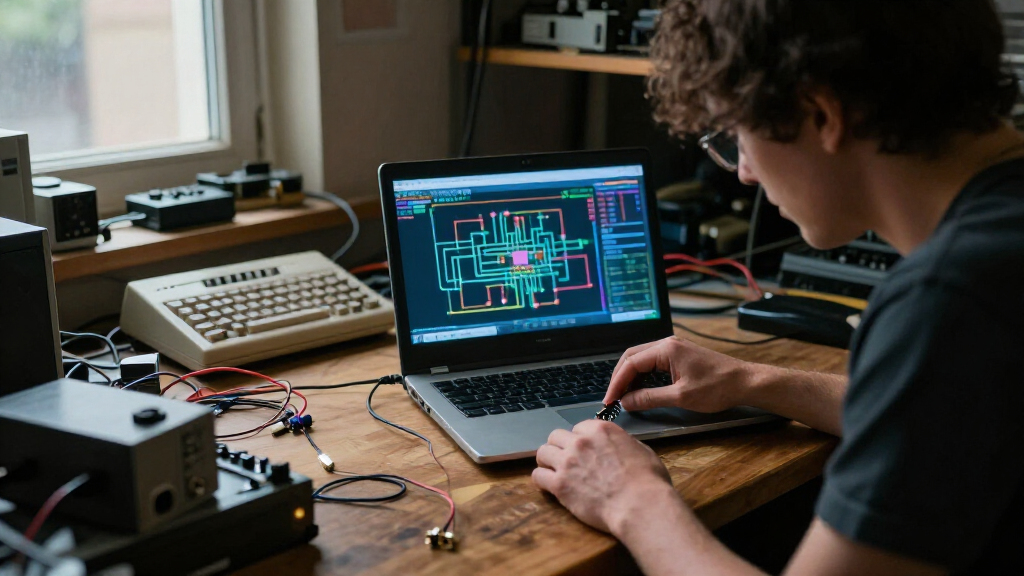
The simulator represents the board’s electrical netlist—the connections among components—and models how chips behave at their pins. Users can lift a pin, connect it to ground or +5 volts, remove a socketed chip, or open a resistor, ferrite bead or crystal. The interface displays the board and monitor, shows pin states like a logic probe, and provides an oscilloscope view. It can also run without its graphical window and apply faults through command-line options.
The project’s report gives an example involving pin 17 (A7) of the color RAM. With that pin lifted before startup, the computer appears to boot normally because the CPU and video chip access the same incorrectly addressed memory. The report says restoring the connection exposes random colors in the part of memory that was not written. It also describes removing the character ROM: a BASIC maze program continues running, but the character shapes disappear. These are results reported by the project, not independent tests of the simulator.
The board model was generated from a KiCad replica and contains 216 parts and 249 nets, according to the project documentation. It draws on chip models by Andre Weissflog, also known as floooh, and credits the board design to bwack’s C64-250407-Replica-KiCad. The software runs on macOS and Linux with OpenGL. The author reports that, on tested systems, simulation reaches between 31% and 48% of a C64’s speed; those figures are hardware-specific examples, not a general performance guarantee.
A Safer Way to Test C64 Faults
Repairing vintage computers can involve desoldering components, a process the project author describes as time-consuming and capable of damaging a board. A simulator that allows faults to be introduced and reversed may help hobbyists learn how signals interact before working on physical hardware. It could also help narrow down which components to investigate, particularly when a repairer has a specific suspected fault.
The key limitation is diagnostic certainty: the author warns that a matching symptom is a clue, not proof. Different faults can produce similar behavior, and the simulation is not a substitute for measurements on the actual machine. Its value is as an exploratory model of a particular board design, not as a definitive repair diagnosis.
As an affiliate, we earn on qualifying purchases.
Built Around One C64 Board
The simulator targets the ASSY 250407 revision of the Commodore 64 motherboard rather than every C64 board variant. Its modeled components include the 6502-family CPU, VIC-II video chip, memory, ROMs, logic chips and PLA address decoder. The project adapts pin-oriented chip models, with the board’s component layout and connections represented in software.
At the electrical level, the model tracks whether signals are driven high or low, weakly pulled up, shorted to a supply, or left floating. The documentation says competing equal-strength outputs count as contention, while an undriven net retains charge and then drifts. That behavior is intended to account for effects such as a floating data line when a ROM is removed. Users can load program files into simulated DRAM, inspect signals and apply or repair faults while the machine runs.
“A matching symptom is a clue, not a proof.”
— The c64-hw-sim project author
As an affiliate, we earn on qualifying purchases.
Limits of the Fault Model
The project documentation does not establish how closely every simulated fault matches measurements across real C64 boards, or how its results compare with independent hardware tests. Its example figures cover one motherboard revision, and different C64 revisions may have different layouts or components. The author also notes that fault symptoms can overlap. The source material does not specify a publication date, a formal validation study, or a plan to add other board revisions.
electronics fault simulation software
As an affiliate, we earn on qualifying purchases.
As an affiliate, we earn on qualifying purchases.
Testing and Project Development
Users can build the program from its GitHub repository and run its included fault tests; the documentation says a script covers 31 common faults, with expected symptoms recorded before the simulator was run. That describes the project’s test approach, not an independent validation result. The repository is the place to check for later code changes, additional fault cases or support for other C64 boards. No further release schedule is stated in the supplied report.
As an affiliate, we earn on qualifying purchases.
Key Questions
What does the Commodore 64 hardware simulator do?
It models the ASSY 250407 motherboard at pin level. Users can introduce faults such as removing a chip or grounding a pin, then inspect the simulated screen, keyboard and electrical signals.
Can it help diagnose a broken real C64?
It may offer clues when a user has a suspected fault and wants to compare simulated behavior. The project author cautions that a matching symptom is not proof, and results should not replace testing the real board.
Can I use it to play Commodore 64 games?
The author says it is not intended as a game emulator. Reported performance on several computers ranges from 31% to 48% of C64 speed, and actual results depend on the host system.
Which Commodore 64 motherboard does it simulate?
The project models the ASSY 250407 revision. The supplied documentation does not say that other motherboard revisions are supported.
Source: hn
Halloween Picks
halloween
As an affiliate, we earn on qualifying purchases.