
TL;DR

Get the latest gadgets delivered free with Prime
- Fast, free delivery on millions of items
- Prime Video, Amazon Music and more included
- Member-only deals all year
A developer has demonstrated a method to play Atari ST music on the Amiga by using the Amiga’s PAULA chip for direct sound emulation, eliminating CPU usage. This breakthrough allows seamless music playback during intensive graphics routines.
A developer has successfully used the Amiga’s PAULA chip to directly emulate Atari ST music, allowing playback without any CPU involvement. This innovation enables the Amiga to run intensive graphics routines, like sin-dots effects, while simultaneously playing Atari music, a feat previously limited by CPU constraints.
The project involves repurposing the Amiga’s PAULA chip, originally designed for PCM sample playback, to generate Atari YM2149 sounds. By precomputing the sound wave data and storing it in memory, the developer bypasses the need for real-time CPU processing, resulting in a zero-CPU overhead during music playback. The approach hinges on exploiting the PAULA’s ability to loop small sample waveforms, such as square waves, and modulating their parameters based on Atari music data. Initial tests with simple square wave sounds produced bland results, but further techniques inspired by demoscene innovations—particularly the use of envelope tricks to generate richer, sweeping sounds—have been applied to produce more complex and authentic Atari sound effects. This method was demonstrated during a recent prototype showcase, confirming the feasibility of playing Atari music on the Amiga with minimal resources.
Why It Matters
This development matters because it opens new possibilities for Amiga demos and games, enabling simultaneous high-performance graphics and complex Atari-style music without taxing the CPU. It also demonstrates a creative hardware reuse, pushing the boundaries of what the Amiga’s PAULA chip can achieve, and offers a new tool for chiptune artists and demo coders to craft richer soundtracks with minimal processing overhead.
As an affiliate, we earn on qualifying purchases.
Background
Historically, the Amiga and Atari ST used different sound chips—PAULA and YM2149, respectively—each with unique capabilities. Previous efforts to emulate Atari music on the Amiga relied heavily on CPU-intensive software synthesis, limiting real-time performance during graphics routines. The recent demonstration builds on decades of demoscene experimentation, particularly techniques to produce richer sounds from the YM2149 by manipulating its envelope generator and waveform arrangements. The challenge has always been balancing sound quality with CPU load, especially during graphics-intensive routines like sin-dots effects that demand maximum CPU resources. This new approach leverages the Amiga’s hardware to offload sound synthesis entirely, representing a significant step forward in hardware-based sound emulation.
“Using the PAULA chip to emulate Atari sounds allows us to play complex music tracks without any CPU overhead, freeing the processor for graphics routines.”
— Developer behind the project
“By exploiting envelope tricks and sample looping, we can produce rich, sweeping sounds that mimic the classic Atari soundtrack effects.”
— Demoscene musician inspired by YM2149 tricks
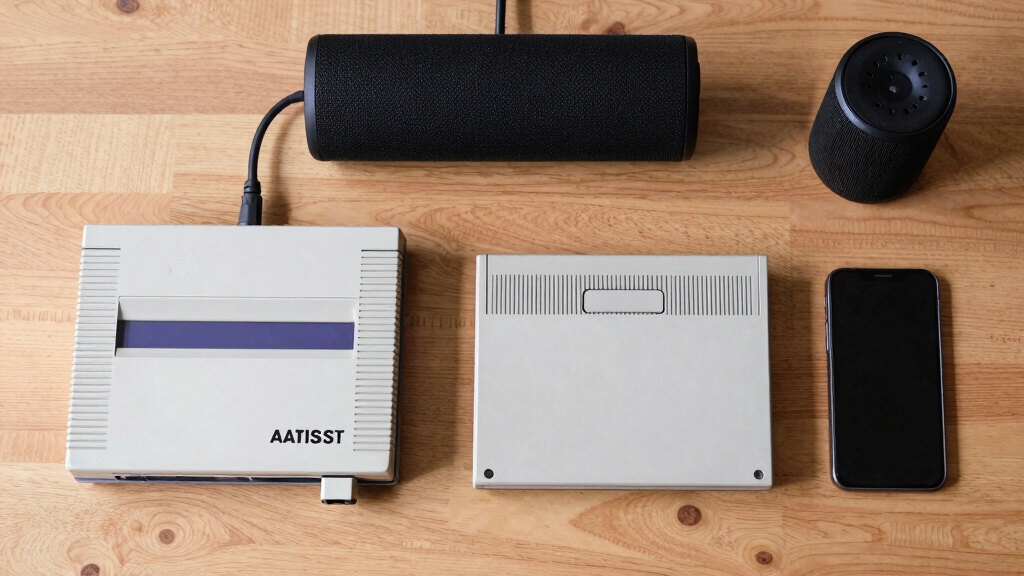
Atari ST music playback on Amiga
As an affiliate, we earn on qualifying purchases.
As an affiliate, we earn on qualifying purchases.
What Remains Unclear
While the prototype has demonstrated the concept successfully, it remains unclear how well this approach scales with more complex or multi-channel Atari music files. The exact limitations regarding sound fidelity, timing accuracy, and compatibility with various Atari sound formats are still being evaluated. Additionally, the long-term stability and performance of this method in different Amiga hardware configurations are not yet confirmed.
As an affiliate, we earn on qualifying purchases.
What’s Next
The next steps include refining the emulation technique, testing with a broader range of Atari music files, and integrating this method into demo productions or games. Developers plan to optimize the data precomputation process and explore real-time adjustments to improve sound quality further. A public release or demonstration at upcoming retro computing events is anticipated.
Amiga sound card for retro gaming
As an affiliate, we earn on qualifying purchases.
As an affiliate, we earn on qualifying purchases.
Key Questions
How does this method avoid CPU usage entirely?
It precomputes all sound parameters and stores them in memory, allowing the PAULA chip to generate sounds independently during playback, eliminating real-time CPU processing.
Can this emulate all Atari music formats?
Currently, it is best suited for simple square wave-based music and certain envelope tricks. More complex formats with digital effects may require additional development.
Will this technique work on all Amiga models?
The demonstration was performed on a standard Amiga 500, but further testing is needed to confirm compatibility with other models and configurations.
How does the sound quality compare to original Atari hardware?
Preliminary results produce authentic-sounding effects, especially with envelope tricks, but may not fully replicate the richness of the original YM2149 outputs in all cases.
Fall Picks
fall essentials
As an affiliate, we earn on qualifying purchases.