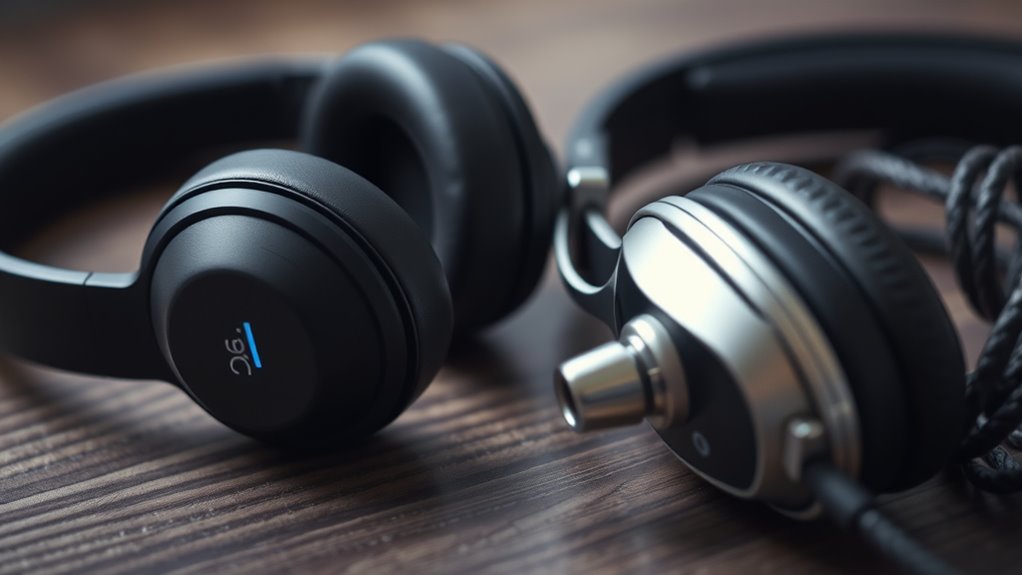

If you’re an audiophile, wired headphones often give you better sound quality with clearer detail and fewer distortions, thanks to a direct connection. Wireless models offer great convenience and freedom of movement but might compromise on sound fidelity and introduce latency. If you value pristine audio, the wired option is usually the way to go. Still, to find out which fits your lifestyle and preferences best, there’s more to explore beyond these basics.
Key Takeaways
- Wired headphones generally provide superior sound fidelity with richer detail and less signal loss, favored by audiophiles.
- Wireless headphones offer greater convenience and freedom of movement, ideal for active lifestyles and on-the-go use.
- High-end wired models deliver pristine audio quality, while wireless options may compromise sound clarity at lower price points.
- Wireless headphones often feature active noise cancellation, enhancing listening in noisy environments, but can introduce latency.
- Wired headphones eliminate the need for charging, ensuring uninterrupted listening, whereas wireless models depend on battery life.

When choosing between wireless and wired headphones, you need to think about how each option fits your lifestyle and preferences. If you’re an audiophile who values sound quality above all, wired headphones often come out on top. They typically offer superior sound fidelity, thanks to a direct connection that minimizes signal loss. This means you get richer, more detailed audio, with better dynamic range and fewer distortions. However, there’s more to consider than just sound quality. Battery life becomes a vital factor with wireless models. While some high-end wireless headphones provide impressive battery longevity, they still require regular charging, which can interrupt your listening sessions. Noise cancellation is another key feature; many wireless headphones come equipped with active noise cancellation (ANC), allowing you to block out external distractions effortlessly. This can greatly enhance your listening experience, especially in noisy environments. Wired headphones don’t usually include noise cancellation technology, but their wired design naturally isolates sound better in many cases, especially if they come with good ear cups or in-ear tips. Since they don’t rely on batteries, they’re always ready to use without worrying about running out of power.
On the other hand, wireless headphones offer unmatched convenience. No more tangled cords or having to sit near your device. They give you the freedom to move around, whether you’re commuting, working out, or simply lounging at home. Many wireless models now feature long-lasting battery life, enabling hours of playback on a single charge. Plus, with advancements in noise cancellation, wireless headphones can create a peaceful listening environment, even in bustling streets or busy gyms. The absence of wires also means fewer points of failure, which can be an advantage for everyday use. But keep in mind, wireless headphones might compromise slightly on sound quality compared to wired options, especially at lower price points. While high-end wireless models have closed this gap considerably, some audiophiles still prefer the pristine sound delivered through a wired connection.
Ultimately, your choice hinges on what matters most: if pristine sound quality and uninterrupted listening are your priorities, wired headphones might serve you better. But if convenience, portability, and noise cancellation are more important, wireless headphones offer a compelling solution. Consider your daily routines, how often you listen, and whether the trade-offs are worth it. Balancing these factors will help you pick the headphones that best fit your lifestyle and elevate your listening experience.
Frequently Asked Questions
How Do Wireless Headphones Handle Latency During Critical Listening?
Wireless headphones can handle latency during critical listening fairly well, especially with advanced Bluetooth codecs like aptX Low Latency and AAC. These codecs reduce lag, making synchronization with audio more seamless. Signal stability also plays a role; a strong, stable connection minimizes interruptions. However, some delay may still occur, so for precise timing, wired headphones often outperform wireless options. Still, modern wireless tech has improved considerably, making latency less of an issue.
Are Wireless Headphones More Prone to Interference Than Wired Ones?
Wireless headphones are more prone to interference susceptibility than wired ones because they rely on wireless signals, which can be disrupted by other electronic devices or obstacles. This affects signal stability, potentially causing audio dropouts or degraded sound quality. Wired headphones, on the other hand, maintain a consistent connection, offering better stability and fewer interference issues, making them a reliable choice for critical listening.
What Are the Best Wireless Headphones for High-Resolution Audio?
Open the symphony within with top wireless headphones for high-resolution audio. Think of Bluetooth codecs like aptX HD and LDAC as bridges to pure sound, ensuring clarity and detail. Noise cancellation acts as a shield, immersing you fully in your music. These headphones give you convenience without sacrificing sound quality, making every listen feel like a personal concert—you just need to pick the right pair to experience true audio excellence.
How Long Do Wireless Headphones Typically Last on a Single Charge?
Wireless headphones typically last between 20 to 40 hours on a single charge, depending on the model and features. You can expect a battery life of around 8 to 12 hours for most, with some high-end options offering even longer. Charging time usually takes about 2 to 3 hours to fully restore the battery. Keep an eye on battery life indicators to avoid unexpected power loss during your listening sessions.
Can Wired Headphones Be Upgraded for Better Sound Quality?
Yes, you can upgrade wired headphones for better sound quality. You might consider cable upgrades, which reduce interference and improve clarity, and driver replacements, if compatible, to enhance sound performance. Upgrading cables often results in clearer audio and better bass, while replacing drivers can markedly improve overall sound quality. Just make certain of compatibility with your headphones model, and carefully follow installation instructions to achieve ideal audio improvements.
Conclusion
Ultimately, choosing between wireless and wired headphones is like selecting a path through different forests. Wired headphones offer the rooted, pure essence of sound—deep and unwavering, like ancient trees standing tall. Wireless headphones, on the other hand, symbolize the freedom to roam, light and unbound, like the wind whispering through leaves. Your choice reflects your journey: whether you seek the timeless depth or the effortless breeze of convenience. The forest awaits your decision.