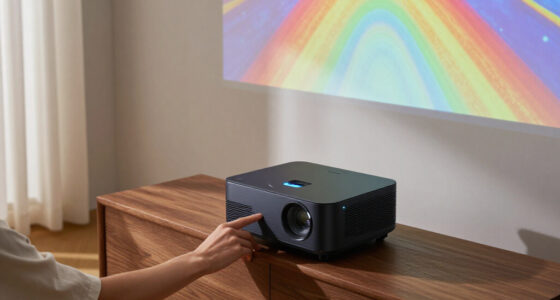

8K TVs will become mainstream once prices drop, content providers expand native 8K options, and infrastructure improves—trends expected to unfold over the next few years. Right now, high costs and limited content hold back widespread adoption. As technology advances and more 8K content becomes available, it’ll become easier for you to enjoy this ultra-high-definition experience. Stay with us to uncover how these changes will shape the future of home entertainment.

Get the latest gadgets delivered free — and shop member deals
- Fast, free delivery on millions of items
- Access to Prime Big Deal Days deals on October 6–7
- Prime Video, Amazon Music and more included
Key Takeaways
- Widespread adoption of 8K TVs is expected to occur gradually over the next several years.
- As manufacturing costs decrease and content expands, 8K will become more accessible to consumers.
- Increasing content availability and infrastructure improvements will drive mainstream adoption.
- Currently, high prices and limited native 8K content slow market penetration.
- Industry projections suggest 8K will become more mainstream as technology matures and consumer demand grows.
Although 8K TVs have been on the market for a few years, they are not yet mainstream. One of the main reasons is the high cost considerations involved. These TVs tend to be considerably more expensive than their 4K counterparts, largely because of the advanced technology packed into their screens. If you’re thinking about upgrading, you might wonder whether the investment is worth it right now. The price gap between 8K and 4K models is narrowing, but it’s still substantial enough to discourage casual buyers. As the technology matures and production scales up, prices are expected to come down, making 8K more accessible. However, right now, the cost remains a key barrier for most consumers, especially when considering budget-conscious households or those who don’t prioritize the latest tech.
Another factor influencing mainstream adoption is content availability. Even if you’re willing to spend on an 8K TV, the content you can watch in 8K resolution is limited. Currently, there are very few movies, streaming services, or broadcast channels offering native 8K content. Most content is still produced in 4K or lower resolutions, and upscaling from these formats doesn’t always provide the same clarity or detail that native 8K can deliver. This lack of abundant, high-quality 8K content makes it harder for consumers to justify the expense. You might find yourself investing in a high-end TV with little to watch in its full resolution. Over time, as more content creators and streaming platforms adopt 8K technology, content availability will improve. But for now, it’s a chicken-and-egg situation where content and hardware development need to progress together for widespread adoption.
Additionally, the infrastructure needed for 8K streaming is still evolving. You’ll need a robust internet connection and compatible devices to truly enjoy 8K content without interruptions. This adds another layer of complexity and cost for consumers looking to upgrade. Despite these hurdles, the industry expects that as manufacturing costs decrease and content providers expand their 8K offerings, more people will start considering 8K TVs as a practical choice. For now, though, most consumers are content with 4K, waiting for prices to drop and content to increase before making the switch to 8K. The transition to mainstream adoption will likely take a few more years, but the momentum is building gradually. Moreover, the development of advanced display technology continues to improve the overall viewing experience, making 8K more appealing in the future.
As an affiliate, we earn on qualifying purchases.
Frequently Asked Questions
Will 8K Content Be Widely Available Soon?
8K content won’t be widely available soon, as content production and broadcasting standards are still catching up. Producers need time to create more 8K footage, and broadcasters must upgrade their infrastructure for 8K transmission. While some high-profile events and tech demos showcase 8K, you’ll likely see limited mainstream content in the near future. Stay patient, as gradual improvements are on the horizon, but full 8K content will take years to become common.
How Much Will 8K TVS Cost in the Future?
Price points for 8K TVs will plummet as production profits and manufacturing costs decrease. You can expect prices to gradually drop, making future models more affordable for all. As technology advances and economies of scale kick in, 8K TVs will become more budget-friendly, turning pricey purchases into practical, perfect picks. So, stay tuned for cheaper, cutting-edge screens that’ll soon be within your reach.
Do 8K TVS Require Special Internet Bandwidth?
Yes, 8K TVs require higher internet bandwidth to guarantee ideal streaming quality. You’ll need a fast, stable connection, ideally at least 25 Mbps or more, to handle the large data loads of 8K content without buffering or quality drops. Upgrading your internet plan might be necessary to enjoy smooth, high-quality streaming, especially as more 8K content becomes available and demand for better streaming quality increases.
Are There Health Risks Associated With 8K Screens?
You might experience some eye strain or sleep disruption from 8K screens if you watch them for long periods or in low light. Bright, high-resolution displays can cause eye fatigue, especially if your eyes aren’t accustomed to the intense detail. To reduce risks, limit screen time before bed and take regular breaks. Overall, there’s no proven serious health risk, but moderation helps prevent discomfort.
Will 8K TVS Replace Current 4K Models Entirely?
8K TVs are unlikely to replace 4K models entirely anytime soon. The resolution upgrade offers impressive detail, but widespread technology adoption takes time due to high costs and limited content. You’ll probably see 8K screens as premium options rather than standard replacements, giving consumers the chance to enjoy advanced features while 4K remains the more practical choice for most. Manufacturers will continue refining 8K tech, but full replacement isn’t imminent.
As an affiliate, we earn on qualifying purchases.
Conclusion
So, while 8K TVs are still planting their flags in the tech frontier, don’t hold your breath for them to flood your living room overnight. Think of 8K as a rising star, gradually illuminating the night sky of entertainment. As technology advances and prices drop, they’ll become as common as cozy fireside chats. Until then, enjoy the view in high definition—you’re on the brink of a visual revolution just over the horizon.
As an affiliate, we earn on qualifying purchases.
As an affiliate, we earn on qualifying purchases.
Fall Picks
fall essentials
As an affiliate, we earn on qualifying purchases.