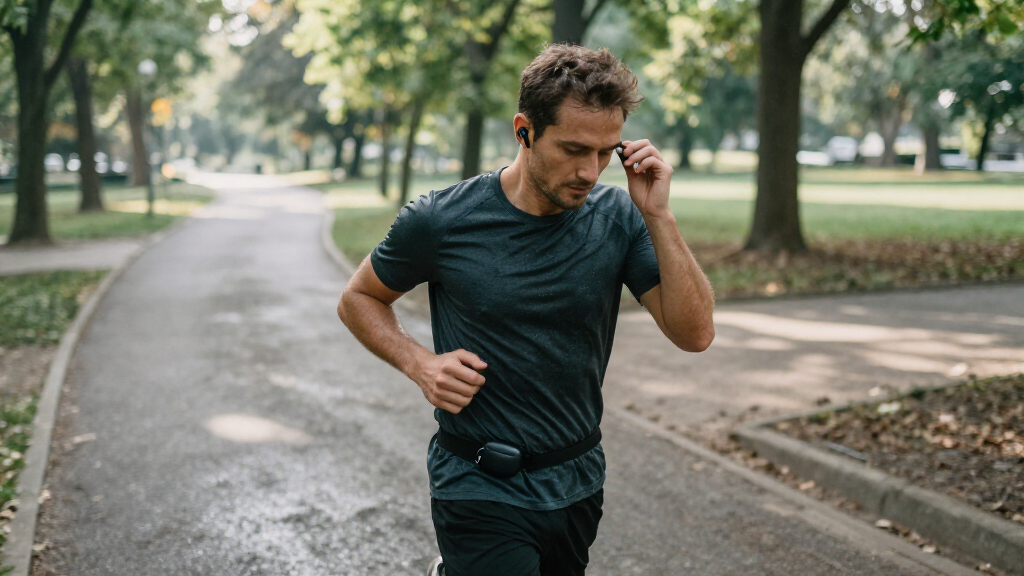

Choosing sports earbuds is less about which pair sounds best in a quiet room and more about which stays comfortable and connected through your actual training. The Jabra Elite 8 Active (2nd gen) and Beats Fit Pro both have active noise cancellation, water resistance, and a design intended to stay put during exercise. Their priorities differ: Jabra is built to take more exposure to sweat, dust, and rough handling, while Beats combines a flexible wingtip fit with convenient Apple device features and often costs less.

Get the latest gadgets delivered free with Prime
- Fast, free delivery on millions of items
- Prime Video, Amazon Music and more included
- Member-only deals all year

JLab Go Sport+ True Wireless Workout Earbuds – Bluetooth, Clear Calling, Graphite
- ✔ Water resistance: IP55 sweat and dust resistant
- ✔ Playback per earbud: 9+ hours
- ✔ Total playback: Up to 35 hours with case

HILDCROA BX31 Wireless Sports Earbuds with Bluetooth 5.3
- ✔ Water resistance: IPX7
- ✔ Playback per charge: Over 8 hours
- ✔ Total playback: Up to 75 hours with case

TRAUSI T6 Open-Ear Wireless Earbuds with Earhooks, Bluetooth 5.4, 80-Hour Playtime, and IPX7 Waterproofing
- ✔ Design: Open-ear with earhooks
- ✔ Water resistance: IPX7
- ✔ Total playback: Up to 80 hours with case
That makes the decision fairly direct. Choose the Jabra if your workouts include outdoor use, heavy sweating, or conditions where tougher protection and longer battery life matter. Choose Beats if you want a secure fit for gym sessions, use Apple devices, and value a lower price and easy switching. The comparison below focuses on those practical tradeoffs; fit and sound remain personal, so a return window is useful if either pair feels uncomfortable.
At a Glance
| Criteria | Jabra Elite 8 Active (2nd gen) | Beats Fit Pro | Winner |
|---|---|---|---|
| Workout fit | Compact, stable in-ear design; no external wingtip | Flexible wingtip helps anchor the earbud; fit varies by ear | Depends |
| Water and dust protection | IP68 earbuds and IP54 case | IPX4 earbuds; case has no stated water-resistance rating | A |
| Battery life | Up to 8 hours with ANC; up to 32 hours with case | Up to 6 hours with ANC; up to 24 hours with case | A |
| Noise control | Adaptive ANC and HearThrough transparency | ANC and Transparency mode | Depends |
| Device features | Multipoint connection and customizable controls | Apple H1 features, including automatic switching and hands-free Siri | B for Apple users; A for multipoint |
| Sound | Customizable sound with Jabra app | Energetic, bass-forward tuning | Depends |
| Price and value | Usually the more expensive option | Often cheaper, especially on sale | B |
JLab Go Sport+ True Wireless Workout Earbuds – Bluetooth, Clear Calling, Graphite
The JLab Go Sport+ is our most balanced option for regular workouts. Its ergonomic earhooks are designed to keep the earbuds in place as we move, and the IP55 sweat and dust resistance makes it a practical match for indoor training and sweaty runs. Compared with the HILDCROA BX31 and TRAUSI T6, JLab has the clearest stated advantage in per-earbud listening time: more than nine hours, rather than just over eight for the BX31, while the T6 description does not specify a per-charge figure.Battery life is especially useful for long training days because the stated 35-hour total includes the case, but we should not confuse that total with uninterrupted listening. HILDCROA and TRAUSI list larger case totals, at 75 and 80 hours respectively. JLab instead gives us a stronger balance between case capacity and time per charge, plus a two-year warranty that stands apart from the 90-day terms listed for the other two models.Dual MEMS microphones are described as helping with calls by reducing background noise, and the companion app allows EQ and touch-control customization. Those are useful extras when a training session includes calls or when we want to tailor controls. The tradeoffs are straightforward: the earhooks may feel tight on some ears, the built-in charging cable cannot be removed, and the listed Bluetooth range is about 10 meters. Choose JLab for the most rounded workout profile; choose HILDCROA for a higher waterproof rating or TRAUSI when awareness matters more than isolation.
Pros:
- IP55 sweat and dust resistance is suited to sweaty training sessions.
- More than nine hours of stated playback per earbud, with up to 35 hours total including the case.
- Earhooks are designed to provide a secure fit during movement.
- App-based EQ and touch-control customization, plus dual microphones described for clearer calls.
Cons:
- Earhooks may feel tight for some users.
- The built-in charging cable is non-removable.
- The listed Bluetooth range is about 10 meters.
Best for: Regular gym users and runners who want secure earhooks, sweat and dust protection, more than nine hours of stated playback per charge, and a longer listed warranty.
Not ideal for: People who dislike earhooks, need an IPX7 rating for very wet conditions, or want an open-ear design to hear more of their surroundings.
Bottom line: The Go Sport+ is our best all-around sports choice when we want a secure, sweat-resistant fit and stronger per-charge endurance than the other specified models.
“The Go Sport+ is our best all-around sports choice when we want a secure, sweat-resistant fit and stronger per-charge endurance than the other specified models.”
HILDCROA BX31 Wireless Sports Earbuds with Bluetooth 5.3
If water protection is our main concern, the HILDCROA BX31 has the strongest stated rating in this lineup: IPX7 waterproofing. That makes it a more natural fit than the JLab Go Sport+ for workouts where heavy exposure to water is a priority. The rating does not tell us how the earbuds will feel or perform in every situation, but it gives buyers a clear basis for comparing their listed protection. Like the JLab and TRAUSI, HILDCROA uses earhooks, so it is built around a secure sports fit rather than a standard in-ear shape.The BX31’s headline battery figure is up to 75 hours with the case, alongside just over eight hours per charge. That total can mean fewer trips to an outlet over repeated sessions, but JLab states more playback per earbud, which may suit a particularly long workout better. The 13 mm drivers, ENC microphone noise reduction, touch controls, and included three sizes of ear tips give us useful details about adjustment and everyday operation. An LED battery display and USB-C charging also make it easier to check and top up the case.We rank it behind JLab because the per-charge figure is shorter and the listed 90-day warranty is much less extensive than JLab’s two years. It also lacks the open-ear awareness offered by the TRAUSI T6, so it is not our choice for runners who want to keep their ears open to nearby sounds. Pick the BX31 when waterproofing and a high stated case total lead the decision; skip it if longer single-session playback or a longer warranty matters more.
Pros:
- IPX7 waterproof rating is the highest stated water-protection rating in this comparison.
- Up to 75 hours of stated total playback with the charging case.
- Earhooks and three ear-tip sizes give users options for adjusting fit.
- USB-C charging and an LED case battery display.
Cons:
- Single-charge playback is just over eight hours, shorter than JLab’s stated 9+ hours.
- The listed warranty is 90 days.
- The in-ear design provides less ambient awareness than TRAUSI’s open-ear style.
Best for: Workout users who prioritize a stated IPX7 waterproof rating, want earhooks and multiple tip sizes, and value a high total playback claim from the case.
Not ideal for: Buyers who need the longest specified playback per earbud, prefer open-ear awareness, or want a warranty longer than 90 days.
Bottom line: The BX31 is the better fit when IPX7 protection and case endurance outweigh shorter per-charge playback and a brief warranty.
“The BX31 is the better fit when IPX7 protection and case endurance outweigh shorter per-charge playback and a brief warranty.”
TRAUSI T6 Open-Ear Wireless Earbuds with Earhooks, Bluetooth 5.4, 80-Hour Playtime, and IPX7 Waterproofing
The TRAUSI T6 serves a different training priority from the other two: its open-ear design leaves the ears less isolated, helping us remain aware of nearby sounds while running or exercising outdoors. That is the key reason to choose it over the JLab Go Sport+ or the in-ear HILDCROA BX31. Its earhooks are intended to keep the earbuds secure during movement, and it carries the same stated IPX7 water rating as the BX31.TRAUSI lists up to 80 hours total with the case, the largest total in this comparison, but provides no per-earbud playback figure in the supplied specifications. For a single long session, JLab’s more than nine hours per earbud and HILDCROA’s just over eight hours are easier to compare. The T6 also includes Bluetooth 5.4, touch controls, and ENC noise cancelling in its product details. However, an open fit inherently gives up some isolation, so it may be less suitable when we want to block gym noise or focus on audio in a busy environment.The T6 is therefore a purposeful third-place pick, not a weaker substitute for the others: it prioritizes awareness over an enclosed listening experience. JLab remains the more rounded recommendation for mixed gym and running use, while HILDCROA is the alternative for buyers focused on waterproofing and a documented per-charge figure. TRAUSI’s main drawback beyond the open design is its 90-day warranty, which is far shorter than JLab’s. Choose it when hearing the world around us is central to the workout, and look elsewhere when isolation or warranty coverage is more important.
Pros:
- Open-ear design supports greater awareness of nearby sounds than the two in-ear alternatives.
- Earhooks are designed to stay secure during workouts.
- IPX7 waterproof rating is shared with the HILDCROA BX31.
- Up to 80 hours of stated total playback with the case.
Cons:
- Open-ear fit provides less isolation from surrounding noise.
- No per-charge playback figure is supplied in the listed specifications.
- The listed warranty is 90 days.
Best for: Outdoor runners and active users who want an earhook-secured fit while keeping their ears more open to nearby sounds.
Not ideal for: People who want stronger isolation from surrounding noise, a clear per-charge battery specification, or warranty coverage longer than 90 days.
Bottom line: The T6 is our awareness-first choice for outdoor training, provided we accept less isolation and limited battery and warranty detail.
“The T6 is our awareness-first choice for outdoor training, provided we accept less isolation and limited battery and warranty detail.”
As an Amazon Associate we earn from qualifying purchases.
Key Differences
The biggest practical gap is protection. Jabra rates the earbuds IP68 for dust and water resistance and the case IP54, while Beats rates the earbuds IPX4 and gives no stated water-resistance rating for the case. That makes Jabra the more reassuring choice for sweaty training, rain, and dusty outdoor routes. Neither rating means the earbuds should be submerged or charged while wet; care guidance still applies.
Beats counters with a wingtip that physically braces against the ear and Apple’s H1 conveniences, including automatic switching among compatible Apple devices and hands-free Siri. That can make everyday use feel simpler if an iPhone, iPad, or Mac is already central to your routine. Jabra instead has multipoint, so it can maintain connections with two devices, and it lasts longer per charge by its rated figures. Its higher cost is easier to justify for durability and battery than for sound alone.
Neither is an automatic comfort or audio winner. The Beats wingtip can add security, but some ears find it presses after long sessions; Jabra avoids that protruding support but its standard in-ear fit will not suit everyone. Both offer ANC and transparency modes, and both can work for exercise when correctly fitted. Try the fit before committing, especially if you run for long periods or wear earbuds under a hat or helmet.
Detailed Comparison
Workout fit (moderate difference)
Beats has the more visibly workout-specific anchor: its flexible wingtip braces against the ear and can help keep the bud secure during repeated movement. Jabra uses a compact in-ear shape without an external wingtip, which some people find less intrusive. The winner depends on ear shape and preference; the gap is moderate for runners who need extra anchoring, but negligible if both stay put. Test with the movement you actually do.
Water and dust protection (Jabra Elite 8 Active (2nd gen) wins — major)
Jabra wins by a major margin on published protection ratings: IP68 for the earbuds and IP54 for the case, compared with IPX4 earbuds and no stated case rating for Beats. The distinction matters for frequent heavy sweating, dusty trails, and exposure to rain. Beats is still designed to handle workout sweat and splashes, but Jabra offers more headroom. Follow each maker’s cleaning and drying instructions.
Battery life (Jabra Elite 8 Active (2nd gen) wins — moderate)
Jabra rates the earbuds for up to eight hours with ANC and 32 hours total with the case; Beats rates six hours with ANC and 24 hours total. Jabra wins moderately: it offers more time between charges and more reserve across a week of sessions. Actual runtime changes with volume, ANC, calls, and other settings, so the published difference is a guide rather than a guarantee.
Noise control (minor difference)
Both pairs offer ANC and a transparency mode, so either can reduce gym noise or let some surroundings through when needed. There is no universal winner from the feature list alone: fit, ear seal, and the particular noise environment affect results. The gap is minor as a buying criterion unless you already know one model’s tuning or controls suit you better. For road running, keep awareness of traffic ahead of maximum isolation.
Device features (moderate difference)
For Apple users, Beats wins moderately: its H1 chip supports conveniences such as automatic switching among compatible Apple devices and hands-free Siri. Jabra wins for people who regularly connect to two devices at once, thanks to multipoint support. The practical winner follows your setup. A person moving between an iPhone and Mac may prefer Beats; someone switching between a work laptop and personal phone may value Jabra’s multipoint.
Sound (minor difference)
Beats generally leans toward energetic, bass-forward sound, which can suit workout playlists. Jabra offers app-based sound customization, useful if you want to adjust the presentation. Neither sound profile is objectively best for every listener, so this is a minor-to-moderate personal preference rather than a clear overall win. Check whether the earbud seal is comfortable, since a poor seal can undermine bass and isolation on either pair.
Price and value (Beats Fit Pro wins — moderate)
Beats often sells for less, making it the better upfront value for Apple users who want a stable workout fit and do not need extensive environmental protection. Jabra costs more, but the premium buys higher rated dust and water protection, multipoint, and longer rated battery life. The value gap is moderate: pay extra for Jabra if those advantages solve a real use case, not simply because a higher rating sounds more premium.
Jabra Elite 8 Active (2nd gen): Pros and Cons
Pros:
- IP68-rated earbuds and IP54-rated case provide stronger stated dust and water protection.
- Longer rated battery life with ANC than Beats Fit Pro.
- Multipoint connection suits switching between two devices.
- Compact fit without an external wingtip.
Cons:
- Typically costs more.
- No wingtip anchor, which may not feel as secure for some ears.
- Fit and sound still depend on individual ear shape and seal.
Beats Fit Pro: Pros and Cons
Pros:
- Wingtip can provide a secure hold during workouts.
- Apple H1 features are convenient across compatible Apple devices.
- Often costs less than Jabra Elite 8 Active.
- ANC and Transparency mode are included.
Cons:
- Lower water-resistance rating and no stated case rating.
- Shorter rated battery life than Jabra.
- Wingtip pressure may be uncomfortable for some ears during long sessions.
- Less suitable if dust and heavy exposure are regular concerns.
Who Should Choose What
Choose Jabra Elite 8 Active (2nd gen) if:
- You train outdoors in rain or dusty conditions and want stronger stated protection.
- You sweat heavily and prefer a case with its own water-resistance rating.
- You often switch between two devices and want multipoint.
- Longer rated battery life is worth paying extra for your routine.
Choose Beats Fit Pro if:
- You use an iPhone, iPad, or Mac and want Apple device conveniences.
- The wingtip feels secure and comfortable in your ears.
- Your workouts are mostly indoors or involve ordinary sweat and splashes.
- The lower purchase price matters more than maximum protection and battery life.
Skip both if: Skip both if neither shape stays comfortable and stable in your ears, or if you need open-ear awareness for outdoor training; try a different fit style before buying.
Value for Money
Beats Fit Pro is usually the better value at the checkout for Apple users who train indoors or in ordinary conditions. You get ANC, a wingtip-supported fit, and useful Apple integration without paying for Jabra’s higher protection rating. The cheaper price is a real advantage when those Jabra extras would go unused.
Pay more for the Jabra Elite 8 Active if heavy sweat, dust, rain exposure, multipoint, or longer time between charges describes your routine. Those are practical gains, not just spec-sheet decoration. If your sessions are short and mostly indoors, the premium is harder to justify; if your earbuds see frequent outdoor use, Jabra’s added protection can make the difference worthwhile.
Final Verdict
For most people choosing specifically for regular sports use, the Jabra Elite 8 Active (2nd gen) is the stronger pick when workouts are sweaty, outdoor, or frequent: it offers much higher stated protection and longer rated battery life. Choose Beats Fit Pro if you use Apple devices, its wingtip fits your ears comfortably, and a lower price matters more than ruggedness. The biggest deciding factor is exposure: pay extra for Jabra when protection and battery solve recurring problems; otherwise, Beats is the better-value choice. If fit is uncertain, buy from a retailer with a practical return policy and test them during the motions you do most.
Frequently Asked Questions
Are Jabra Elite 8 Active or Beats Fit Pro better for running?
Either can work if it stays secure in your ears. Beats’ wingtip offers an extra anchor, while Jabra has stronger stated dust and water protection for outdoor conditions. Choose by fit first, then by how much weather and sweat protection your routes require.
Can I use Beats Fit Pro in heavy rain?
Beats rates the earbuds IPX4, which indicates protection against splashes, not a guarantee for prolonged heavy rain or submersion. Jabra’s IP68 earbud rating gives it a stronger stated water-resistance position. Follow the makers’ care instructions and dry earbuds before charging.
Is the Jabra price premium worth it over Beats Fit Pro?
It is worth paying more if you need Jabra’s higher dust and water ratings, longer rated battery life, or multipoint connection. For indoor gym use with Apple devices, Beats often provides better value at its lower typical price.
Which is better for iPhone users?
Beats Fit Pro has the advantage for people invested in Apple devices because its H1 features support conveniences such as automatic switching and hands-free Siri. Jabra remains a good choice if multipoint or durability matters more than Apple-specific integration.