
TL;DR
Developers have created a guitar tuner that uses a phone’s accelerometer to measure vibrations directly from the guitar body. This method provides an alternative to traditional audio-based tuners and is currently available for Android devices. The approach is still in experimental stages but shows promise for musicians seeking new tuning tools.
A developer has introduced a guitar tuner that uses a smartphone’s accelerometer to detect string vibrations, providing an alternative to traditional audio-based tuners. This approach, primarily tested on Android devices, could offer musicians a new way to tune their instruments without relying on microphone input.
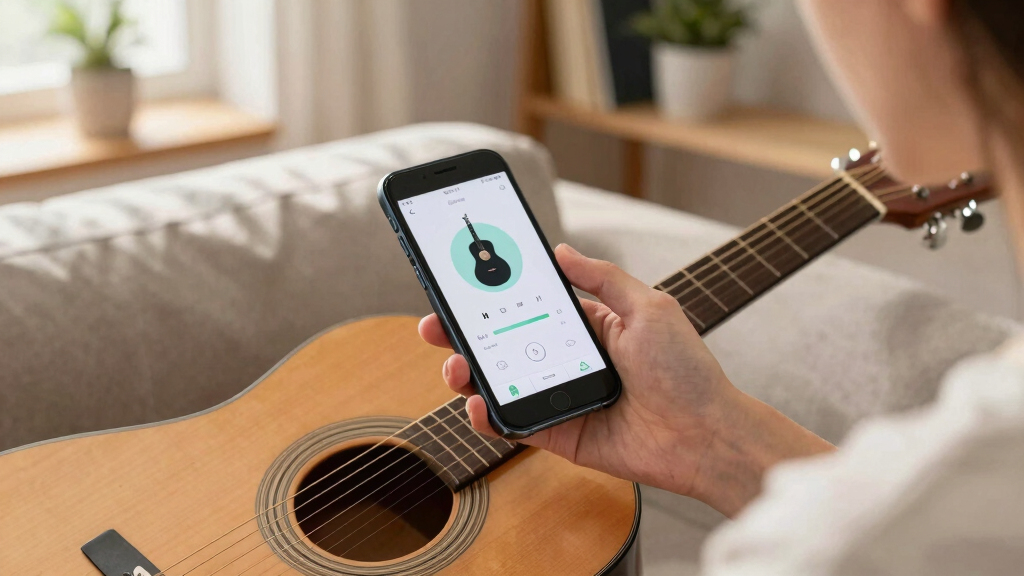
The tuner functions by pressing the phone firmly against the guitar body and plucking a string. It then captures vibration data across the phone’s axes, with the strongest axis indicating the string’s pitch. The system processes raw vibration signals, calculating the combined magnitude and alias correction to determine the actual frequency of the string.
This method was detailed on a project page hosted on Hacker News, where the developer explained that the accelerometer data is used to identify the fundamental frequency of the vibrating string. The system requires motion permission on Android devices and performs best on phones with high-rate IMU sensors. The technique is still experimental but has been demonstrated to work reliably under controlled conditions.
Why It Matters
This development matters because it introduces a hardware-based tuning method that could bypass some limitations of traditional microphone-based tuners, such as background noise interference. For musicians in noisy environments or with devices that have poor microphone quality, this accelerometer-based approach could offer a more accurate and consistent tuning experience.
Additionally, it expands the potential uses of smartphone sensors beyond typical applications, showcasing how existing hardware can be repurposed innovatively. If refined and made more user-friendly, this technology might influence future tuning tools and musical accessories.

Guitar Tuner Free
4 MB
As an affiliate, we earn on qualifying purchases.
As an affiliate, we earn on qualifying purchases.
Background
Traditional guitar tuners rely on microphone input to analyze sound waves and determine pitch. Recent years have seen the rise of clip-on tuners and app-based solutions, but these still depend on audio capture. The use of phone accelerometers for this purpose is a novel idea, first proposed in experimental projects shared online. The concept leverages the fact that vibrating guitar strings produce measurable physical vibrations, which can be detected directly through the phone’s inertial sensors.
This approach is part of broader efforts to utilize smartphone sensors for musical and scientific applications. The developer’s implementation on Hacker News is among the first known attempts to create a practical, hardware-based tuner that does not depend on audio input, potentially reducing latency and improving accuracy in certain conditions.
“Press the phone firmly against the guitar body and pluck a string. Each axis trace shows raw vibration; |a| is the combined magnitude. Pitch is detected from the strongest axis (alias-corrected to the actual string frequency).”
— Developer on Hacker News
“Works best on Android with high-rate IMU sensors and requires motion permission.”
— Project description on Hacker News

Fender FT-1 Professional Guitar Tuner Clip On, with 1-Year Warranty, Full-Range Chromatic Guitar Tuner with Dual-Rotating Hinges, A4 Calibration
One black Fender FT-1 Professional Clip On Tuner for guitar, including electric, bass, acoustic, and more, with dual-rotating…
As an affiliate, we earn on qualifying purchases.
As an affiliate, we earn on qualifying purchases.
What Remains Unclear
It is not yet clear how well the accelerometer-based tuner performs across different guitar types, string gauges, or in noisy environments. The method is still experimental, and user experience may vary. Further testing and development are needed to determine its reliability and accuracy in real-world scenarios.

Fender FCT-2 Professional Multi-Instrument Clip-On Tuner for Guitar, Bass, Ukulele, and Violin
RELIABLE TUNING, NO MATTER WHERE YOU PLAY: By sensing vibrations directly from the instrument, tuning stays accurate in…
As an affiliate, we earn on qualifying purchases.
As an affiliate, we earn on qualifying purchases.
What’s Next
The developer plans to refine the application, improve user interface, and conduct broader testing with musicians. Future updates may include compatibility for iOS devices, enhanced vibration analysis algorithms, and integration into existing tuning apps. Additional research will clarify the method’s effectiveness compared to traditional audio-based tuners.
Fender FCT-2 Professional Multi-Instrument Clip-On Tuner for Guitar, Bass, Ukulele, and Violin
RELIABLE TUNING, NO MATTER WHERE YOU PLAY: By sensing vibrations directly from the instrument, tuning stays accurate in…
As an affiliate, we earn on qualifying purchases.
As an affiliate, we earn on qualifying purchases.
Key Questions
How does the accelerometer-based guitar tuner work?
The tuner detects vibrations from the guitar string by pressing the phone against the guitar body. It then analyzes the raw acceleration data across the device’s axes to determine the string’s pitch, using the strongest axis and alias correction to find the fundamental frequency.
Is this method reliable for all guitar types?
Since the approach is still experimental, its reliability may vary depending on guitar construction, string gauge, and environmental noise. More testing is needed to confirm its effectiveness across different instruments.
Can this work on iPhones or only Android devices?
The current implementation requires high-rate IMU sensors and motion permission on Android. Compatibility with iOS devices has not been confirmed and may require additional development.
How accurate is the pitch detection compared to traditional tuners?
Initial demonstrations suggest it can reliably detect pitch under controlled conditions, but comprehensive accuracy comparisons with standard audio tuners are still pending.