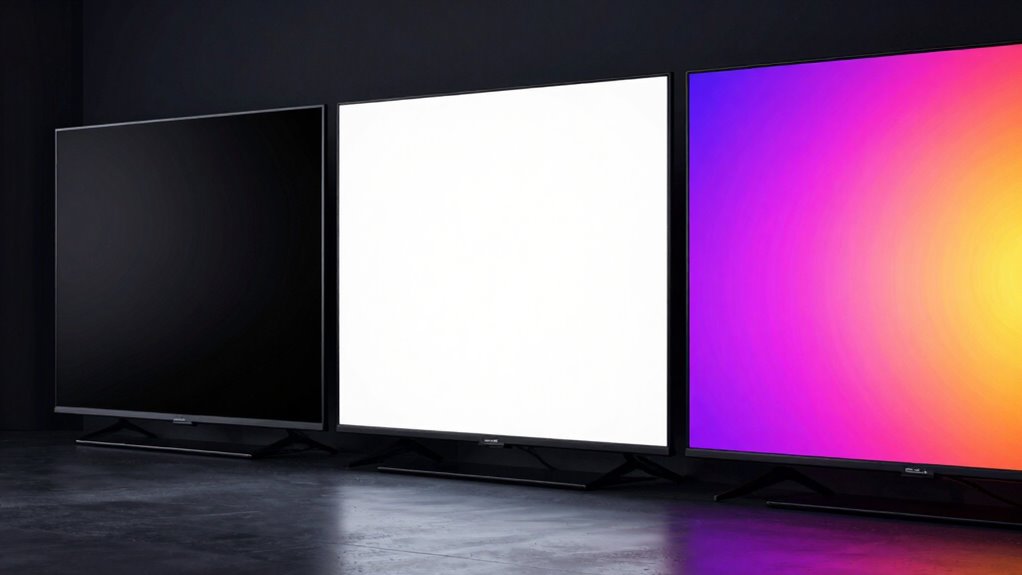
If you’re choosing between OLED, Mini-LED, and QLED, consider what matters most to you. OLED offers deep blacks, exceptional color accuracy, and wide viewing angles, making it perfect for cinematic experiences. Mini-LED provides high contrast and brightness at a lower cost, with less risk of burn-in. QLED excels in bright rooms with vivid colors and higher durability. Want to see which options fit your needs best? Keep exploring for more details.
Key Takeaways
- OLED displays offer perfect blacks and wide viewing angles but are more expensive and prone to burn-in.
- Mini-LEDs provide high contrast, better black levels than traditional LEDs, and are more affordable than OLEDs.
- QLEDs excel in brightness and color vibrancy, ideal for bright environments, but have narrower viewing angles.
- OLEDs are best for cinematic, color-accurate viewing, while Mini-LEDs balance contrast and cost; QLEDs suit bright rooms.
- Consider your environment, budget, and usage to choose the best display type: OLED, Mini-LED, or QLED.
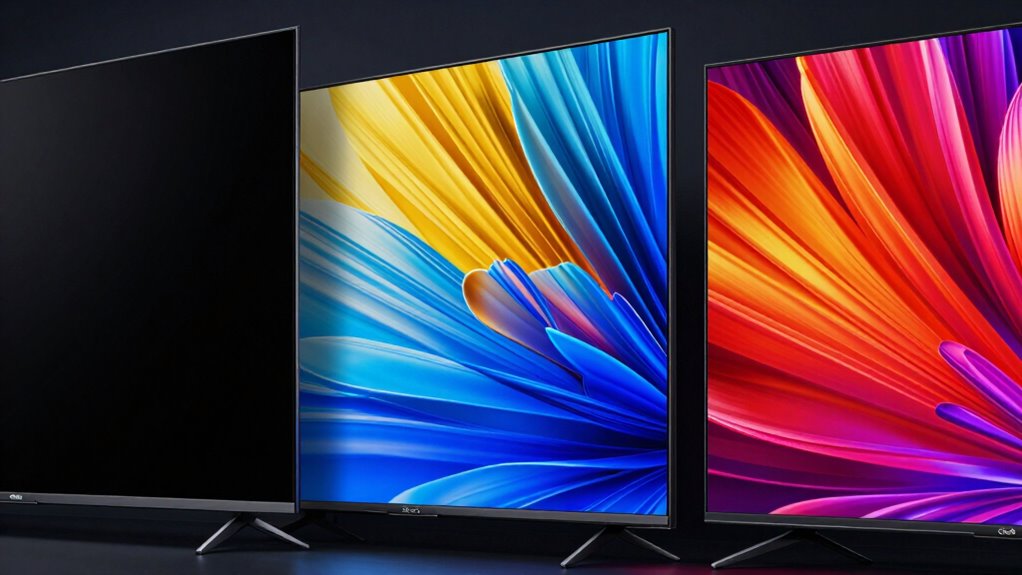
Are you confused about the differences between OLED, Mini-LED, and QLED displays? You’re not alone. These technologies each have their strengths, especially when it comes to color accuracy and viewing angles. Understanding how they compare can help you pick the right screen for your needs.
OLED screens are known for their exceptional color accuracy and deep blacks. Since each pixel emits its own light, they produce vibrant, true-to-life colors with remarkable precision. This pixel-level control also results in excellent viewing angles, meaning the picture stays consistent no matter where you’re sitting—no color shifting or contrast loss. If you prioritize accurate colors and wide viewing angles, OLED is a top choice. However, they can be more expensive, and their pixels are susceptible to burn-in over time, which might be a concern if you watch static images frequently. pixel-level control allows OLED screens to deliver such vivid images, making them ideal for high-quality visual experiences. Additionally, OLED displays tend to have faster response times, which can reduce motion blur during fast-paced scenes.
OLED screens deliver stunning color accuracy and deep blacks with wide viewing angles, but can be costly and prone to burn-in.
Mini-LED displays, on the other hand, are a variation of LED technology that uses thousands of tiny LEDs as backlights. This enables the screen to achieve higher contrast ratios than traditional LED TVs, approaching OLED levels in some cases. While Mini-LEDs don’t emit light from individual pixels, their local dimming zones can be controlled precisely, resulting in better black levels and more accurate contrast. Color accuracy on Mini-LEDs is generally very good—though it may not match OLED’s vibrancy— and they tend to have wider viewing angles than standard LED TVs. They also tend to be more affordable than OLEDs and less prone to burn-in, making them a solid middle-ground option. Furthermore, Mini-LED technology allows for higher peak brightness, which is beneficial for HDR content.
QLED technology, primarily used by Samsung, is a type of LCD panel enhanced with quantum dots. These tiny particles improve color accuracy and brightness considerably, often surpassing OLED in peak brightness. This makes QLEDs especially good in brightly lit environments. However, because they are still LCD panels, their viewing angles can be narrower, with some color and contrast degradation when viewed from the side. While they offer excellent color vibrancy and brightness, their black levels and contrast aren’t quite as deep or uniform as OLEDs. They are generally more durable and less expensive than OLEDs, making them appealing if you want vivid colors and high brightness without worrying about burn-in. The presence of quantum dots helps QLEDs achieve their impressive color performance and high brightness levels.
As an affiliate, we earn on qualifying purchases.
Frequently Asked Questions
How Do These Display Technologies Impact Gaming Performance?
Your gaming performance benefits from these display techs through higher refresh rates and faster response times. OLED screens offer quick response times and deep blacks, reducing motion blur. Mini-LED displays provide bright visuals and smooth gameplay, while QLED screens excel with high brightness and color accuracy. Choosing the right tech depends on your gaming needs, but all can improve your experience by minimizing lag and enhancing image clarity.
Are There Significant Price Differences Between OLED, Mini-Led, and QLED?
They say “you get what you pay for,” and when it comes to OLED, Mini-LED, and QLED, pricing variations reflect quality differences. OLEDs generally cost more due to their superior picture quality, while Mini-LEDs and QLEDs offer more budget-friendly options. The cost comparison shows that investing in OLED might be pricier upfront, but it delivers unmatched contrast and color. Your choice depends on your budget and what features matter most to you.
Which Technology Is Most Future-Proof for Upcoming Content?
You should choose OLED for the most future-proof display. Its superior display longevity and rapid technological advancements make it a strong option. OLED screens offer excellent contrast and color accuracy, which are likely to remain relevant as content quality improves. While Mini-LED and QLED also advance, OLED’s ongoing innovations and durability suggest it will stay ahead in delivering high-quality visuals for upcoming content.
How Do These Screens Perform in Different Lighting Conditions?
You’ll notice OLED screens excel in different lighting conditions because they have perfect blacks and high contrast, making them ideal for dim or dark rooms. Mini-LED and QLED screens perform well in bright ambient light, thanks to their high brightness levels, helping maintain color accuracy and visibility even in well-lit environments. Overall, OLEDs are best in low-light, while Mini-LED and QLEDs handle bright conditions better.
What Are the Environmental Impacts of Manufacturing Each Display Type?
Think of manufacturing each display as planting a seed—each with its environmental footprint. OLED production tends to emit fewer manufacturing emissions but uses rare materials, making recycling more challenging. Mini-LED and QLED screens often involve more intensive manufacturing processes and materials, leading to higher emissions and recycling hurdles. You can help reduce environmental impact by choosing brands that prioritize sustainable practices and effective material recycling.
As an affiliate, we earn on qualifying purchases.
Conclusion
So, now you’re armed with the ultimate showdown between OLED, Mini-LED, and QLED. Imagine choosing a TV so spectacular, it transforms your living room into a cinematic universe—bright, vivid, and jaw-droppingly immersive. Whether you crave perfect blacks, blistering brightness, or vibrant colors, this battle is for your throne. Don’t settle for less—pick the champion that’ll blow your mind and turn every viewing into an unforgettable adventure!
As an affiliate, we earn on qualifying purchases.
As an affiliate, we earn on qualifying purchases.