
📊 Full opportunity report: What Youth-Service Vendors Should Consider When Managing Consent on IdeaNavigator AI — validation score, market gap, and execution plan.

Get the latest gadgets delivered free with Prime
- Fast, free delivery on millions of items
- Prime Video, Amazon Music and more included
- Member-only deals all year
TL;DR
A new product proposal from IdeaNavigator AI identifies parental consent management as an underserved need among youth-service vendors such as camps, coaches, photographers and youth apps. The recommendation follows expanding children’s privacy enforcement under COPPA and state laws, which is pushing small vendors toward defensible, verifiable consent records.
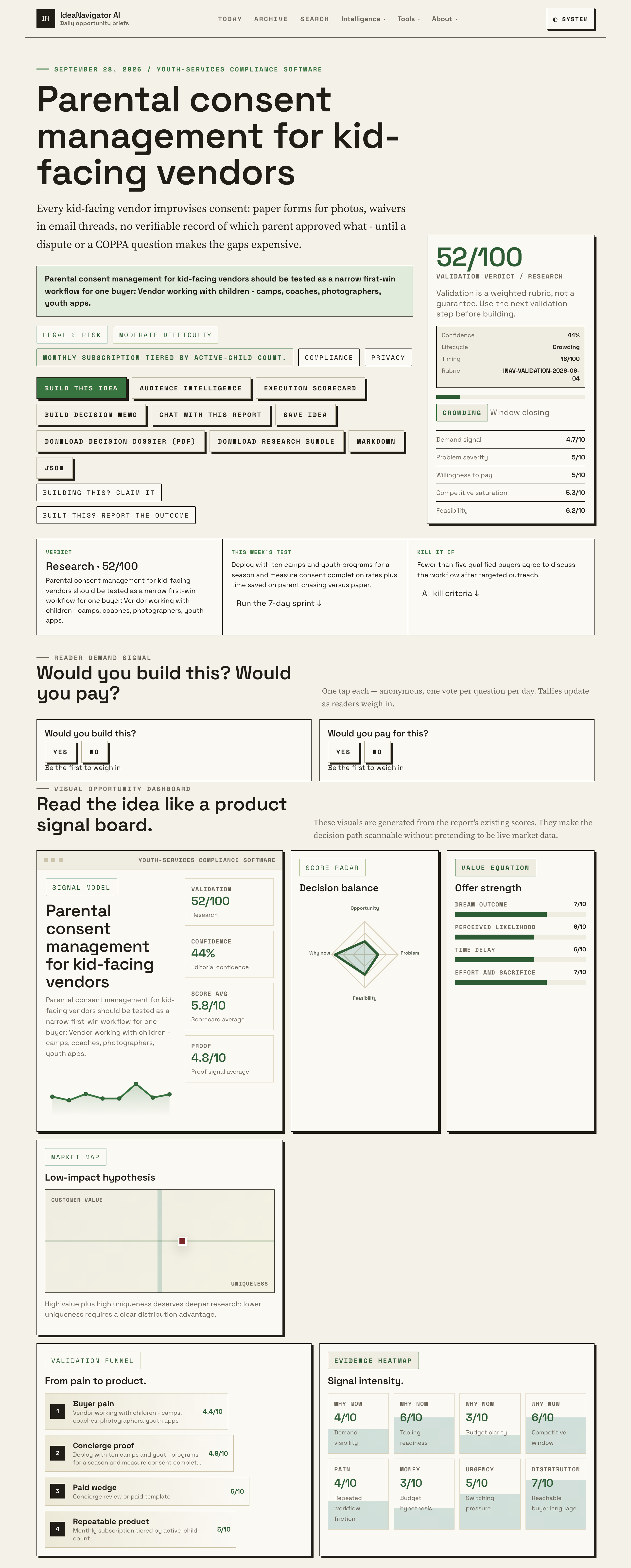
A product analysis published by IdeaNavigator AI recommends that builders target parental consent management as a narrow, high-need workflow for vendors who work with children — camps, coaches, photographers and youth apps — because improvised consent practices are colliding with expanding children’s privacy enforcement. The proposal outlines a subscription-based tool that would replace paper photo-release forms and emailed waivers with vendor-branded consent flows completed on parents’ phones, backed by per-child consent ledgers and audit exports.
According to the analysis, most kid-facing vendors currently manage consent informally: paper forms for photo use, waivers buried in email threads, and no verifiable record of which parent approved what. The proposal argues those gaps become expensive when a dispute arises or a regulator raises a question under the Children’s Online Privacy Protection Act (COPPA).
The proposed minimum viable product would offer vendor-branded consent flows covering photo use, data collection, medical authorization and liability, with identity verification scaled to the risk tier of each consent type. Each child would have a per-child consent ledger, and the system would track expiry dates and support instant audit exports so a vendor could produce records on demand.
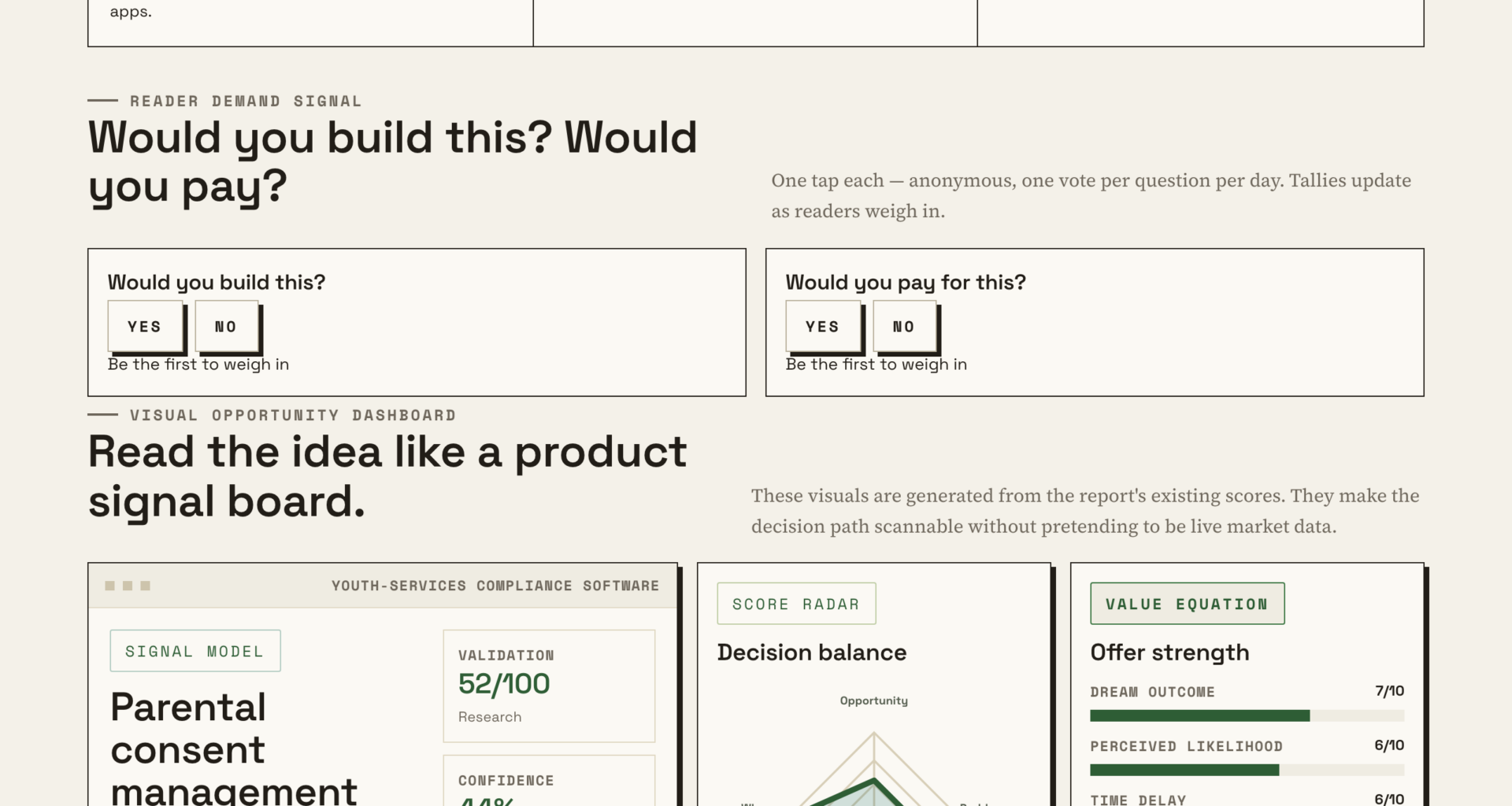
The suggested business model is a monthly subscription tiered by active-child count, placing the product in the youth-services compliance software market. Validation would involve deploying with ten camps and youth programs for a full season and measuring consent completion rates and time saved chasing parents, compared with paper-based processes.
Why Small Vendors Cannot Improvise Anymore
The proposal speaks to a structural shift in how youth-serving businesses handle children’s data and images. According to the analysis, children’s privacy enforcement is expanding through COPPA updates and new state laws, while parents are increasingly likely to challenge how photos and data about their children are used. That combination pushes even very small operators — a single coach or a seasonal camp — toward consent records they can actually defend.
For software builders, the recommendation frames consent management as a narrow first-win workflow: a focused tool with a clear buyer and measurable outcomes, rather than a broad compliance platform. For vendors, the value proposition is reduced administrative time and reduced exposure when a parent or regulator asks who approved what, and when.
Products Worth Considering

Logitech MX Mechanical Wireless Illuminated Keyboard, Tactile Quiet, Graphite

Kindle Paperwhite Signature Edition 32GB (2024 Model) – Metallic Black

Sony WH-1000XM6 Wireless Noise-Canceling Headphones, Black
As an affiliate, we earn on qualifying purchases.
The Paper-to-Digital Consent Gap
: “Consent for youth activities has traditionally lived on paper: photo release forms signed at registration, medical authorizations filed in a binder, and liability waivers stapled to enrollment packets. The IdeaNavigator AI analysis characterizes this as an improvisation problem — records exist, but they are not verifiable, not searchable, and not tied to a specific parent’s verified approval.
The backdrop is a tightening regulatory environment. COPPA governs the online collection of personal information from children under 13 in the United States, and the analysis notes that updated COPPA rules and a growing set of state-level children’s privacy laws are expanding what vendors must be able to demonstrate. Youth apps face the most direct obligations, but offline vendors such as camps and photographers increasingly interact with children’s data and images in ways that draw scrutiny.
Unvalidated Assumptions in the Proposal
The proposal is a strategic recommendation, not a validated result. No product has been built or measured against the benchmarks it describes. The claimed value — higher consent completion rates and time saved versus paper — would only be established after the suggested validation step: a season-long deployment with ten camps and youth programs.
Several questions remain open, according to the proposal’s own framing. It does not specify what level of identity verification is sufficient for each risk tier, how the tool would handle custody disputes or non-custodial parents, whether it would be positioned as providing legal compliance, or how it would keep pace with differing state requirements. Pricing tiers based on active-child count have not been tested against what small seasonal vendors would actually pay.
The Ten-Camp Validation Season
Under the proposal’s roadmap, the next step is a validation pilot: deploying the consent tool with ten camps and youth programs for one season and measuring two metrics — consent completion rates and time saved chasing parents compared with paper. Those results would determine whether the workflow justifies a broader product. Builders following the recommendation would also need to decide verification standards, expiry policies and audit-export formats before launch. Whether any vendor adopts the approach, and whether regulators treat such ledgers as adequate records, remains to be seen.
Source: IdeaNavigator AI
Key Questions
What is parental consent management software?
It is a tool that lets vendors who work with children collect, record and verify parental approvals digitally — for photo use, data collection, medical authorization and liability — instead of relying on paper forms or email. The version proposed by IdeaNavigator AI includes per-child consent ledgers, expiry tracking and audit exports.
Which vendors would use this type of tool?
The proposal targets kid-facing vendors specifically: camps, coaches, photographers and youth apps. These businesses regularly need parental approval for photos, data handling, medical situations and liability waivers, but typically lack verifiable records of those approvals.
Why is this being recommended now?
According to the analysis, children’s privacy enforcement is expanding through COPPA updates and new state laws, and parents are increasingly challenging photo and data use. Together these trends push small vendors toward consent records they can defend in a dispute or regulatory inquiry.
Has the product been built or tested?
No. The IdeaNavigator AI document is a product-strategy proposal. Its value claims — improved consent completion rates and time saved versus paper — are untested and would be validated only through a season-long pilot with ten camps and youth programs.
How would such a product make money?
The proposal suggests a monthly subscription model priced in tiers based on the number of active children served, placing the product in the youth-services compliance software market.
Source: IdeaNavigator AI