
📊 Full opportunity report: Real-Time Business Closure Alerts: Transforming Asset Buying Strategies on IdeaNavigator AI — validation score, market gap, and execution plan.
TL;DR
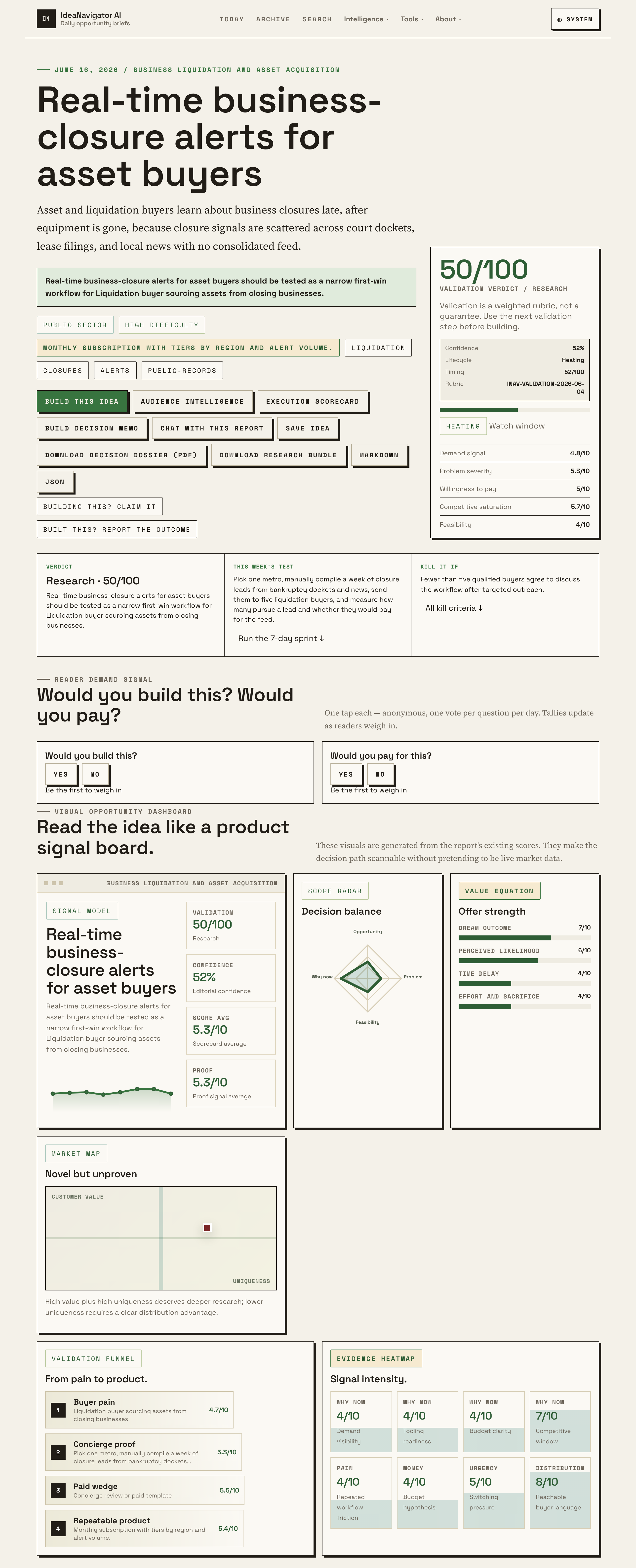
A new system for real-time alerts on business closures is being tested to help liquidation buyers act faster. This innovation could reshape asset acquisition, especially in a post-pandemic environment with elevated closures.
Real-time alerts for business closures are being tested as a new tool to assist liquidation and asset buyers in sourcing assets more efficiently. The initiative aims to address delays in discovering business closures, which currently hinder timely asset acquisition, especially in a landscape with rising small-business bankruptcies post-pandemic.
The proposed system involves a manually curated daily alert where buyers specify a region and asset category. Human analysts then scan bankruptcy dockets and local news to identify closures matching the criteria, providing details such as business type, estimated asset value, and closure timeline. This approach is designed to deliver timely, actionable information directly to asset buyers.
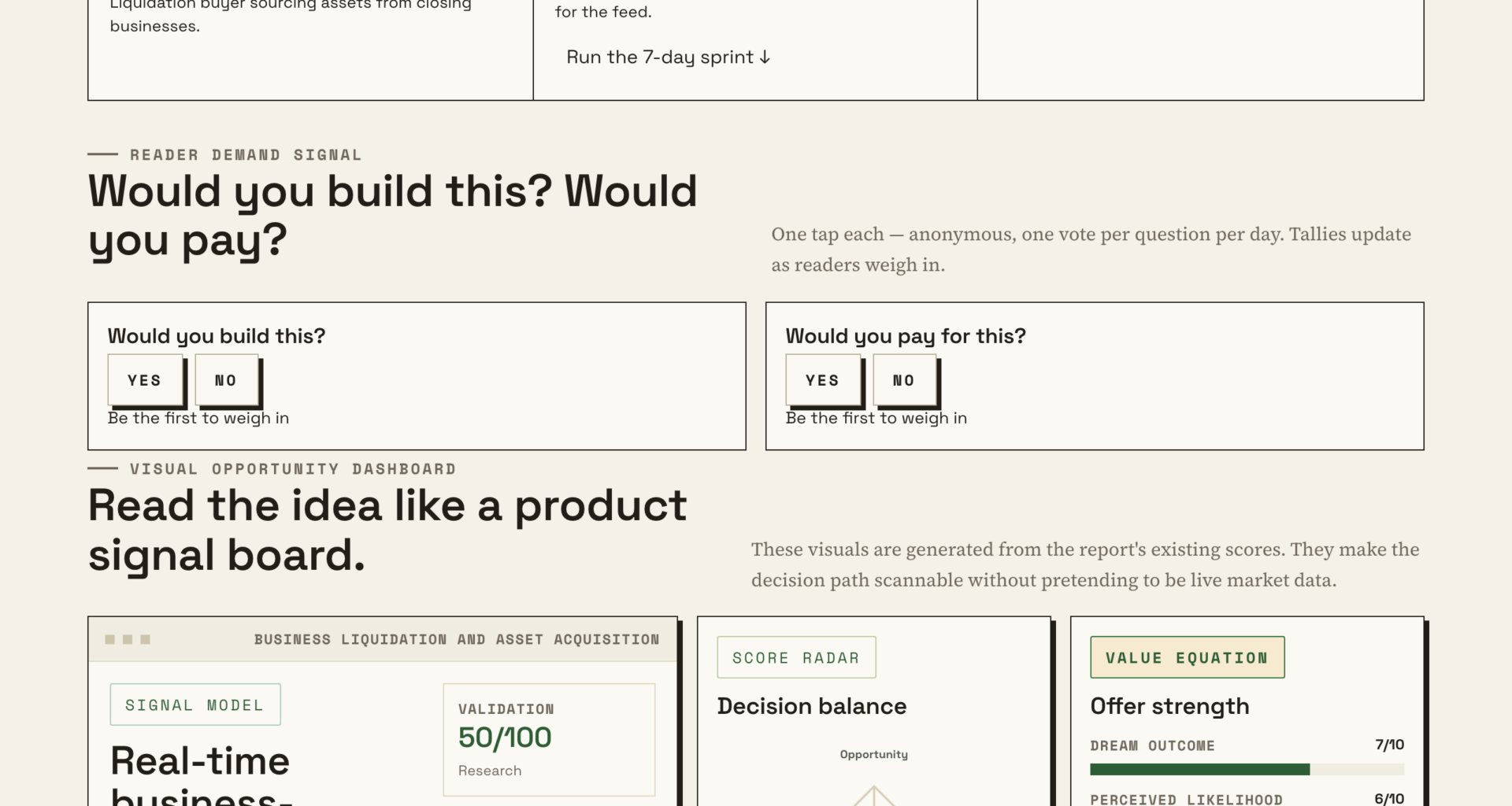
According to sources involved in the project, the goal is to test whether this method increases the likelihood of pursuing closure leads and whether buyers are willing to pay for such a feed. The model envisions a subscription-based revenue stream, with tiers based on region and alert volume.
The market focus is on business liquidation and asset acquisition, with initial validation through a pilot in a single metropolitan area. The test involves compiling closure leads over a week, then measuring buyer engagement and willingness to pay.
Potential Impact on Asset Acquisition Strategies
This development could significantly alter how liquidation and asset buyers identify and act on business closures. Currently, the scattered nature of closure signals—spread across court dockets, lease filings, and local news—causes delays that reduce asset value recovery. Real-time alerts could enable buyers to act sooner, increasing the chances of acquiring valuable equipment and inventory before they are sold or removed.
In a post-pandemic environment where small-business closures remain elevated, such a system offers a timely, scalable solution to a longstanding problem. If proven effective, it could lead to broader adoption and potentially reshape the asset liquidation market by making closure signals more accessible and actionable.

Epson Workforce ES-50 Compact & Lightweight Mobile Document Scanner
- Portability: Lightweight, mobile document scanner
- Fast Scanning: Single page in 5.5 seconds
- Compatibility: Works with Windows and Mac
As an affiliate, we earn on qualifying purchases.
As an affiliate, we earn on qualifying purchases.
Rise in Business Closures and Electronic Filing Accessibility
Small-business closures and bankruptcies have remained high following the pandemic, creating a steady stream of liquidation opportunities. Traditionally, information about closures was difficult to access quickly, as signals were scattered across various sources and often delayed. However, the increasing digitization of bankruptcy filings, lease records, and local news reports now enables the possibility of real-time aggregation.
Initial efforts to improve asset sourcing have focused on manual compilation and alerts, but technological advancements suggest that automated, real-time feeds could be on the horizon if pilot tests prove successful. This initiative aligns with broader trends toward digital transformation in asset liquidation and distressed asset markets.
“Real-time alerts could dramatically improve the speed and efficiency of asset acquisition, especially in a market with rising business closures.”
— an anonymous researcher

Short Term Business Closure We Will Return Soon Notice Sign, 8"x12" Aluminum Tin, Temporary Service Alert for Office Shop Outdoor Customer Reception Area
- High Visibility and Professional Design: Bold lettering on 8×12 inch aluminum sign
- Weatherproof and UV Resistant: Durable 40 Mil aluminum with rust-resistant coating
- Easy to Install: Pre-drilled holes for quick mounting
As an affiliate, we earn on qualifying purchases.
As an affiliate, we earn on qualifying purchases.
Unconfirmed Effectiveness and Buyer Adoption Rates
It is not yet clear how many buyers will find the alerts valuable or whether the manual process can be scaled effectively. The pilot is still in early stages, and data on buyer engagement, willingness to pay, and actual asset acquisition outcomes are forthcoming. Additionally, the accuracy of closure detection and the timeliness of alerts remain to be validated in real-world conditions.
asset acquisition tools for liquidation
As an affiliate, we earn on qualifying purchases.
As an affiliate, we earn on qualifying purchases.
Next Steps in Validation and Potential Expansion
The immediate next step involves completing the pilot in a selected metropolitan area, analyzing buyer response, and refining the alert process. Success could lead to broader testing across multiple regions and the development of automated aggregation tools. If the system demonstrates clear benefits, subscription models may be expanded, and integration with existing liquidation platforms could follow.
business bankruptcy liquidation equipment
As an affiliate, we earn on qualifying purchases.
As an affiliate, we earn on qualifying purchases.
Key Questions
How does the real-time alert system work?
The system involves human analysts manually scanning bankruptcy dockets and local news daily, then sending alerts to buyers based on specified regions and asset categories.
What assets are covered by this alert system?
The focus is on business assets such as equipment, inventory, and other liquidation-worthy items from closed businesses.
Will this system replace automated data feeds?
Currently, it is a manual pilot, but success could lead to automation and integration with existing platforms for broader, faster coverage.
How much will the subscription cost?
Pricing details are still under development, with plans for tiered subscriptions based on region and alert volume.
When will the pilot results be available?
Results are expected after a week of data collection and analysis, with further development contingent on initial success.
Source: IdeaNavigator AI