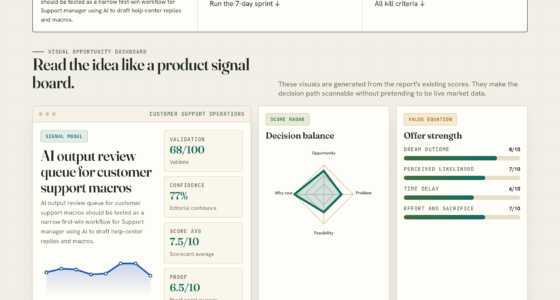
📊 Full opportunity report: Key Steps To Using Automation-Flow Rebuilders In Email Migrations on IdeaNavigator AI — validation score, market gap, and execution plan.

Get the latest gadgets delivered free with Prime
- Fast, free delivery on millions of items
- Prime Video, Amazon Music and more included
- Member-only deals all year
TL;DR

An email platform migration tool that automates the rebuilding of automation flows is emerging as a solution for agencies. It connects source and target accounts, exports flow structures, and rebuilds them with verification, promising efficiency gains. This approach is still being validated across initial migrations.
Automation-flow rebuilders for email platform migrations are emerging as a promising solution for agencies seeking to reduce manual effort and errors when transferring client accounts between email marketing platforms. These tools, now enabled by API access and language models, aim to automate the complex process of recreating automation workflows, which traditionally involves significant manual labor and risk of mistakes.
The core concept involves connecting source and target email accounts through a specialized tool that can extract the entire structure of automation flows, including triggers, branches, delays, and content. Once exported, the tool uses language models to interpret and translate these components into the target platform’s native format, then rebuilds the flows automatically. An exceptions report highlights any steps that cannot be directly mapped, allowing for review and manual adjustment.
This process transforms what was once a weeks-long, manual task into a mostly automated workflow, with the potential to significantly cut down migration time and reduce errors. The initial focus is on agency-led migrations, where the tool can be sold as a per-migration service, with pricing tiered by flow count. Validations are ongoing, with early tests involving ten real agency migrations to measure rebuild hours, error rates, and overall efficiency gains.
Efficiency Gains and Reduced Manual Effort in Migrations
This development matters because it addresses a key pain point for marketing agencies: the labor-intensive and error-prone process of migrating automation workflows between email platforms. By automating the extraction, translation, and rebuilding of flows, agencies can save time, minimize human error, and deliver faster migrations for clients. The approach also opens new revenue opportunities, as agencies can offer fixed-fee migration services with higher margins.
Furthermore, as API access to flow structures becomes more common and language models improve, the accuracy and scope of these rebuilders are expected to expand. This could lead to widespread adoption and a fundamental shift in how email migrations are handled, making them more predictable and less disruptive for clients.
email automation flow builder software
As an affiliate, we earn on qualifying purchases.
As an affiliate, we earn on qualifying purchases.
Growing Need for Automated Migration Solutions
Traditionally, migrating email automation flows has been a manual, time-consuming process, often requiring dozens of hours of work per client. This is especially burdensome when moving between platforms like Mailchimp and Klaviyo, which have different paradigms and markup languages for automation. Agencies have often deferred migrations or accepted errors to avoid the manual effort.
Recent developments in API access to flow structures and advances in language models have created the opportunity for automation tools to interpret and replicate automation flows automatically. Early prototypes and pilot programs indicate that such tools can accurately export flow configurations, translate them into the target platform’s syntax, and rebuild flows with minimal human intervention. The current focus is on validating these tools through real-world migrations and measuring efficiency gains.
As an affiliate, we earn on qualifying purchases.
Validation Status and Limitations of Current Tools
While initial tests show promise, it is not yet clear how accurately these rebuilders can handle complex or highly customized flows. Some steps, such as advanced branching logic or platform-specific content, may not be fully mappable, requiring manual intervention. The scope of supported platforms and flow types is still being defined, and long-term reliability remains to be proven in broader deployments.
API-based email workflow migration tool
As an affiliate, we earn on qualifying purchases.
As an affiliate, we earn on qualifying purchases.
Next Steps for Validation and Broader Adoption
The next phase involves deploying the tool across multiple agency migrations to measure time savings, error rates, and client satisfaction. Developers are also working on expanding platform compatibility, refining the translation algorithms, and improving the user verification interface. Results from these pilots will determine whether the tool can be commercially scaled and integrated into standard migration workflows.
email marketing automation platform
As an affiliate, we earn on qualifying purchases.
As an affiliate, we earn on qualifying purchases.
Key Questions
How does the automation-flow rebuilder work?
The tool connects to source and target email accounts via API, exports the entire flow structure, uses language models to interpret and translate the components, then rebuilds the flows in the target platform with an exceptions report for any unmappable steps.
What are the main benefits of using this tool?
It reduces manual labor, minimizes errors, speeds up migrations, and allows agencies to offer fixed-fee services with higher margins.
What limitations currently exist?
The accuracy of translation for complex flows varies, and some steps may require manual adjustments. Compatibility is still being expanded, and long-term reliability is under evaluation.
When will this tool be widely available?
Validation is ongoing; broader commercial availability depends on successful pilot results, which are expected within the next few months.
Can this tool handle all email platforms?
Currently, focus is on popular platforms like Mailchimp and Klaviyo, but future versions aim to support additional platforms as API access and translation capabilities improve.
Source: IdeaNavigator AI
Halloween Picks
halloween
As an affiliate, we earn on qualifying purchases.