
If you’re looking for the best PoE Ethernet switches in 2025, I recommend options that combine reliable power delivery with fast, stable network performance. Look for models offering PoE+ support, ample port counts, and management features to suit both small and large setups. Many switches include fiber uplinks, extended distances, and energy-efficient standards to future-proof your network. Keep in mind environmental durability and installation flexibility. If you stick around, you’ll find detailed insights to help make the right choice.
Key Takeaways
- Look for switches supporting PoE+ (IEEE 802.3at/af) with high power budgets up to 380W for powering multiple devices reliably.
- Prioritize models with managed features like VLAN, QoS, and remote management for enhanced network control and security.
- Opt for switches with fiber uplink options and extended transmission distances to ensure scalable and flexible network setups.
- Choose fanless, durable designs suitable for quiet environments and long-term reliability in various deployment settings.
- Consider models offering comprehensive warranties and environmental protections for sustained performance and peace of mind.
TP-Link TL-SG1005P 5 Port Gigabit PoE Switch

If you’re looking for a reliable PoE switch for small to medium-sized networks, the TP-Link TL-SG1005P is an excellent choice. It offers five Gigabit ports, with four supporting PoE+ to power devices like cameras and VoIP phones, and one non-PoE port for high-speed connectivity. The switch delivers up to 30W per port, with a total power budget of 65W, ensuring efficient device operation. Its fanless design keeps it silent, and the sturdy metal case allows for desktop or wall mounting. Plug-and-play setup makes deployment quick and easy, making this switch a versatile and dependable solution for various environments.
Best For: small to medium-sized businesses or home offices needing a reliable, easy-to-install PoE switch for powering cameras, VoIP phones, and access points.
Pros:
- Supports 4 PoE+ ports with up to 30W per port, ideal for powering multiple devices simultaneously.
- Fanless design ensures silent operation, suitable for quiet work environments.
- Plug-and-play setup allows for quick and straightforward installation without requiring additional configuration.
Cons:
- Limited to a total power budget of 65W, which may be insufficient for larger or more power-hungry setups.
- Only one non-PoE port, reducing flexibility if more high-speed connections are needed.
- Lacks advanced management features found in higher-end switches, limiting customization options.
TP-Link LS108GP 8-Port PoE Gigabit Ethernet Switch
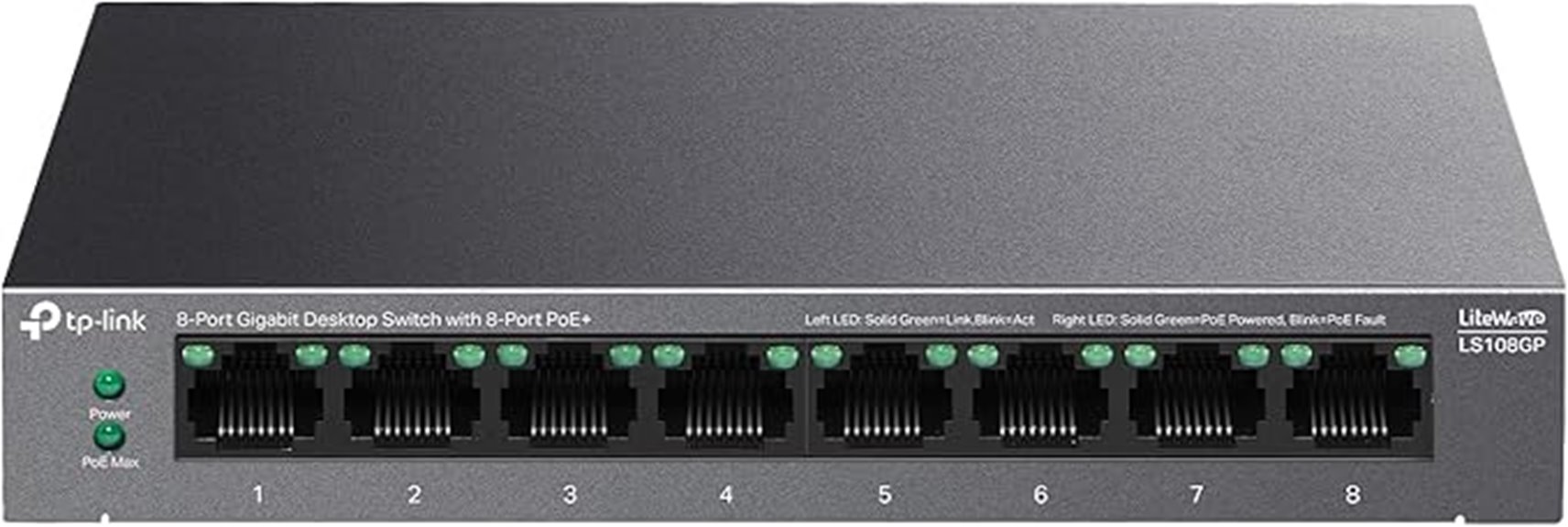
The TP-Link LS108GP stands out as a top choice for small to medium-sized businesses seeking a reliable, silent, and easy-to-deploy PoE switch. Its compact metal design allows flexible placement on desktops or wall mounting, fitting seamlessly into various environments. With 8 PoE+ ports supporting up to 30W each and a total power budget of 65W, it efficiently powers IP cameras, VoIP phones, and access points. The switch offers fast 16 Gbps switching capacity and extended transmission distances up to 820 feet with Extend Mode. Its fanless operation guarantees silent performance, making it ideal for noise-sensitive spaces. Plus, its plug-and-play setup simplifies deployment.
Best For: small to medium-sized businesses seeking a reliable, silent, and easy-to-deploy PoE switch for powering IP cameras, VoIP phones, and wireless access points.
Pros:
- Compact metal design with flexible desktop or wall-mount installation options.
- Supports 8 PoE+ ports with up to 30W per port and a total power budget of 65W.
- Fanless operation ensures silent performance, ideal for noise-sensitive environments.
Cons:
- Limited PoE power budget may restrict the number of high-power devices connected simultaneously.
- No advanced management features for enterprise-level network control.
- Extended Mode transmission distance of up to 820 feet may require careful placement for optimal coverage.
NETGEAR 8 Port PoE Gigabit Ethernet Managed Switch (GS308EP)
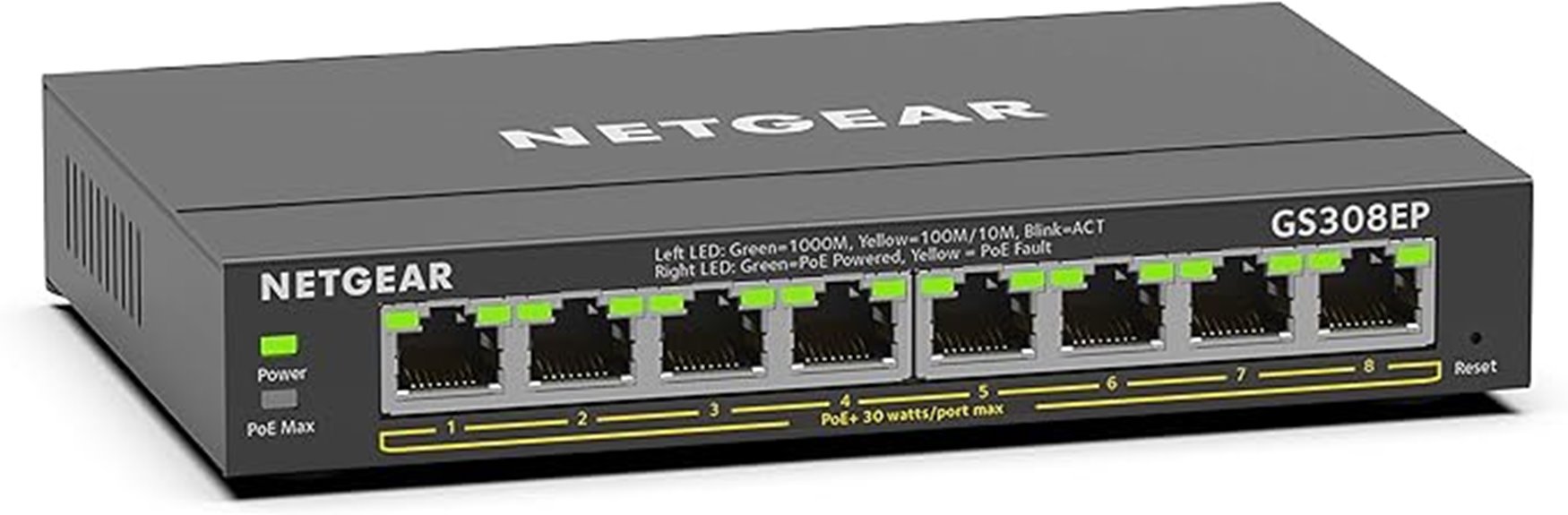
For those seeking a reliable and easy-to-manage PoE switch, the NETGEAR 8 Port PoE Gigabit Ethernet Managed Switch (GS308EP) stands out. It offers 8 Gigabit Ethernet ports, all with PoE+ support and a total power budget of 62W, making it ideal for small to medium setups. The switch features user-friendly Easy Smart Managed Essentials software, allowing straightforward configuration, security, and network monitoring. You can install it on a desktop or wall mount, providing flexible deployment options. Plus, it’s backed by a robust 3-year warranty, giving you peace of mind with its durability and performance.
Best For: small to medium businesses or home offices seeking a reliable, easy-to-manage PoE switch for network expansion and device powering.
Pros:
- User-friendly Easy Smart Managed Essentials software for simple setup and management
- Supports 8 PoE+ ports with a total power budget of 62W, ideal for powering multiple devices
- Flexible installation options, including desktop placement and wall mounting
Cons:
- Limited total PoE power budget may not support high-power devices simultaneously
- Basic managed features may not meet advanced networking needs
- No additional features like SFP ports for fiber connectivity
NETGEAR 5-Port PoE Gigabit Ethernet Switch (GS305P)
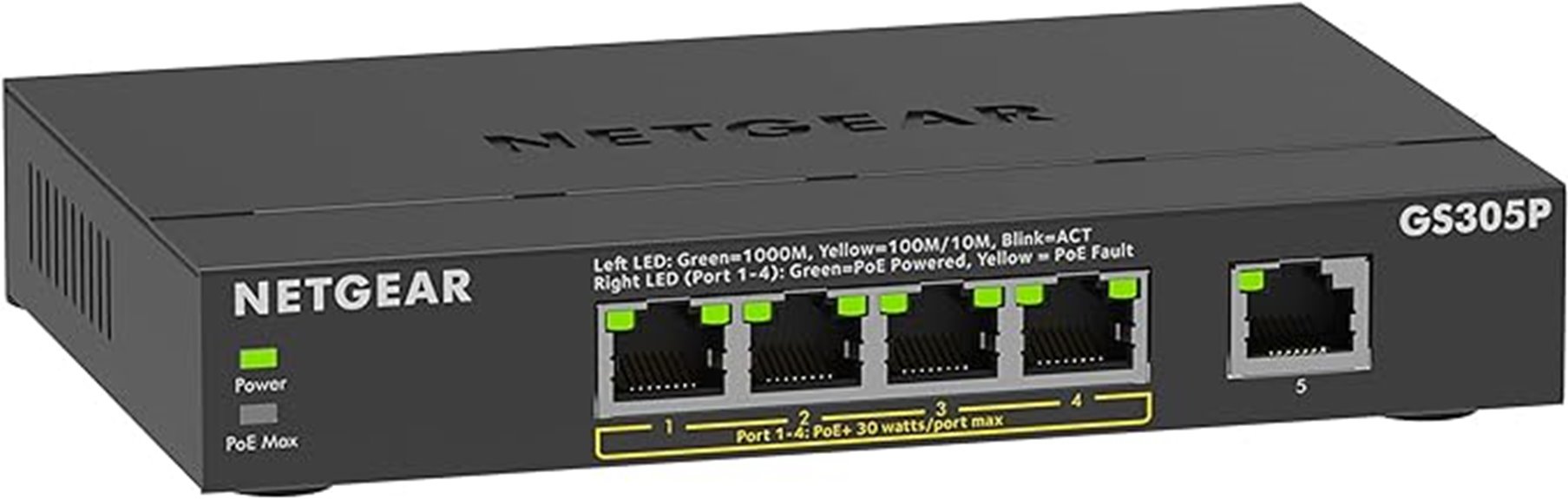
The NETGEAR 5-Port PoE Gigabit Ethernet Switch (GS305P) is an excellent choice for small offices and home setups that need reliable power over Ethernet without complex configuration. It features five gigabit ports, including four PoE+ ports with a total power budget of 63W, ideal for powering IP cameras, VoIP phones, and wireless access points. Its plug-and-play design requires no software setup, making installation quick and straightforward. The switch supports energy-efficient IEEE802.3az and operates silently, perfect for noise-sensitive environments. Its compact, desktop or wall-mountable form factor and a solid 3-year warranty make it a dependable, hassle-free solution for small-scale networking needs.
Best For: small offices and home users seeking a reliable, easy-to-install PoE switch for powering IP devices with minimal setup.
Pros:
- Plug-and-play setup requiring no software or configuration
- Compact design suitable for desktop or wall mounting
- Energy-efficient operation compliant with IEEE802.3az
Cons:
- Limited to 5 ports, which may be insufficient for larger networks
- Total PoE power budget of 63W might not support multiple high-power devices simultaneously
- No advanced management features for network customization
TP-Link TL-SG116P 16 Port Gigabit PoE Switch
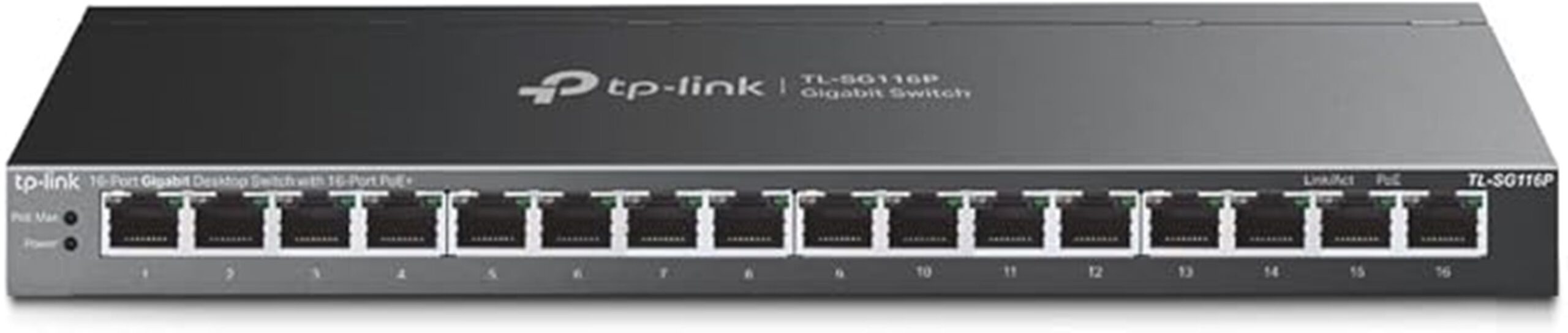
If you’re seeking a reliable, high-performance PoE switch for small to medium-sized networks, the TP-Link TL-SG116P stands out with its 16 Gigabit ports and support for IEEE 802.3at/af standards. It delivers up to 30W per port, with a total power budget of 120W, making it suitable for powering security cameras, Wi-Fi access points, and VoIP phones. The switch is plug-and-play, ensuring easy setup, and features Extend Mode, allowing data and power transmission up to 250 meters at reduced speeds. Its fanless design guarantees silent operation, while Priority and Isolation modes enhance network security and performance. Backed by a 3-year warranty, it’s a solid choice.
Best For: small to medium-sized businesses seeking a reliable, high-performance PoE switch to power security cameras, VoIP phones, and Wi-Fi access points with easy installation and secure network features.
Pros:
- Supports up to 16 Gigabit PoE+ ports with a total power budget of 120W for multiple device connections
- Extend Mode allows data and power transmission up to 250 meters, ideal for surveillance setups
- Fanless design ensures silent operation and increased durability
Cons:
- Power per port is limited to 30W, which may not be sufficient for high-power devices
- Speed reduces to 10 Mbps when using Extend Mode over longer distances
- Requires manual configuration for PoE Auto Recovery feature
NETGEAR 8-Port Gigabit Ethernet PoE Switch (GS108PP)

The NETGEAR 8-Port Gigabit Ethernet PoE Switch (GS108PP) stands out as an excellent choice for small to medium-sized networks that need reliable, straightforward power over Ethernet. It offers eight Gigabit ports, all supporting PoE+ with a total power budget of 123W, perfect for powering IP cameras, VoIP phones, or wireless access points. Its versatile design allows desktop, wall, or rackmount installation, and setup is simple—just plug in and go. The energy-efficient design reduces power consumption, and silent operation makes it ideal for quiet environments. Plus, the warranty and support guarantee peace of mind for long-term network stability.
Best For: small to medium-sized businesses or home offices seeking a reliable, easy-to-install PoE switch to power IP cameras, VoIP phones, and wireless access points.
Pros:
- Simple plug-and-play setup with no software or configuration needed
- Supports PoE+ with a generous 123W power budget for multiple devices
- Energy-efficient design and silent operation suitable for quiet environments
Cons:
- Limited to unmanaged, no advanced management features
- Designed for use in U.S. and Canada only, not suitable for international deployment
- Lacks additional security or VLAN features found in managed switches
TP-Link 5 Port Fast Ethernet PoE Switch

Designed for small to medium-sized networks, the TP-Link 5 Port Fast Ethernet PoE Switch offers a reliable solution with its 4 PoE+ ports delivering up to 30W each. Its sturdy metal casing and fanless design guarantee quiet, durable operation, suitable for various environments. The switch features plug-and-play setup, with no need for software configuration. With a total PoE budget of 67W, it supports PoE Auto Recovery and extend mode, enabling data and power transmission up to 250 meters. Priority mode ensures critical devices get the bandwidth they need, making this switch ideal for surveillance, VoIP, and other network applications.
Best For: small to medium-sized businesses or home networks requiring reliable, quiet, and easy-to-manage PoE networking solutions.
Pros:
- Plug-and-play setup with no software required for quick deployment
- Supports PoE Auto Recovery and extend mode for flexible device connection distances
- Durable metal casing with fanless design ensures quiet operation and longevity
Cons:
- Limited to 10/100 Mbps ports, which may not suffice for high-bandwidth applications
- Only one non-PoE port available, restricting certain network configurations
- Slightly lower overall power budget compared to larger switches for extensive PoE device setups
18-Port Ethernet Gigabit PoE Switch with 16 PoE Ports and 2 Uplink Ports
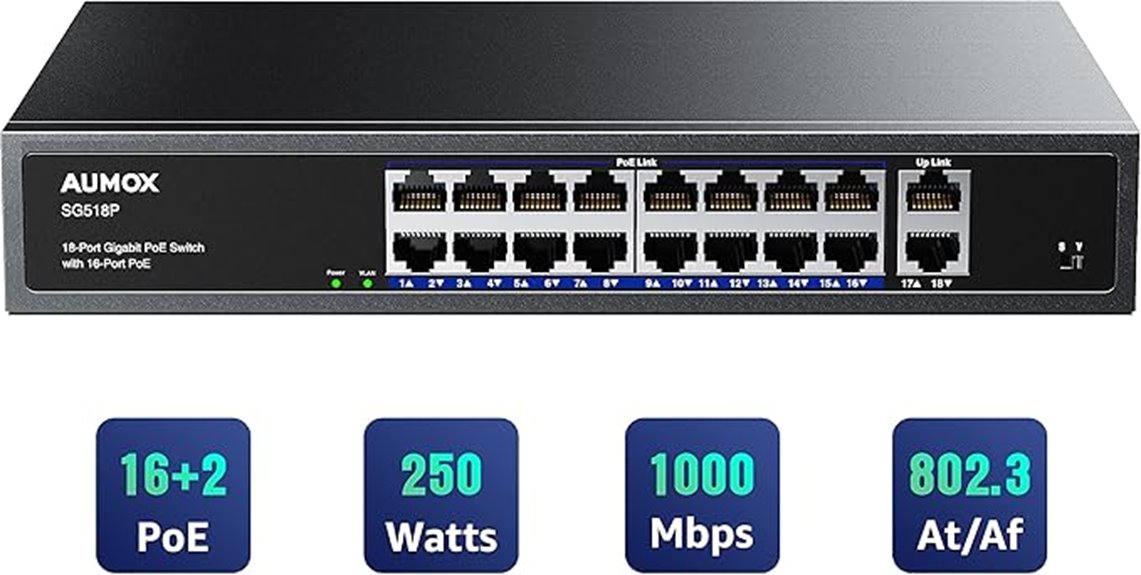
For network setups demanding high power and versatile connections, the Port Ethernet Gigabit PoE Switch with 16 PoE ports and 2 uplink ports stands out as an ideal solution. It features 18 gigabit ports, supporting fast data transfer and traffic optimization. Its built-in 250W power supply guarantees reliable power to devices like cameras and WiFi access points. The sturdy metal casing ensures durability and quiet operation, while flexible installation options—desktop, wall, or rack—make deployment simple. Plug-and-play setup and VLAN security features further streamline management, making this switch perfect for expanding high-performance, PoE-powered networks.
Best For: small to medium-sized businesses or network environments needing high-speed, reliable PoE-powered connections with flexible installation options.
Pros:
- Supports 16 PoE ports with up to 30W power per port, ideal for powering multiple PoE devices simultaneously.
- Built-in 250W power supply eliminates the need for external adapters, simplifying setup.
- Durable metal casing and multiple installation options (desktop, wall, rack) for versatile deployment.
Cons:
- Limited total power budget of 250W may restrict the number of high-power PoE devices connected simultaneously.
- No advanced management features such as network monitoring or configurable VLANs beyond one-key VLAN.
- Lacks fiber optic uplink options, which could limit scalability in larger networks.
NETGEAR 26-Port PoE Gigabit Ethernet Smart Switch
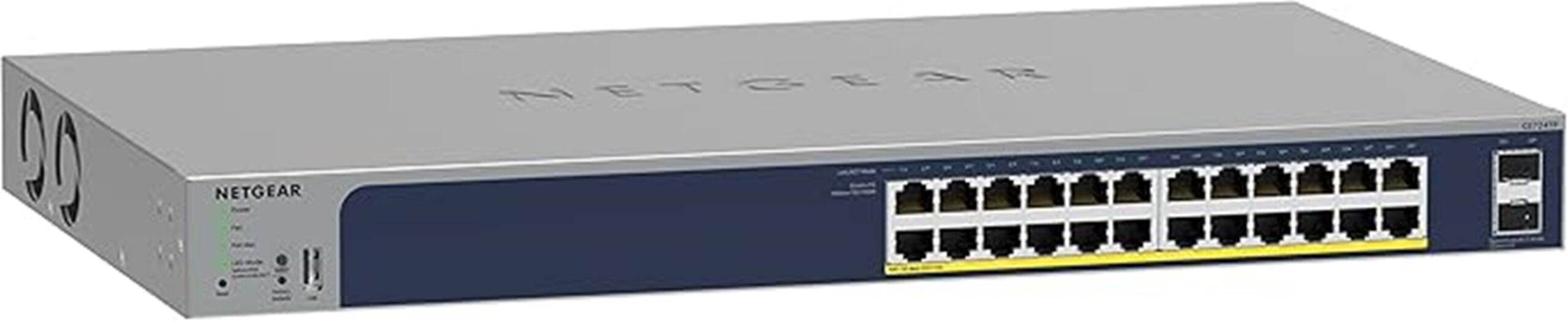
If you’re seeking a versatile and reliable switch for a busy office or small business, the NETGEAR 26-Port PoE Gigabit Ethernet Smart Switch stands out with its managed features and extensive port options. It offers 24 PoE+ ports with a total power budget of 190W, perfect for powering IP cameras, VoIP phones, and wireless access points. Plus, it includes 2 SFP ports for fiber connectivity, ensuring flexible deployment. Its smart management software provides secure setup, SNMP management, and remote control via NETGEAR Insight. Designed for quiet operation and energy efficiency, it also comes with a lifetime warranty and next-day support, making it a dependable choice.
Best For: small to medium-sized offices or businesses seeking a reliable, managed PoE switch with flexible fiber connectivity options.
Pros:
- Supports 24 PoE+ ports with a 190W power budget, ideal for powering multiple devices simultaneously.
- Includes 2 SFP ports for fiber optic connections, offering flexible network deployment.
- Managed with intuitive software supporting SNMP, remote access via NETGEAR Insight, and secure setup.
Cons:
- Designed primarily for use in the U.S. & Canada, limiting international compatibility.
- No additional redundant power supply options are offered.
- May be overkill for very small or home office setups with fewer network devices.
NETGEAR 16-Port PoE+ Gigabit Ethernet Unmanaged Switch
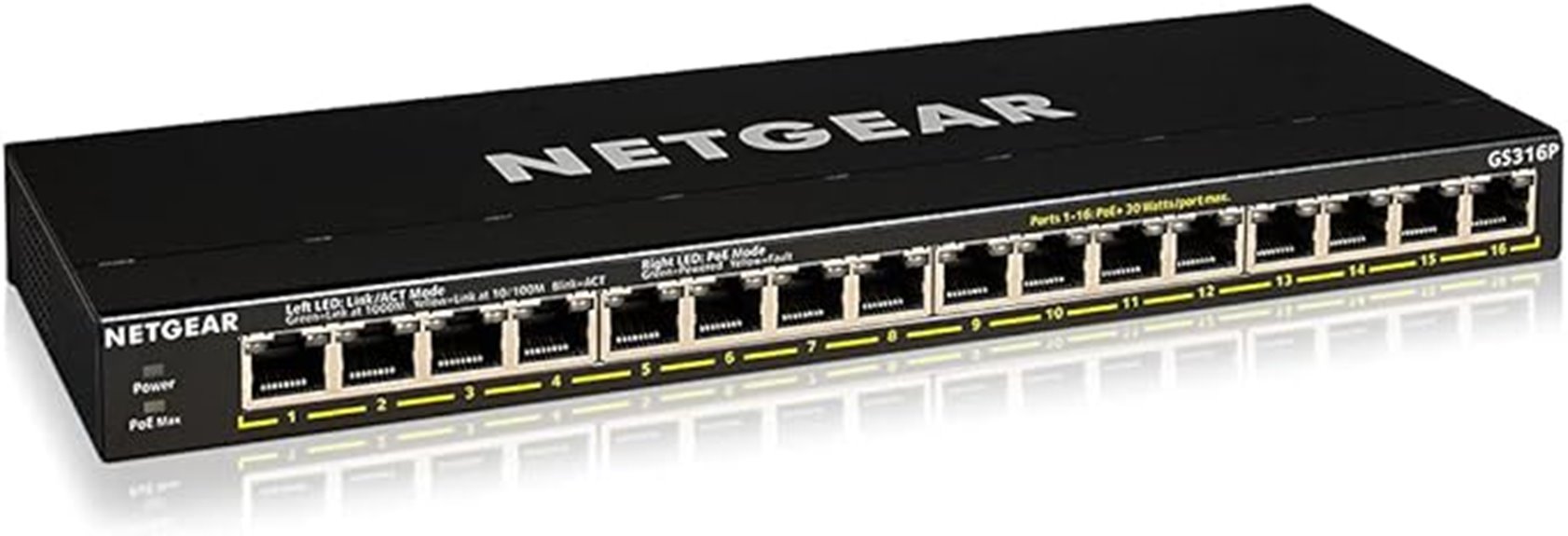
The NETGEAR 16-Port PoE+ Gigabit Ethernet Unmanaged Switch stands out as an excellent choice for small to medium-sized networks that demand reliable, plug-and-play connectivity. With 16 Gigabit ports, all supporting PoE+ and a total power budget of 115W, it efficiently powers IP cameras, access points, and VoIP phones. Its simple setup requires no software or configuration, making deployment quick and hassle-free. Designed for desktop or wall mounting, it offers flexible installation options. Plus, its energy-efficient design reduces power consumption, and its silent operation ensures suitability for noise-sensitive environments. A 3-year warranty gives added confidence in its long-term reliability.
Best For: small to medium-sized businesses or offices seeking a reliable, easy-to-use PoE+ switch for powering IP cameras, Wi-Fi access points, and VoIP phones.
Pros:
- Plug-and-play setup requires no software or configuration, ensuring quick deployment.
- Supports 16 PoE+ ports with a total power budget of 115W to power multiple devices simultaneously.
- Compact design with desktop or wall-mount options and energy-efficient operation reduces power consumption.
Cons:
- Unmanaged switch offers limited network configuration and customization options.
- Designed primarily for US and Canada, potentially limiting use in other regions without compatibility checks.
- No advanced features like VLAN support or network monitoring, which may be needed for larger or more complex networks.
TP-Link TL-SG1428PE 28-Port Gigabit Smart Switch

Designed for network administrators seeking reliable PoE solutions, the TP-Link TL-SG1428PE offers an extensive 28-port setup that balances performance and manageability. It features 24 PoE+ ports, delivering up to 30W per port with a total power budget of 250W, plus 2 Gigabit non-PoE ports and 2 SFP slots for high-speed links. The switch supports easy web-based management and VLAN features, enhancing security and traffic control. It includes PoE auto recovery for unresponsive devices and a plug-and-play setup requiring no software installation. With a limited 3-year warranty and free technical support, it’s a versatile choice for reliable, scalable network deployments.
Best For: network administrators and small to medium-sized businesses seeking a reliable, manageable PoE switch with extensive port options and high-speed connectivity.
Pros:
- Supports 24 PoE+ ports with up to 30W per port, ideal for powering multiple devices simultaneously.
- Features VLAN and traffic segmentation for enhanced network security and management.
- Easy web-based management and plug-and-play setup simplify deployment and configuration.
Cons:
- Limited 3-year warranty may be less comprehensive compared to longer-term options.
- Total PoE power budget of 250W might be restrictive for very high-power device deployments.
- No mention of advanced Layer 3 routing features, potentially limiting scalability for larger networks.
8 Port Gigabit PoE Switch with 2 Gigabit Uplink, 802.3af/at Compliant, 120W Built-in Power, Unmanaged Metal Plug and Play

This Port Gigabit PoE Switch with 2 Gigabit Uplink is an excellent choice for small to medium-sized networks that require reliable, easy-to-install power over Ethernet solutions. It features 8 Gigabit ports, each supporting up to 30W, with a total PoE budget of 120W. The switch is compliant with 802.3af/at standards, ensuring compatibility with a wide range of PoE devices. Its built-in power supply and unmanaged, metal design make setup straightforward and durable. With lightning protection and various safety features, it guarantees stable operation. Plus, its fanless, plug-and-play design provides silent operation, perfect for network monitoring, security, or enterprise applications.
Best For: small to medium-sized organizations seeking a reliable, easy-to-install PoE switch for powering security cameras, network monitoring devices, and other PoE-enabled equipment.
Pros:
- Supports up to 30W per port with a total PoE budget of 120W, suitable for multiple devices.
- Plug-and-play, unmanaged design with built-in power supply simplifies setup and reduces clutter.
- Equipped with lightning protection and safety features ensuring stable and secure operation.
Cons:
- Limited to unmanaged functionality, offering no advanced management or configuration options.
- Passive PoE devices require additional power sources or splitters, which may increase setup complexity.
- Fixed power budget may restrict use with high-power PoE devices or future expansion.
NETGEAR 8-Port PoE+ Gigabit Ethernet Switch (GS308PP)
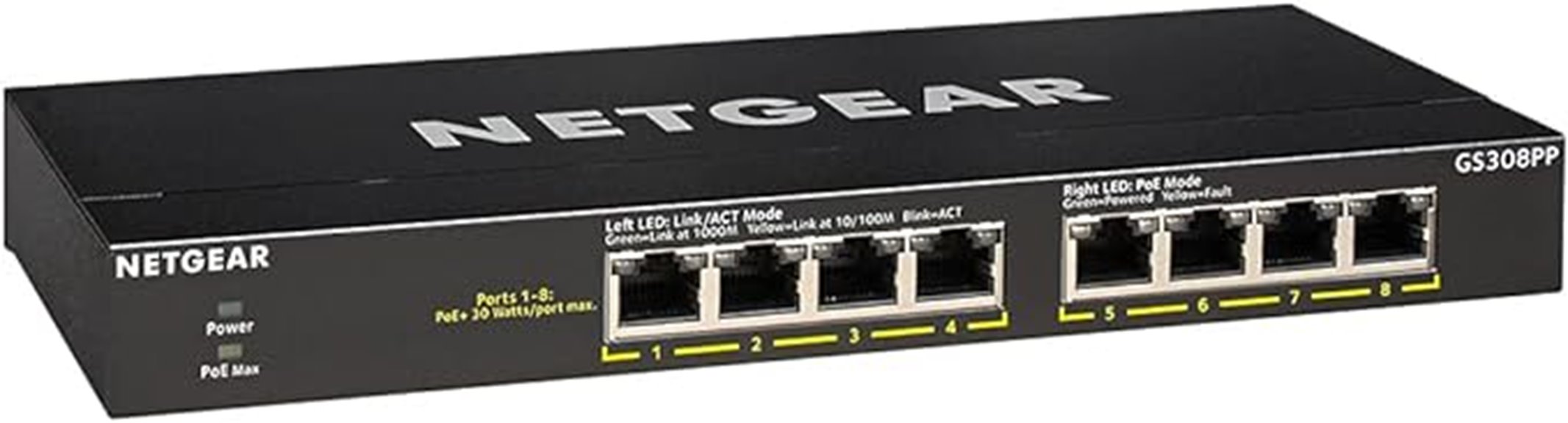
If you’re looking for a reliable, budget-friendly PoE switch for small office or home network setups, the NETGEAR 8-Port PoE+ Gigabit Ethernet Switch (GS308PP) is an excellent choice. It features 8 Gigabit ports, all supporting PoE+ with a total power budget of 83W, perfect for powering IP cameras, VoIP phones, or wireless access points. The switch offers a plug-and-play setup, requiring no software or configuration, and can be easily mounted on your desktop or wall. Plus, it comes with a solid 3-year warranty, giving you peace of mind in a compact, user-friendly design.
Best For: small offices or home networks seeking an affordable, easy-to-use switch to power and connect multiple devices.
Pros:
- Plug-and-play setup requiring no software or configuration
- Supports PoE+ on all 8 Gigabit ports with 83W power budget
- Compact design suitable for desktop or wall mounting
Cons:
- Unmanaged switch with no advanced management features
- Limited power budget may not support high-power PoE devices simultaneously
- No additional features such as VLAN or QoS support
NETGEAR 52-Port PoE Gigabit Ethernet Smart Switch (GS752TP)

The NETGEAR 52-Port PoE Gigabit Ethernet Smart Switch (GS752TP) stands out as an ideal choice for small to medium-sized networks that need reliable, managed PoE connectivity. It offers 48 Gigabit Ethernet ports, including 48 PoE+ ports with a 380W power budget, plus 4 dedicated fiber SFP ports for flexible uplinks. Its user-friendly management software simplifies setup and control, with options for remote cloud management. Built for durability and quiet operation, it supports energy-efficient standards to reduce power consumption. Whether rackmounted or placed on a desk, it’s perfect for ensuring secure, scalable network performance with reliable power delivery.
Best For: small to medium-sized businesses seeking a reliable, managed PoE switch with extensive port capacity and flexible connectivity options.
Pros:
- Offers 48 PoE+ ports with a substantial 380W power budget for powering multiple devices.
- Includes 4 SFP ports for fiber uplinks, enhancing network flexibility.
- Managed switch with user-friendly software and optional remote cloud management for easy control.
Cons:
- Designed primarily for U.S. and Canadian markets, limiting compatibility elsewhere.
- No built-in Wi-Fi or wireless management features.
- May be more feature-rich and costly than necessary for very small or home networks.
UGREEN 10-Port PoE Ethernet Switch

For those seeking a reliable and versatile PoE switch, the UGREEN 10-Port PoE Ethernet Switch stands out with its intelligent power management and auto-recovery features. It offers 8 PoE+ Gigabit ports (up to 30W each) and 2 uplink ports, with a total power budget of 60W, supporting devices like security cameras and IP phones. The switch auto-detects PoE devices, prioritizes ports if power exceeds limits, and automatically restarts devices in Extend Mode for stability. Its three modes—Standard, VLAN, and Extend—allow flexible network management. Rugged, with lightning protection and support for desktop or wall mounting, it’s built for dependable performance in various environments.
Best For: small to medium-sized businesses and home networks needing reliable, flexible PoE connectivity for security cameras, IP phones, and network devices.
Pros:
- Intelligent power management and auto-recovery for stable device operation
- Supports three versatile modes (Standard, VLAN, Extend) for flexible network configuration
- Rugged metal housing with lightning protection, suitable for various environments
Cons:
- Total power budget of 60W may limit the number of high-power PoE devices connected simultaneously
- Only 8 PoE+ ports, which may be insufficient for larger setups requiring more PoE ports
- No mention of advanced management features like VLAN segmentation beyond basic mode switching
Factors to Consider When Choosing Poe Ethernet Switches
When choosing a PoE Ethernet switch, I consider several key factors to guarantee it meets my needs. Compatibility with my power budget, port count, and speed are vital, along with management features and installation environment. Understanding the device’s power requirements helps me pick the right switch for reliable performance.
Power Budget Compatibility
How do you guarantee your PoE switch can reliably power all your devices? First, verify the switch’s total PoE power budget meets or exceeds the combined power needs of your connected devices. Check each port’s maximum output—like 30W for PoE+—to match individual device requirements. It’s wise to contemplate future expansion; a higher cumulative power capacity allows adding more devices later. Look for switches with PoE auto-recovery or dynamic power management features, which optimize power distribution and prevent overloads. Finally, confirm the switch’s compatibility with IEEE 802.3af/at standards. These standards ensure reliable power delivery and seamless interoperability with a broad range of PoE devices. Balancing these factors ensures your network remains powered, flexible, and efficient.
Port Count and Speed
Choosing the right PoE Ethernet switch hinges substantially on its port count and speed. The number of ports determines how many PoE devices I can connect simultaneously, with options ranging from 5 to over 50 ports. A higher port count supports network expansion but often requires more power and advanced features. Speed is equally essential; Gigabit ports support data transfers up to 1 Gbps, vital for high-bandwidth tasks like video streaming and large file sharing. Some switches include uplink ports, which connect to other switches or the internet, influencing network topology. Balancing port count and speed helps guarantee scalability, peak performance, and future-proofing my network as demands grow. These factors directly impact the overall reliability and efficiency of my setup.
Management Features Needed
Management features play a crucial role in ensuring my PoE switch meets both current and future network demands. Managed switches offer advanced options like VLANs, QoS, and port security that unmanaged ones lack. These features help optimize traffic flow, prioritize critical data, and enhance security. The management interface, whether web-based, CLI, or SNMP, allows me to monitor and control the network remotely, saving time and reducing downtime. Features like Auto Recovery, bandwidth control, and traffic prioritization are essential for maintaining reliability and performance. Some switches support cloud management, enabling centralized oversight across multiple devices. However, I need to match the complexity and cost of these features with my network’s size, security needs, and administrative expertise to make the most of what’s available.
Installation Environment Suitability
Selecting the right PoE Ethernet switch involves more than just features and performance; the installation environment plays a vital role in ensuring long-term reliability. I consider the switch’s physical design—whether it’s a desktop, wall-mount, or rackmount—to match the available space and optimize setup. Durability matters too; I look for sturdy casings like metal for industrial settings or fanless models for noise-sensitive areas. Size and mounting options must fit the physical constraints of the deployment site, whether it’s a compact space or a large rack. I also check environmental protections—such as temperature tolerance, dust, and moisture resistance—especially for outdoor or harsh environments. Ultimately, I verify that power and cooling needs align with the site’s electrical infrastructure and ventilation capabilities.
Device Power Requirements
Understanding the power requirements of your PoE switch is essential to guarantee all connected devices receive reliable power without overloading the system. I always start by calculating the total power budget needed for all devices, making sure the switch can support the combined wattage. It’s important to check the maximum power per port—usually up to 30W for PoE+—to meet the needs of devices like IP cameras and VoIP phones. I also verify if the switch supports PoE Auto Recovery, which helps reboot unresponsive devices, maintaining consistent power delivery. Additionally, I consider energy efficiency and whether the switch complies with IEEE802.3az standards to reduce power consumption. Ensuring the total PoE power budget aligns with device demands is critical for reliable, safe operation.
Frequently Asked Questions
How Do Poe Switches Differ From Traditional Ethernet Switches?
PoE switches differ from traditional Ethernet switches because they not only transmit data but also deliver power over the same cable. This means I can connect devices like cameras or VoIP phones directly to the switch without needing separate power adapters. Traditional switches only handle data transfer, so PoE switches simplify setup, reduce clutter, and make powering network devices more efficient and flexible.
What Safety Features Are Essential in Poe Switches?
Safety features are vital in PoE switches to protect both devices and users. I look for switches with overcurrent protection, which prevents power surges from damaging connected gear. PoE isolation safeguards against electrical faults, while temperature sensors help prevent overheating. Additionally, features like secure firmware updates and port security enhance safety by reducing vulnerabilities. These elements guarantee my network stays reliable, safe, and protected from potential electrical issues.
Can Poe Switches Be Upgraded or Expanded Easily?
Yes, PoE switches can be upgraded or expanded quite easily. I recommend choosing switches with modular designs or stacking capabilities, which let me add more ports or upgrade firmware without replacing the entire device. Many models support daisy-chaining or stacking, so I can grow my network seamlessly as my needs increase. This flexibility saves me time and money, making my setup scalable and future-proof.
How Energy-Efficient Are Modern Poe Switches?
Modern PoE switches are quite energy-efficient, thanks to advanced power management technologies. I’ve noticed that many models automatically adjust power output based on device requirements, reducing waste. This not only saves energy but also lowers operational costs. Overall, I find that contemporary PoE switches strike a good balance between reliable power delivery and energy conservation, making them a smart choice for eco-conscious networks.
What Maintenance Is Required for Long-Term Poe Switch Reliability?
Think of maintaining a PoE switch like tending a garden—regular care keeps it thriving. I check firmware updates monthly, clean dust from vents, and inspect cables for wear. In one instance, a simple firmware update restored full performance after a slowdown. Consistent monitoring, timely updates, and cleaning prevent failures, ensuring your switch remains reliable for years. Proper maintenance is key to long-term network health and performance.
Conclusion
Choosing the right PoE Ethernet switch can considerably boost your network’s reliability and power efficiency. Did you know that PoE switches can reduce cabling costs by up to 30%? With options ranging from compact 5-port models to robust 52-port setups, there’s a perfect switch for every need. Investing in the right switch guarantees smoother performance and future-proofing, making your network smarter and more dependable for years to come.