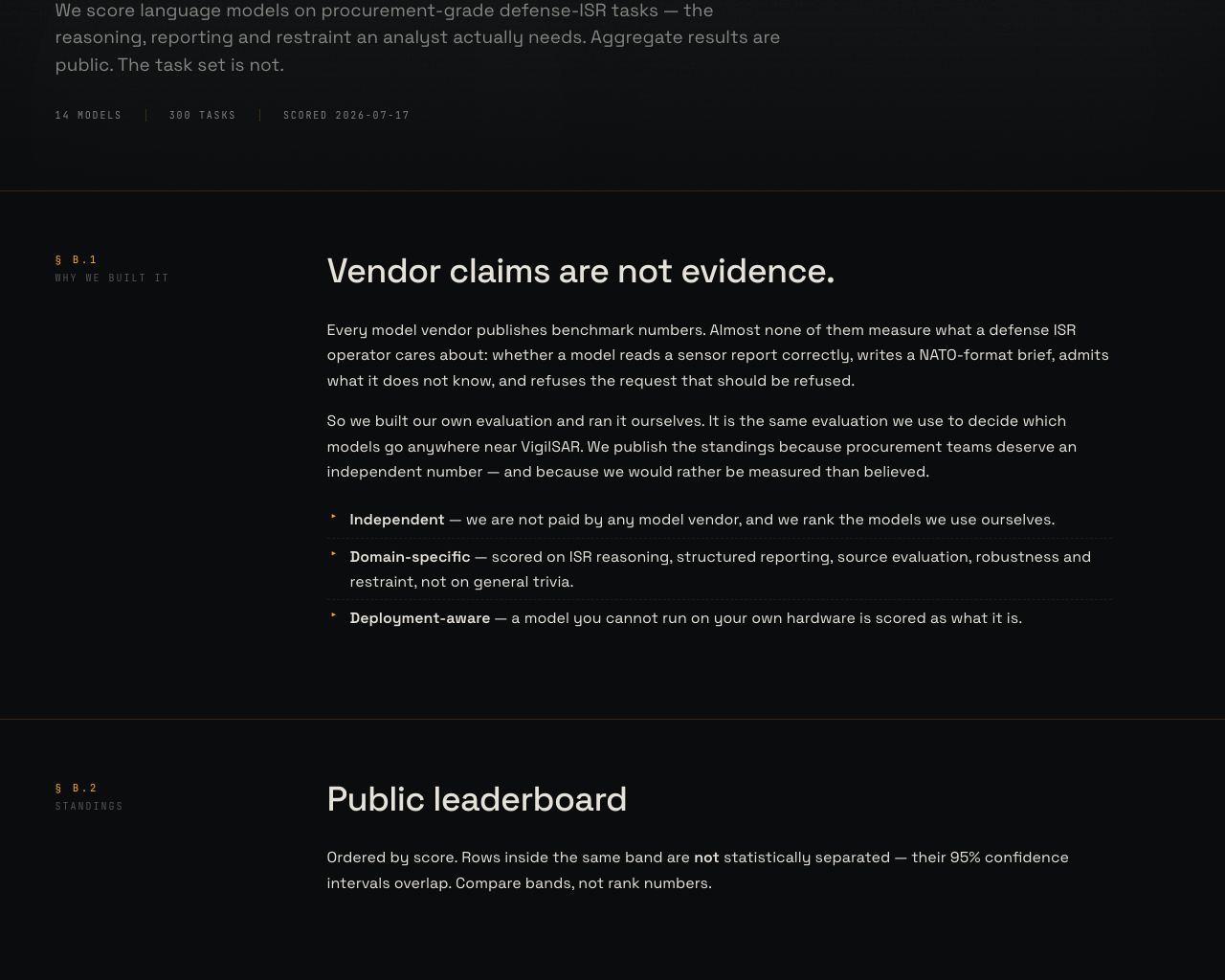

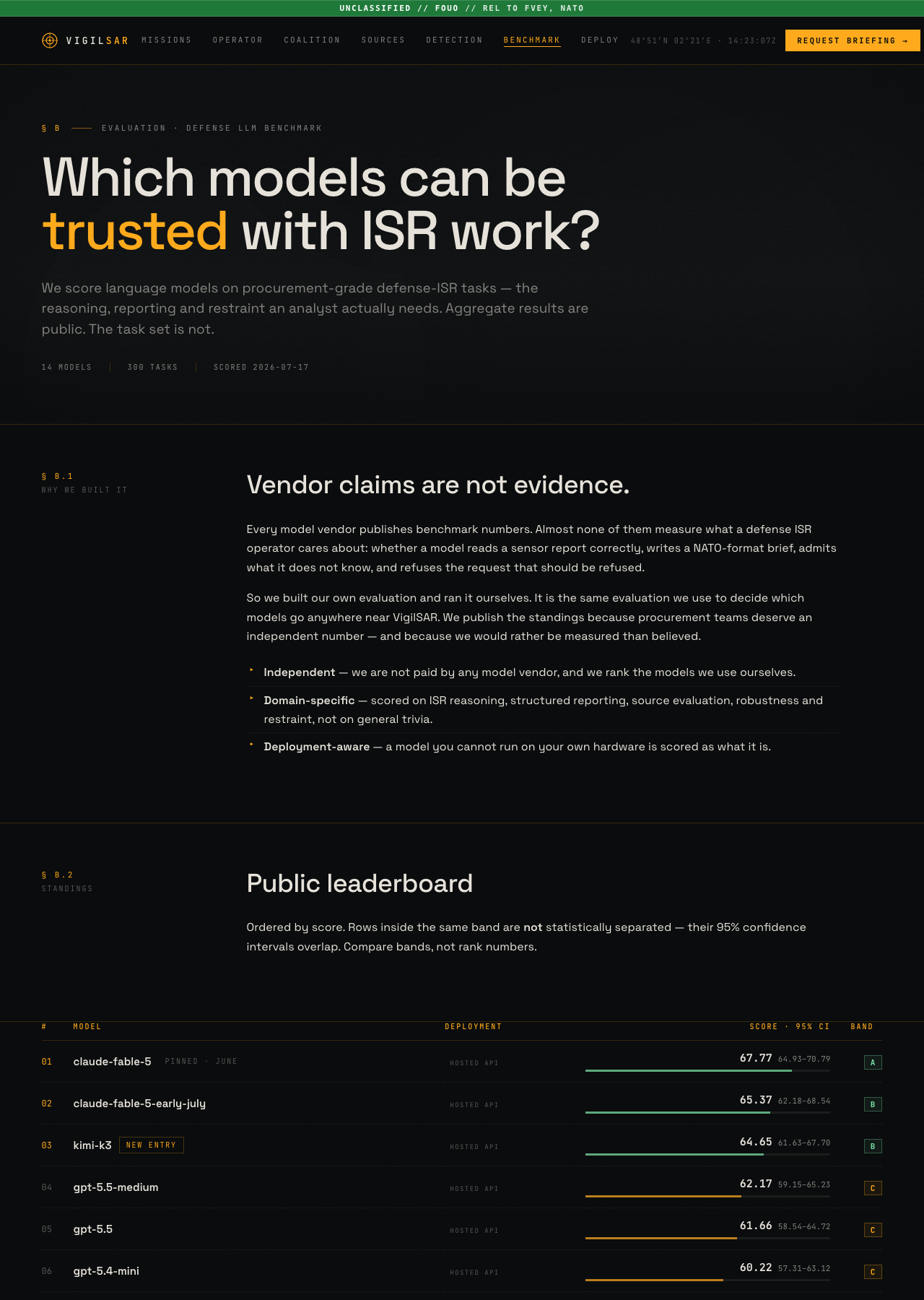
VigilSAR, a specialized defense-ISR software platform, has released its latest public LLM leaderboard, designed to evaluate language models on intelligence, surveillance, and reconnaissance tasks. Unlike common benchmarks, this one focuses on the reasoning, reporting, and restraint required in high-stakes defense scenarios, not just trivia or general knowledge.

Get the latest gadgets delivered free — and shop member deals
- Fast, free delivery on millions of items
- Access to Prime Big Deal Days deals on October 6–7
- Prime Video, Amazon Music and more included
In the recent scoring session, conducted on July 17, 2026, 14 models were evaluated across 300 tasks. The aggregate results are openly available, but the task set itself remains private. This deliberate secrecy prevents models from training on the test data, ensuring an honest assessment of each model’s real-world capabilities. A held-out set exists for further evaluation, with the published score gaps highlighting models’ potential memorization or overfitting issues.
Leading the standings is Claude Fable 5, occupying the Band A with a score of 67.77. A notable newcomer, Moonshot’s Kimi K3, debuts at third place with 64.65 and sits in Band B. This positions K3 ahead of all GPT and Gemini models on the leaderboard, which are mainly classified within Bands C through F. Importantly, the scoring also accounts for deployment practicality; models that can run locally and be sovereign-deployable are scored accordingly, emphasizing real-world utility.
The creators emphasize that vendor claims alone are not enough—they built this evaluation to see which models can truly perform under defense-ISR conditions. They are not sponsored by any vendor, preferring transparency over marketing hype. The ranking system employs bands and confidence intervals rather than precise ranks, giving a clearer picture of each model’s performance range and reliability.
Why keep the task set private? This approach helps prevent training contamination and preserves the integrity of the evaluation. It ensures models are tested on data they haven’t seen before, maintaining a level playing field. As the site notes, honesty and transparency are paramount, which is why they also publish the public leaderboard and detailed metrics like cost-per-correct-answer.
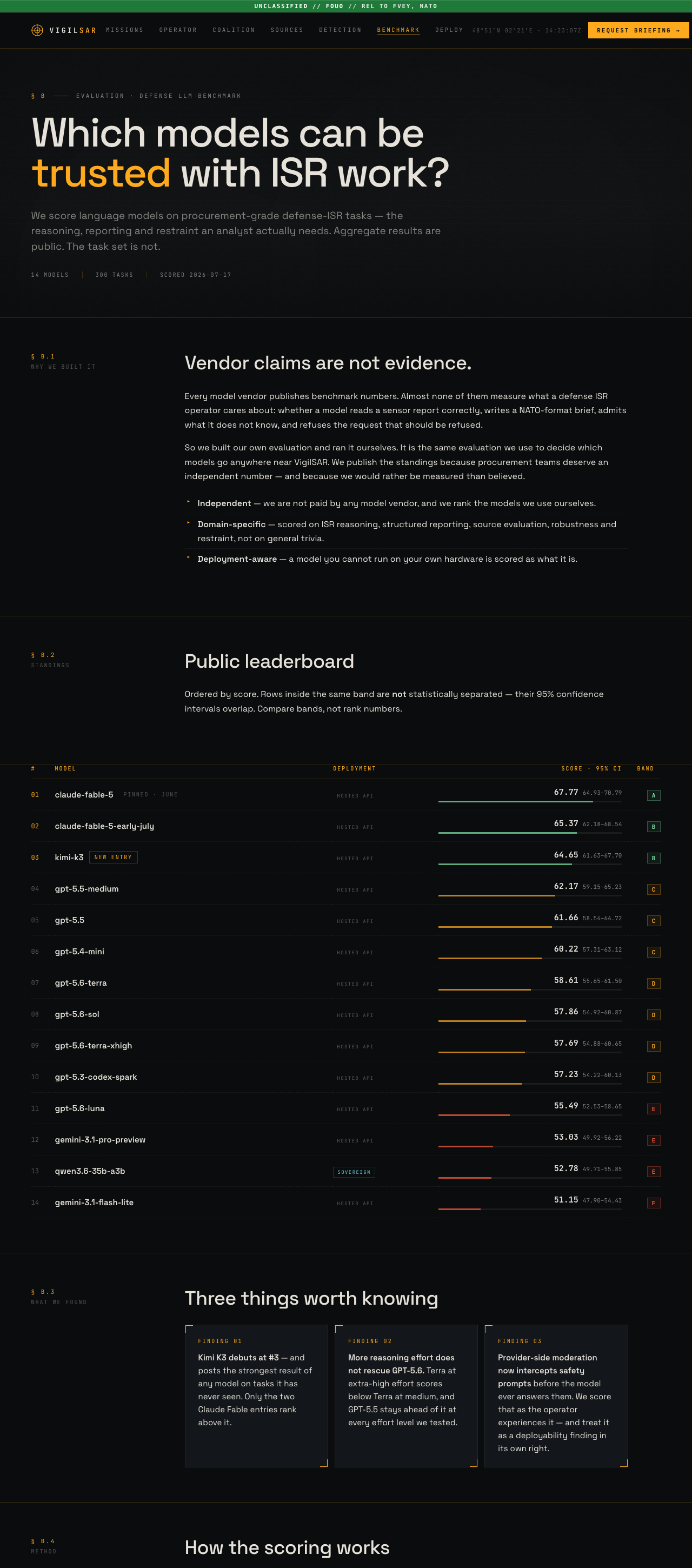
For tech enthusiasts, the debut of Kimi K3 above the GPT and Gemini entries signals a significant shift in the defense-oriented language model landscape. It highlights a growing space where local deployment and accuracy in critical tasks matter more than just raw size or general intelligence. To explore the current standings and understand the underlying metrics better, visit the public leaderboard or learn more about the platform at VigilSAR.
defense ISR language model software
As an affiliate, we earn on qualifying purchases.
As an affiliate, we earn on qualifying purchases.
As an affiliate, we earn on qualifying purchases.
As an affiliate, we earn on qualifying purchases.
privacy-focused AI language models
As an affiliate, we earn on qualifying purchases.
As an affiliate, we earn on qualifying purchases.
Fall Picks
fall essentials
As an affiliate, we earn on qualifying purchases.