
TL;DR

Get the latest gadgets delivered free — and shop member deals
- Fast, free delivery on millions of items
- Access to Prime Big Deal Days deals on October 6–7
- Prime Video, Amazon Music and more included
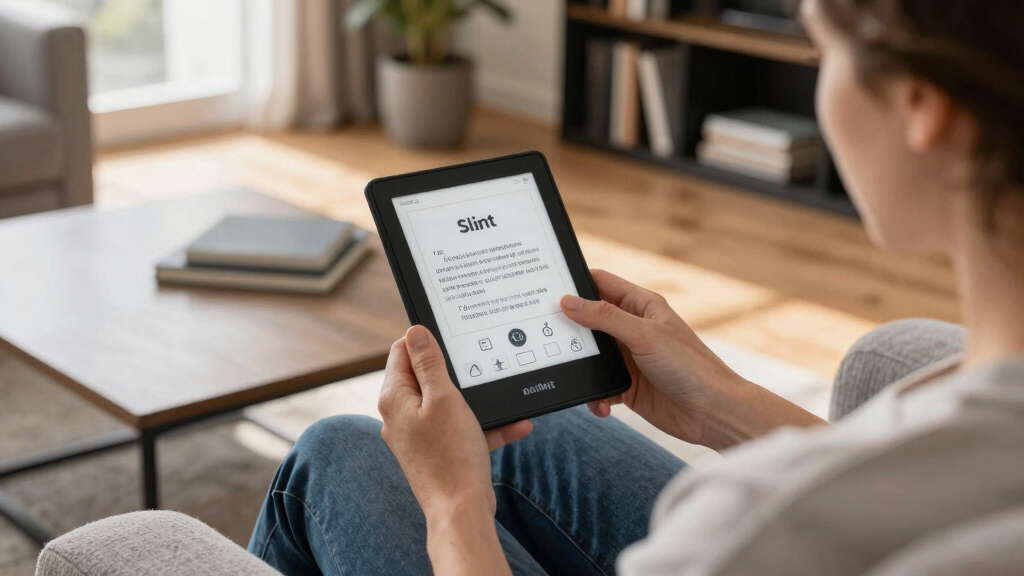
A developer successfully compiled and ran Rust and the Slint GUI library on a jailbroken Kindle Paperwhite. This development allows custom applications and interfaces to be created on e-ink devices, expanding their potential beyond standard use.
A developer has successfully ported Rust and the Slint GUI library to a jailbroken Kindle Paperwhite, enabling custom applications on the device. This achievement matters because it demonstrates the Kindle’s potential as a programmable platform beyond its intended e-reader functionality.
The developer, Pete Cordell, jailbroke his Kindle Paperwhite and used cross-compilation tools, specifically cargo-zigbuild with Zig, to compile Rust code targeting ARMv7 architecture. He then gained shell access via USBNetwork and SSH, allowing him to run compiled binaries on the device.
Using Rust, he implemented a basic graphical interface with Slint, a lightweight GUI library. By leveraging the Kindle’s framebuffer device (/dev/fb0), he rendered visual output, and by reading from /dev/input/event1, he processed multi-touch input according to the Linux kernel’s multi-touch protocol. After extensive debugging, he achieved a functional interface, including visual elements and touch input, on the Kindle’s e-ink screen.
Why It Matters
This development is significant because it shows that e-ink devices like the Kindle can be repurposed as programmable hardware platforms. It opens possibilities for custom interfaces, home automation dashboards, or other applications that leverage the device’s low power consumption and always-on display. For hobbyists and developers, it demonstrates a new avenue for extending the functionality of existing e-readers.
Kindle Paperwhite jailbreak tools
As an affiliate, we earn on qualifying purchases.
As an affiliate, we earn on qualifying purchases.
Background
Prior to this, Kindle devices have been jailbroken for various purposes, such as removing DRM or installing custom firmware. However, running a full Rust environment with GUIs is a new milestone, made possible by cross-compilation and Linux device access. The project builds on existing knowledge of Linux device drivers, touch input protocols, and embedded development, but applying this to a Kindle is novel.
Rust’s increasing popularity for embedded and cross-platform development, combined with lightweight GUI libraries like Slint, makes this a feasible approach for hobbyists. The developer’s work also involved adapting the Kindle’s framebuffer and input devices, which are typically reserved for the device’s native e-reader software.
“Getting Rust and Slint to run on the Kindle was a matter of cross-compiling, gaining shell access, and interfacing with the device’s framebuffer and input system.”
— Pete Cordell
“This project shows that even low-power e-ink devices can be transformed into programmable platforms with enough effort.”
— Unspecified source
ARM development boards for embedded projects
As an affiliate, we earn on qualifying purchases.
As an affiliate, we earn on qualifying purchases.
What Remains Unclear
It is not yet clear how stable or practical the running system is across different Kindle models or firmware versions. The current implementation appears to be a proof of concept, and further testing is needed to assess long-term stability, performance, and usability.
As an affiliate, we earn on qualifying purchases.
What’s Next
The next steps involve refining the port, improving stability, and creating more complex applications or dashboards. The developer may also publish tools or instructions to help others replicate the process on different Kindle models or e-ink devices.
Linux compatible touchscreen modules
As an affiliate, we earn on qualifying purchases.
As an affiliate, we earn on qualifying purchases.
Key Questions
Can I run Rust on my Kindle without jailbreaking?
No, jailbreaking is required to gain the necessary root access and modify the device’s firmware to run custom code.
Is this project stable enough for daily use?
Currently, it is a proof of concept. Stability and usability for everyday tasks are still under development and testing.
What applications can I run with this setup?
In theory, any Rust-based application with a GUI can be ported, including dashboards, clocks, or simple games, but practical limitations exist due to hardware constraints.
Will this work on all Kindle models?
It is uncertain; the port was tested on a Kindle Paperwhite 7th generation. Other models may require adjustments for compatibility.
How difficult is it to replicate this process?
It requires familiarity with Linux, cross-compilation, and device hacking. The developer’s detailed steps provide a useful guide, but some technical expertise is necessary.
Source: Hacker News
Fall Picks
fall essentials
As an affiliate, we earn on qualifying purchases.