
TL;DR
Thorsten Meyer AI published a capstone comparison of Apple Silicon Macs and GPU towers for local LLM use, framing the choice around heat, noise, memory bandwidth and memory capacity. The report says GPU towers are faster on models that fit in VRAM, while Macs can run larger quantized models more quietly through unified memory.
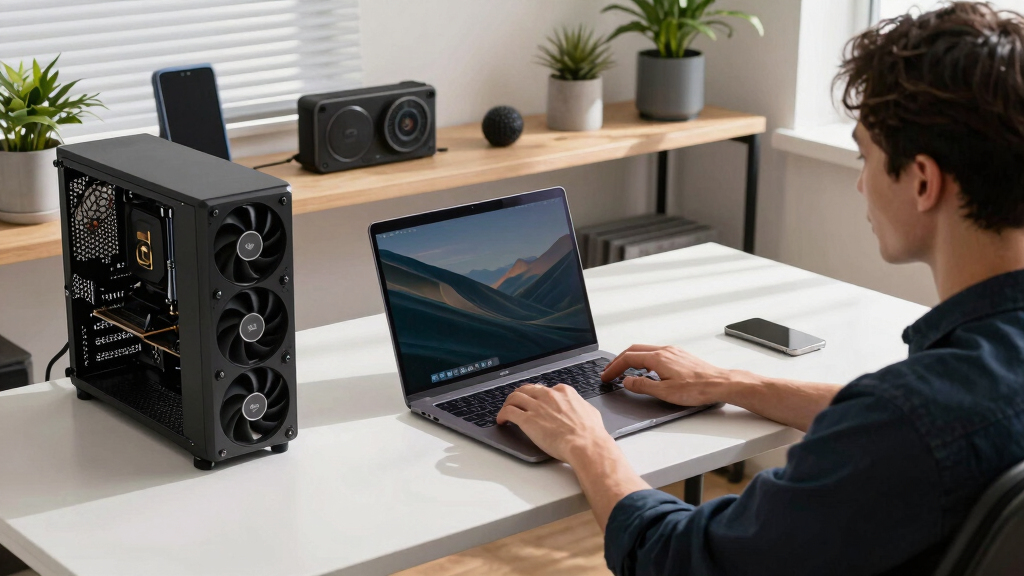
Thorsten Meyer AI has published a capstone comparison arguing that the Mac-versus-GPU-tower choice for local LLMs is less about one machine being best overall and more about a tradeoff between speed, memory capacity, heat and noise, a decision that matters as more users try to run AI models locally rather than through cloud services.
The article says GPU towers and Apple Silicon machines optimize for different constraints. According to the source material, an RTX 5090 tower offers roughly 1,792 GB/s of memory bandwidth, compared with about 819 GB/s for a Mac Studio M3 Ultra. The report says that bandwidth gap can make a tower several times faster on models that fit inside available VRAM.
The same comparison says capacity changes the decision. Consumer GPU cards are described as being limited to about 24GB to 32GB of VRAM per card, and the article says multiple GPUs do not simply combine VRAM into one large pool for a single model. Apple Silicon, by contrast, is described as using unified memory of up to 256GB to 512GB, allowing much larger quantized models to load even when they run more slowly.
The report also places the machines at opposite ends of the heat-and-noise scale. It cites a single RTX 5090 at about 575W and a dual-GPU tower above 800W, with most of that power becoming heat that must be removed by cooling systems. A Mac Studio is described as using a fraction of that power and being near-silent for many local inference tasks, though the article does not claim it wins on raw throughput.
Why It Matters
The comparison matters for developers, researchers and AI hobbyists buying local hardware because the wrong choice can mean paying for speed they cannot use, or choosing a quiet machine that feels too slow for their workload. For users running models that fit inside high-end GPU VRAM, the tower remains the faster option, according to the article. For users trying to load larger 70B-class quantized models on one machine, the Mac may be more practical because of its memory pool.
The heat and noise angle also affects where local AI work can happen. A high-power tower may be acceptable in a separate room, lab or office, but harder to tolerate beside a desk. The article says many users may land on a hybrid setup: a quiet Mac for daily interactive work and a headless GPU tower elsewhere for CUDA work, fine-tuning or throughput-heavy jobs.
As an affiliate, we earn on qualifying purchases.
Background
The article is framed as the capstone to Thorsten Meyer AI’s series on reducing heat and noise in high-power AI workstations. Earlier parts of the series focused on managing towers through undervolting, cooling, airflow, fan tuning and placement. This installment asks whether some users should avoid the thermal problem by choosing a different architecture.
The source material says its figures come from 2026 comparisons, BIZON, independent benchmarks, and Apple Silicon and NVIDIA datasheets. It also says token rates are ballpark estimates for Q4_K_M quantized models and vary by model, quantization and workload. The article includes an affiliate disclosure, stating that some links may earn commissions at no extra cost to readers.
“It isn’t only about tokens per second.”
— Thorsten Meyer AI
“The question that actually decides it is: does it fit? or how fast?”
— Thorsten Meyer AI
“Silence is its default, not an achievement.”
— Thorsten Meyer AI
As an affiliate, we earn on qualifying purchases.
What Remains Unclear
Several points remain workload-dependent. The article does not establish one universal winner, and its token-speed claims are presented as ballpark estimates rather than fixed results. Actual performance can change with the model, context length, quantization, inference engine, cooling setup, driver stack and whether the task is pure inference, batching, fine-tuning or CUDA-specific work. Pricing and availability may also shift the value comparison.
As an affiliate, we earn on qualifying purchases.
What’s Next
The next step for readers is to match the hardware choice to the workload: choose a GPU tower when throughput on models that fit in VRAM is the main need, choose Apple Silicon when quiet desk-side use and large unified memory matter more, or use both by placing the tower remotely and connecting to it from a quieter Mac.
As an affiliate, we earn on qualifying purchases.
Key Questions
Which machine is faster for local LLMs?
According to the article, a GPU tower is faster on models that fit inside VRAM because its memory bandwidth is much higher. The Mac may be slower per token but can load larger quantized models through unified memory.
Why does memory capacity matter for local AI?
Capacity determines whether a model can load at all. The article says a model that exceeds a consumer GPU’s VRAM limit may still run on a high-memory Apple Silicon system, though at lower speed.
Does using two GPUs double usable VRAM?
The source material says no: VRAM does not simply pool into one combined memory space for a single model. That limits what very large models can fit on consumer GPU cards.
Is a Mac always quieter than a GPU tower?
The article describes Apple Silicon machines as near-silent by design for many local inference uses. A well-built tower can be made quieter, but the report says high-power GPUs produce far more heat that fans must remove.
Who should use a hybrid setup?
A hybrid setup may fit users who want a quiet desk machine for daily work but still need CUDA, fine-tuning or high-throughput inference. The article suggests placing the tower where its heat and noise matter less and connecting to it remotely.
Source: Thorsten Meyer AI