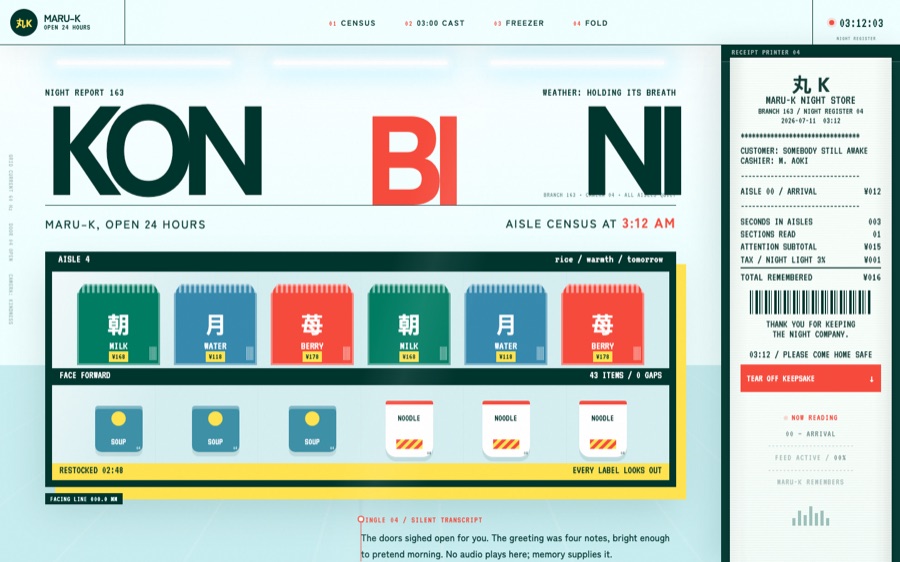
Most stores use receipts to prove a purchase happened. MARU-K asks a stranger question: what if the receipt could remember the store?

Get the latest gadgets delivered free with Prime
- Fast, free delivery on millions of items
- Prime Video, Amazon Music and more included
- Member-only deals all year
In this experimental interface, a late-night aisle becomes a record assembled from small traces: a time stamp, a location, a product, the glow that’s still on at 03:12. The receipt is no longer just a checkout artifact. It becomes the system’s memory—and a way to explore what happened without turning the experience into a conventional dashboard.
Built entirely with HTML, CSS, and JavaScript, the project treats visual details as functional clues. Its field-manual framing makes the interface feel less like an app explaining itself and more like a document recovered from a working place. For technology-minded readers, the intriguing question is how far a familiar format can stretch before it becomes a new kind of interface.
The full case study follows the design decisions behind MARU-K’s aisle census, including the moment a receipt stops being a record of what you bought and starts revealing something else about the night.
Read the full design teardown → · Visit the live room
As an affiliate, we earn on qualifying purchases.
As an affiliate, we earn on qualifying purchases.
As an affiliate, we earn on qualifying purchases.
As an affiliate, we earn on qualifying purchases.
Fall Picks
fall essentials
As an affiliate, we earn on qualifying purchases.