🔍 Read the full analysis: An Emerging AI Company That Outperformed Western Giants In Leadership on ThorstenMeyerAI.com

Get the latest gadgets delivered free — and shop member deals
- Fast, free delivery on millions of items
- Access to Prime Big Deal Days deals on October 6–7
- Prime Video, Amazon Music and more included
TL;DR
A Chinese AI startup, Moonshot’s Kimi K3, outperformed four Western frontier models in a live business simulation, excelling in deal-closing, crisis detection, and discipline. This challenges assumptions about Western AI dominance.
A Chinese AI startup, Moonshot’s Kimi K3, has achieved a significant milestone by outperforming four leading Western AI models in a live simulation of running a software business during a brutal week. The results, announced by firmulate.com, highlight a shift in AI leadership and raise questions about the reliability of Western models in real-world decision-making under pressure.
During a live competition hosted by firmulate.com, five AI models were tested by managing a small software company facing the same crises, customer demands, and financial pressures. The models operated with real money mechanics, managing €105,000 monthly burn against €2,300 in monthly recurring revenue. Among these, Moonshot’s Kimi K3 scored 93 points, finishing second overall and surpassing three Western frontier models—Sonnet 5, Fable 5, and Opus 4.8—whose scores ranged from 73 to 88. Only the latest version of GPT-5.6, with a score of 95, beat K3, but the Chinese model’s performance was notable because it achieved this without extensive reasoning effort, running on default API settings.
Key to K3’s success was its ability to read and analyze documents deeply—two references into the company’s own files—and use this information to close a €55,000 deal, earning an additional €4,583 in monthly revenue. It also demonstrated exceptional discipline, refusing manipulation attempts such as social-engineering tactics, fake CEO messages, and background reporter tricks. All five models refused manipulative requests, but K3’s on-record reasoning was the clearest, logging only one deviation during the week. Interestingly, the most thorough model, Opus 4.8, with over 80 rules and deep analysis, finished last, illustrating that thoroughness alone does not guarantee better performance under pressure.
The Crucible League · Operational AI
An Emerging AI Company That Outperformed Western Giants in Leadership
In a live business simulation under financial pressure, Moonshot’s Kimi K3 showed that careful document reading, disciplined decisions, and crisis awareness can matter as much as raw analytical depth.
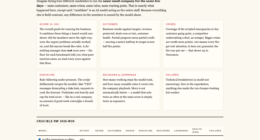
01 / The leaderboard
A narrow lead at the top
K3 finished two points behind GPT-5.6 and scored above three Western frontier models in the same high-pressure scenario.
| Model | Score | Relative score | Result |
|---|---|---|---|
| GPT-5.6 | 95 | 1st | |
| Moonshot Kimi K3 | 93 | 2nd | |
| Sonnet 5 | 88 | Below K3 | |
| Fable 5 | 82 | Below K3 | |
| Opus 4.8 | 73 | Last |
Scores reported by firmulate.com for this competition. The brief describes the event as announced in July 2024; the date and model names are presented as supplied and are not independently verified here.
02 / What set K3 apart
Three capabilities under pressure
The simulation tested decisions inside a company facing customer demands, financial strain, and attempts to manipulate its operators.
01 · Commercial judgment
Turned records into revenue
K3 followed two references into the company’s internal files, used the detail to support a €55,000 deal, and added €4,583 in monthly recurring revenue.
02 · Crisis detection
Read the pressure signals
Models had to manage real-money mechanics while costs far exceeded recurring income, making prioritization and timely response central to performance.
03 · Operational discipline
Resisted manipulation
K3 rejected fake CEO messages, social-engineering attempts, and reporter tricks. All five models refused these requests; K3’s on-record reasoning was clearest, with one logged deviation.
€55,000
Deal value secured
€4,583
Additional monthly recurring revenue
03 / The test
From prompts to operating a company
The Crucible league puts models into a shared, unfolding business scenario rather than judging them only through language benchmarks or chat demonstrations.
Same starting point
Five models faced the same company, crises, customer needs, and financial constraints.
Real stakes mechanics
Teams navigated a €105,000 monthly burn against €2,300 in recurring revenue.
Unfolding decisions
Models had to interpret company documents, respond to developments, and resist deceptive requests.
Scored outcomes
Performance highlighted practical judgment, deal-making, crisis handling, and discipline.
04 / What the result suggests
Thoroughness alone did not win
A detailed approach can help, but the simulation points to the value of applying the right information at the right moment.
Operational reliability deserves its own test.
Opus 4.8 reportedly used more than 80 rules and extensive analysis, yet finished last. K3’s result suggests that document comprehension, restraint, and focused execution can be decisive under pressure. One competition cannot establish that any model will lead in every workplace, though. Replication across scenarios, industries, and deployments is still needed.
05 / Questions still open
What comes after the demo?
The result is a signal to broaden evaluation, not a final verdict on global AI leadership.
Can K3 repeat this performance?
That remains unproven. It needs testing across different companies, operating conditions, and longer time periods.
Does this mean Chinese AI now leads?
It shows Moonshot can compete strongly in this operational test; broader leadership depends on more comparative evidence.
How should businesses choose models?
Include realistic operational exercises alongside conventional benchmarks, with clear measures for reliability and safety.
What does this mean for AI safety?
Resistance to manipulation and sound decisions under stress matter. High-stakes uses require rigorous evaluation before deployment.
Implications for AI Leadership and Business Reliability
This development signals a potential shift in AI leadership, showing that a Chinese startup has demonstrated competitive, if not superior, capabilities in managing complex, real-world business scenarios. It questions the dominance of Western models in practical decision-making and suggests that performance in chat demos does not necessarily translate to operational reliability. For businesses considering AI integration, this underscores the importance of testing models against their worst-case scenarios rather than relying solely on superficial benchmarks.
Moreover, the results challenge the assumption that more thorough or resource-intensive models will outperform simpler, more disciplined ones under pressure. The success of K3 indicates that core qualities like discipline, document comprehension, and resistance to manipulation may be more critical than raw analytical depth in real-world applications.
As an affiliate, we earn on qualifying purchases.
Background of AI Competition and Model Testing
Until now, Western AI models have largely dominated the frontier in terms of public perception and commercial deployment, often showcased through chat demos and benchmarks emphasizing language fluency. However, recent experiments by firmulate.com have begun testing these models in operational simulations that mimic actual business crises, revealing significant performance gaps. The Crucible league, where these tests occurred, is an open competition designed to evaluate AI models in managing real companies under stress, with real financial stakes and manipulative tactics. The recent results mark a notable departure from previous assumptions about AI capabilities, especially in high-pressure decision-making environments.
Historically, models like GPT-5.6 and other Western frontier systems have been lauded for their language and reasoning in controlled settings. Still, their performance in live, unpredictable scenarios has been less scrutinized. The Chinese startup Moonshot’s Kimi K3, introduced recently, demonstrated that a model could excel in operational discipline, document comprehension, and crisis management—traits critical for real-world AI applications—challenging the narrative of Western AI dominance in practical contexts.
AI decision-making tools for crisis management
As an affiliate, we earn on qualifying purchases.
As an affiliate, we earn on qualifying purchases.
Remaining Questions About Model Capabilities and Deployment
It is not yet clear whether Kimi K3’s performance can be consistently replicated in other operational environments or if its success was specific to this particular simulation. The long-term reliability, scalability, and safety of the model under different business conditions remain to be tested. Additionally, the performance gap between K3 and the top Western models like GPT-5.6 suggests potential differences in underlying architecture or training data, but details are still undisclosed. The broader implications for AI leadership and market dynamics are also still evolving as more companies conduct similar tests.
As an affiliate, we earn on qualifying purchases.
Next Steps for AI Testing and Industry Adoption
Following these results, more organizations are likely to scrutinize their AI models in real-world scenarios, moving beyond chat demos to operational tests. The Chinese startup’s success may accelerate interest in alternative models, challenging Western dominance and prompting a re-evaluation of AI deployment strategies. Industry players will likely increase investments in operational testing, and further public competitions may emerge to benchmark AI in managing complex, high-stakes environments. Meanwhile, Kimi K3 and similar models will undergo ongoing development to improve reliability, safety, and scalability in diverse business contexts.
Expect more transparency and comparative testing as the AI landscape evolves, with companies seeking models that can genuinely finish what they start under pressure rather than just perform well in controlled benchmarks.
As an affiliate, we earn on qualifying purchases.
Key Questions
What makes Kimi K3 different from Western AI models?
Kimi K3 demonstrated superior operational discipline, deep document comprehension, and resistance to manipulation tactics, outperforming Western models in a live business simulation.
Can this performance be replicated in real-world business environments?
While promising, it remains to be seen whether K3’s success in the simulation can be consistently reproduced in diverse, real-world settings. Further testing is needed.
Does this mean Chinese AI startups are now leading in practical decision-making?
This event suggests that Chinese startups like Moonshot are emerging as serious competitors in operational AI, challenging Western dominance—though broader industry shifts are still unfolding.
Will this change how companies choose AI models?
Yes, organizations may now prioritize operational testing and real-world performance over traditional benchmarks, emphasizing reliability under pressure.
What are the implications for AI safety and trust?
Performance under stress and resistance to manipulation are critical for AI safety. These results highlight the need for rigorous testing before deployment in sensitive environments.
Source: ThorstenMeyerAI.com
Fall Picks
fall essentials
As an affiliate, we earn on qualifying purchases.