


In the realm of wide-area motion imagery (WAMI), maintaining accurate identification of multiple moving objects is crucial. Corvus ISR has published a detailed public tracker benchmark comparing two models on synthetic scenes with perfect ground truth. Their latest findings highlight significant improvements in tracking consistency and ID switches reduction, vital for surveillance applications.

Get the latest gadgets delivered free with Prime
- Fast, free delivery on millions of items
- Prime Video, Amazon Music and more included
- Member-only deals all year
The older baseline model, v1, employs a simple greedy nearest-neighbour approach, with fixed velocity predictions and minimal filtering. In contrast, v2 features a sophisticated auction-based confirmation system, incorporating three-tier auction associations, velocity consistency gating, and confidence decay — all designed to improve track stability and reduce errors.
The results are striking: under a 150-mover scenario at 2fps, ID switches per minute dropped from 2,042 to 1,183, a reduction of over 42%. When scaled to a dense scene with 400 movers, the switches decreased from 14,032 to 8,040, a similar 42.7% improvement. These figures are especially relevant because they are measured against perfect ground truth, isolating tracker performance from detection capabilities.
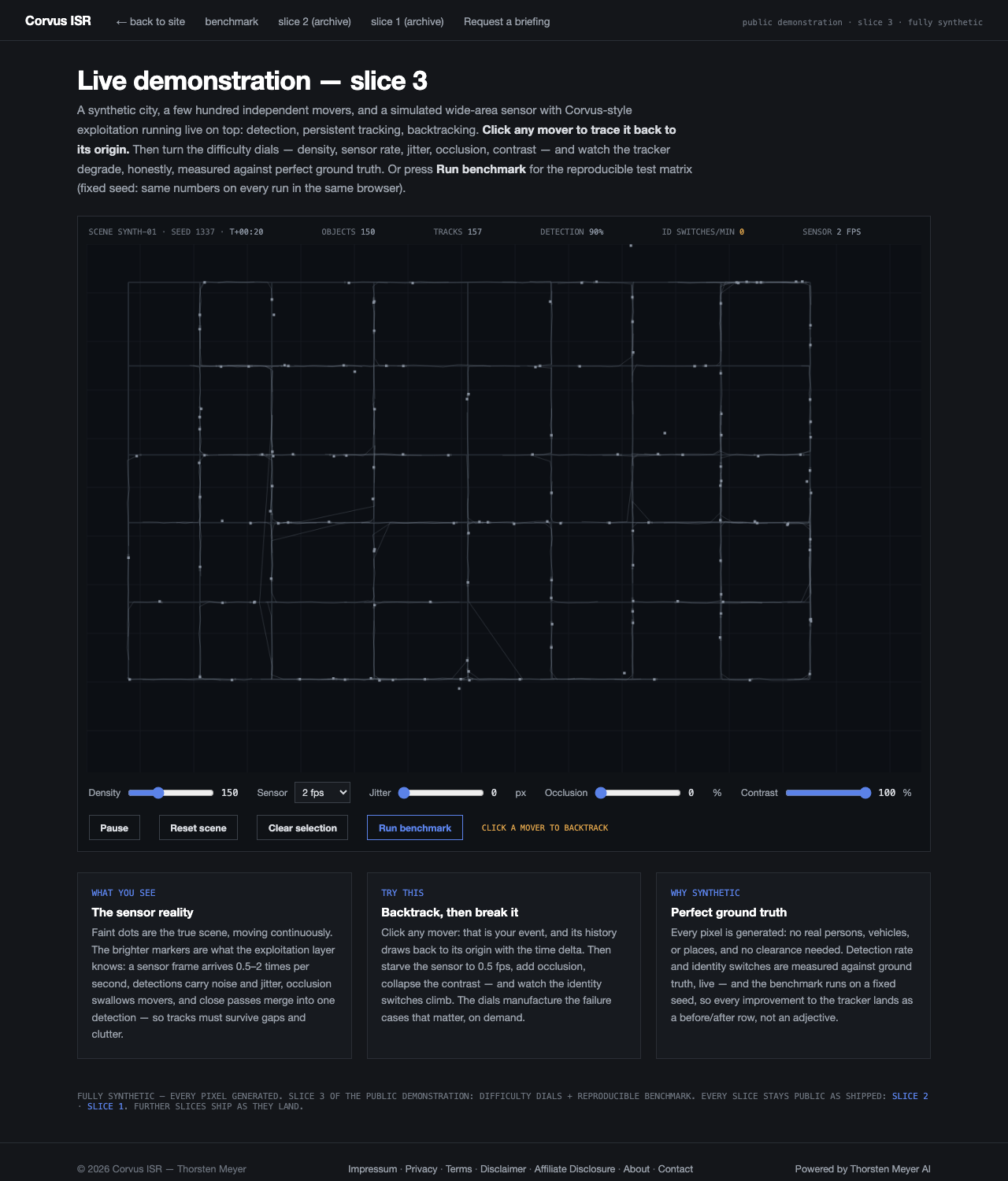
Notably, even under adverse conditions — such as frame-starvation at 0.5fps, occlusions at 20%, and degraded image quality with jitter and low contrast — the v2 tracker still cuts ID switches by approximately 18% compared to v1. Since detection rates are fixed by sensor properties, these improvements stem purely from the advanced association logic.
Corvus ISR emphasizes transparency by publishing failure metrics in addition to successes. These metrics, including the strict ID-switch count, highlight that even the best models still generate thousands of identity errors per minute under stress. The synthetic scene setup ensures perfect ground truth, making these results reliable benchmarks rather than marketing hype.
Engineered for real-time operational use, v2 averages about 1.2 milliseconds per sensor tick at high density, well within typical processing budgets. The entire benchmark process is accessible via the live demo, where users can reproduce it live without signing up or sharing confidential info. This transparency invites tech enthusiasts to see how well the advanced auction-based tracker outperforms simpler methods in real time.
With all data generated synthetically — no real entities or locations involved — Corvus ISR’s approach ensures objective testing and validation. The demonstration showcases how innovative algorithms can significantly enhance multi-object tracking accuracy while maintaining operational speed. We encourage readers to try the benchmark themselves and witness the improvements firsthand.
real-time multi-object tracking software
As an affiliate, we earn on qualifying purchases.
As an affiliate, we earn on qualifying purchases.
As an affiliate, we earn on qualifying purchases.
As an affiliate, we earn on qualifying purchases.
As an affiliate, we earn on qualifying purchases.
Fall Picks
fall essentials
As an affiliate, we earn on qualifying purchases.