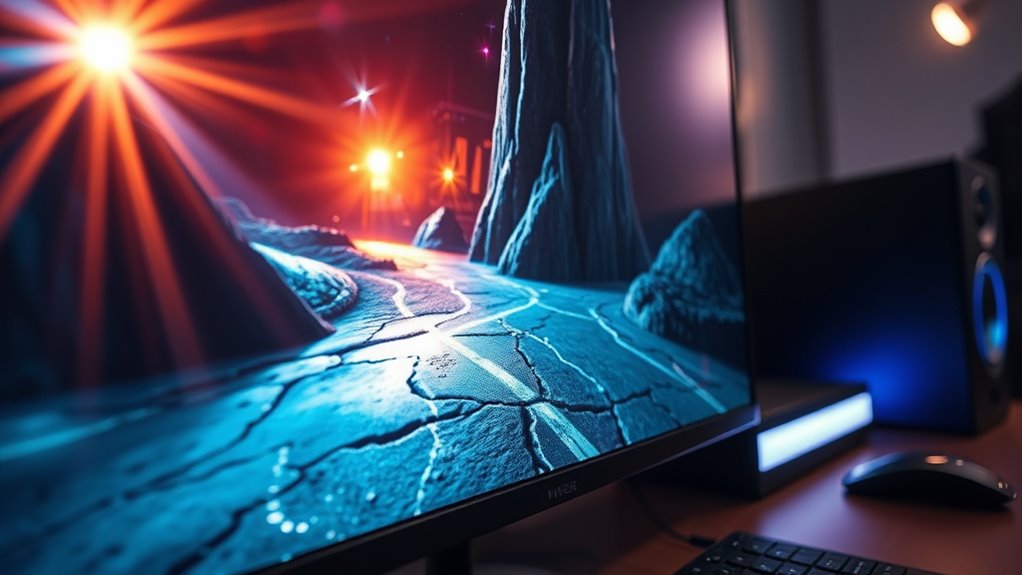

Ray tracing is a technology that simulates how light interacts with surfaces to create incredibly realistic gaming visuals. It models how rays of light bounce, reflect, and refract, producing accurate shadows, reflections, and surface details. This makes scenes look more lifelike and immersive. While it requires powerful hardware, advancements are making it more accessible. If you keep exploring, you’ll discover how ray tracing is transforming the future of game graphics and visual effects.
Key Takeaways
- Ray tracing simulates real-world light behavior to create highly realistic gaming visuals.
- It traces rays from the camera to model shadows, reflections, and indirect lighting accurately.
- Ray tracing enhances graphics by producing natural reflections and more immersive, lifelike scenes.
- It requires powerful hardware, such as advanced GPUs with dedicated RT cores, for real-time performance.
- Future hardware and AI advancements will continue to improve ray tracing’s realism and efficiency in gaming.
The Basic Idea Behind Ray Tracing

Ray tracing is a rendering technique that simulates how light interacts with objects to create realistic images. It builds on the principles of light physics, understanding how photons travel and bounce within a scene. The core idea is to trace the path of light rays as they originate from a camera, bouncing off surfaces, and interacting with different materials. Rendering algorithms use this process to calculate color, shadows, and reflections accurately. By mimicking real-world light behavior, ray tracing produces images with a high level of realism. Instead of just filling in colors, it considers how light behaves in complex scenarios, such as refraction or indirect lighting, giving your virtual scenes a natural and convincing appearance. Understanding vibrational energy plays a role in how these realistic effects are achieved, as the interaction of light with various materials depends on their vibrational properties. Additionally, advances in computational power have made real-time ray tracing more feasible for gaming and interactive applications.
Furthermore, the development of advanced rendering algorithms has contributed significantly to improving the efficiency and quality of ray traced images.
How Light Interacts With Virtual Surfaces
When light hits a virtual surface, it doesn’t simply stop or pass through; instead, it interacts in ways that depend on the material’s properties. These virtual surface interactions determine how the light reflects, absorbs, or refracts. Light reflection is a key part of this process, shaping how you see objects and their surroundings. Some surfaces reflect light sharply, creating clear reflections, while others scatter it, resulting in diffuse lighting. The way light interacts affects the surface’s appearance, whether shiny, matte, or textured. By accurately simulating these interactions, ray tracing creates realistic visuals that mimic real-world behavior. This detailed handling of virtual surface interactions enhances the visual depth, realism, and immersion in modern gaming graphics. Additionally, understanding AI Security helps develop better tools for safeguarding these complex visual rendering systems from cyber threats. Moreover, advancements like the Snapdragon 8 Gen 3 processor are boosting the capabilities of mobile devices to handle such demanding graphics techniques efficiently. Recognizing the importance of material properties allows developers to fine-tune rendering algorithms for even more lifelike results.
The Role of Rays in Rendering Graphics

In the process of rendering graphics with ray tracing, rays act as the primary tools for simulating how light interacts with virtual scenes. When a ray hits a surface, it can reflect, refract, or get absorbed, mimicking real-world light behavior. This process allows you to capture complex light scattering, creating more realistic images. Rays also determine shadow accuracy by tracing paths from light sources to surfaces, ensuring shadows are soft or sharp depending on the scene’s lighting. As rays bounce around, they help simulate indirect lighting effects, enhancing depth and detail. Your rendering engine uses these rays to model how light behaves, making scenes look more lifelike and immersive. Additionally, understanding the vulnerabilities in AI models like GPT-4 is crucial for developing robust safety measures to mitigate biases and prevent misuse. Ongoing research in regional legal resources can provide insights into best practices for responsible AI deployment and regulation. Continuous advancements in AI security are essential to protect these complex systems from adversarial threats.
Comparing Ray Tracing to Traditional Rendering Methods

When comparing ray tracing to traditional rendering methods, you’ll notice that ray tracing offers more realistic lighting effects. However, this increased realism often comes with a performance cost. Understanding the trade-offs helps you decide which method best suits your project’s needs. For example, Vetted – Halloween Product Reviews highlight the importance of choosing the right visual effects for specific applications.
Realism in Lighting
Ever wonder how different rendering techniques affect the realism of lighting in digital images? Ray tracing creates more lifelike lighting by accurately simulating how light interacts with surfaces, producing realistic reflections, shadows, and color blending. Traditional methods often rely on approximations, which can result in flatter, less convincing images. With neural networks, developers can enhance lighting effects further, improving detail and reducing artifacts. Ray tracing also captures subtle effects like motion blur naturally, adding to realism during movement. Unlike traditional techniques, it considers complex light paths, making scenes appear more authentic. This heightened realism immerses you deeper into the game environment and brings out the true beauty of lighting effects in digital worlds.
Performance Impact
While ray tracing produces stunningly realistic images, it demands substantially more computing power than traditional rendering methods. This increased demand impacts performance, often resulting in lower frame rates and higher energy consumption. To mitigate this, developers utilize optimization techniques like adaptive sampling, level of detail adjustments, and hardware acceleration. These methods help maintain smoother gameplay while preserving visual quality. However, even with such optimizations, ray tracing still requires more powerful GPUs and consumes more energy than conventional rendering. This performance trade-off affects gaming experiences, especially on less capable hardware. As technology advances, more efficient algorithms and hardware improvements aim to reduce the performance impact, making ray tracing more accessible without sacrificing its visual benefits. Additionally, ongoing innovations in hardware acceleration continue to improve efficiency and performance in real-time rendering scenarios. Furthermore, advancements in GPU technology are crucial to balancing visual fidelity with playable frame rates.
Hardware Requirements for Ray Tracing
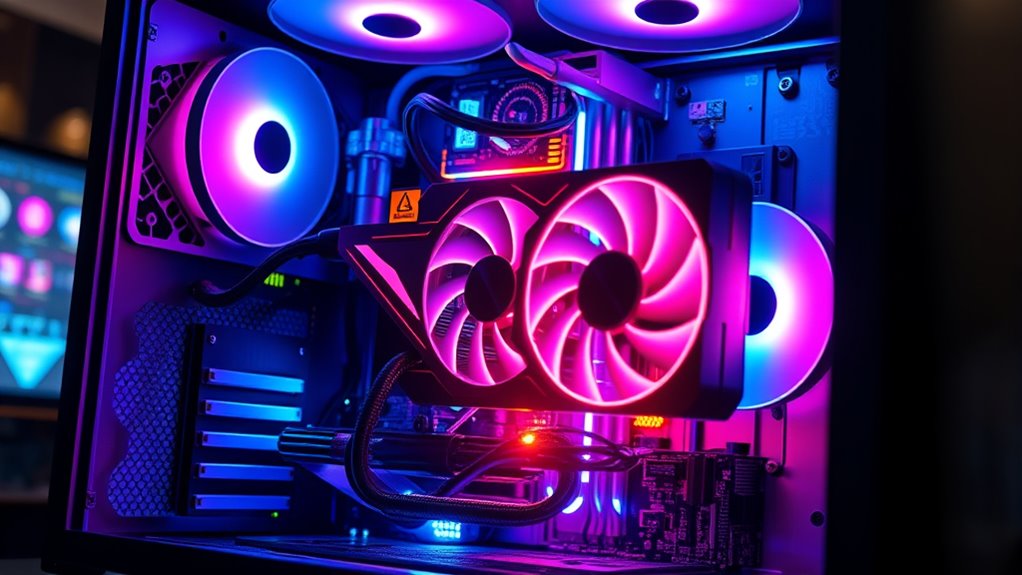
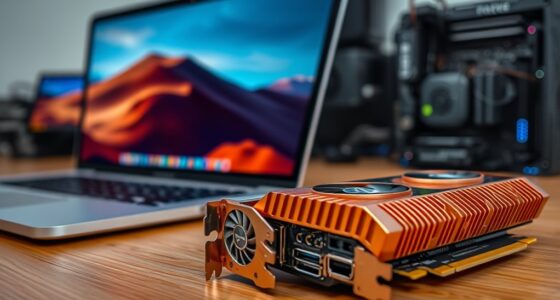
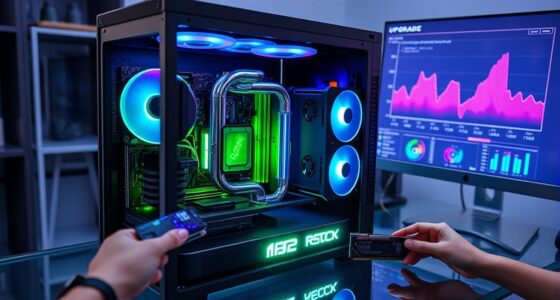
To run ray tracing effectively, your hardware needs to meet specific requirements that can handle the intensive calculations involved. A powerful graphics card is crucial, as it directly determines your system’s ability to process complex lighting and reflections in real time. Look for a GPU that supports ray tracing features, such as Nvidia’s RTX series or AMD’s RX 6000 series. Processing power is equally important; a robust CPU helps manage the workload and prevents bottlenecks. Make sure your system has sufficient VRAM, usually 8GB or more, to handle detailed textures and large rendering datasets. Additionally, a high-quality power supply and adequate cooling are essential to maintain stability during demanding tasks. Hardware compatibility plays a key role in optimizing ray tracing performance and avoiding potential system issues. Ensuring your system has adequate cooling solutions will help sustain consistent performance during extended gaming sessions. Incorporating graphics card cooling options can further enhance overall stability and longevity of your hardware during intensive rendering. Moreover, choosing components with efficient thermal management can significantly reduce overheating risks during prolonged use. As demand for advanced graphics grows, system scalability becomes increasingly important to future-proof your setup.
Real-World Applications and Impact on Gaming
Have you noticed how realistic lighting and reflections have transformed modern video games? Ray tracing enhances visuals, making environments more immersive and believable. Beyond gaming, this technology impacts medical imaging, providing more accurate visualizations for diagnostics. It also advances architectural visualizations, offering lifelike renderings of building designs. These real-world applications demonstrate ray tracing’s versatility and significance.
| Application | Impact |
|---|---|
| Medical Imaging | Improves clarity and realism in diagnostic visuals |
| Architectural Visualizations | Creates detailed, true-to-life building models |
| Video Games | Elevates realism with reflections, shadows, and lighting effects |
| Film & Animation | Produces realistic CGI with accurate lighting and shadows |
| Automotive Design | Enhances visualization of vehicle prototypes and interiors |
Visual Effects Enhanced by Ray Tracing
Ray tracing considerably elevates visual effects in digital media by delivering stunning realism and depth. With reflection effects, it creates lifelike mirrors and shiny surfaces that respond accurately to light sources, enhancing immersion. You’ll notice reflections on water, glass, and metal that behave naturally, adding a convincing sense of space. Ambient occlusion is also improved, providing subtle shading in creases, corners, and contact points where light is less likely to reach. This creates a realistic sense of depth and grounding for objects, making scenes appear more three-dimensional. Incorporating lighting simulation principles can further enhance the realism by integrating believable environments that complement ray-traced effects. The surface interaction between light and materials is more accurately modeled, resulting in more authentic visuals. Together, these effects make environments feel more authentic and visually rich. As a result, your gaming experience becomes more immersive, with visuals that mimic real-world lighting and surface interactions more convincingly than ever before.
Challenges and Limitations of Ray Tracing
Why does ray tracing still pose significant challenges despite its impressive visual capabilities? The main issue is its high computational complexity, which demands immense processing power to simulate light accurately. This complexity leads to slower rendering times and requires powerful hardware, often limiting real-time applications like gaming. Additionally, the energy consumption of ray tracing technology is substantial, putting strain on hardware components and increasing power costs. These factors make it difficult for many users to access ray tracing’s full potential without sacrificing performance or efficiency. As a result, developers must balance visual fidelity with practical limitations, often simplifying scenes or reducing effects to maintain smooth gameplay. Overcoming these challenges is essential for wider adoption and more accessible, high-quality graphics.
The Future of Graphics Technology With Ray Tracing

As hardware improves, you’ll notice graphics becoming more realistic and immersive than ever before. These advancements allow ray tracing to produce stunning visuals that draw you deeper into virtual worlds. Staying ahead means keeping an eye on how hardware evolves to support these cutting-edge techniques.
Realism and Immersion
Have you ever wondered how realistic video game graphics can become? With ray tracing, the level of realism and immersion is skyrocketing. AI integration plays a key role here, enhancing lighting, shadows, and reflections in real-time, making environments feel more authentic. This technology also allows for user customization, letting you tailor visual settings to your preferences, which deepens your connection to the game world. As graphics become more lifelike, you’ll notice how textures, reflections, and lighting work seamlessly, creating a convincing atmosphere. The combination of ray tracing and AI not only elevates visual fidelity but also makes gameplay more engaging. Soon, you’ll find yourself immersed in worlds so realistic, it’s almost like stepping into another reality.
Hardware Advancements
Advancements in hardware are propelling ray tracing into a new era of realism and efficiency. Modern GPUs now feature specialized hardware integration, making real-time ray tracing more accessible and smoother. Increased vendor support ensures better optimization and wider adoption, pushing the technology forward. Here are three key developments:
- Dedicated RT Cores in GPUs streamline ray tracing calculations, reducing latency.
- Newer graphics cards offer higher ray count capabilities, enhancing detail.
- Improved hardware integration allows seamless compatibility with existing gaming systems.
These innovations mean you’ll experience richer visuals with less performance hit. As hardware continues to evolve, expect even faster, more realistic graphics, making ray tracing more mainstream and impactful in gaming and beyond. The future of graphics technology is brighter, sharper, and more immersive.
Frequently Asked Questions
How Does Ray Tracing Improve Realism in Video Game Graphics?
Ray tracing improves realism in your video game graphics by simulating realistic lighting, making shadows and reflections more accurate. This creates immersive environments where every surface reflects light naturally, enhancing depth and detail. As a player, you’ll notice the difference in how scenes look more lifelike, with better contrast and color accuracy. Overall, ray tracing helps you experience more authentic visuals, pulling you deeper into the game’s world.
What Are Common Misconceptions About Ray Tracing Technology?
Many people think ray tracing instantly delivers perfect visuals, but that’s a misconception fueled by marketing hype. In reality, hardware limitations mean it’s not always feasible for all games or setups, and performance can suffer. For example, a gamer might expect flawless reflections on a mid-range PC, but in truth, achieving that requires high-end hardware. Don’t assume ray tracing automatically equals better graphics—it’s a powerful tool, but not a magic fix.
Can Ray Tracing Be Used in Real-Time Gaming?
Yes, ray tracing can be used in real-time gaming, enhancing lighting effects and shadow accuracy. Modern GPUs, like those from NVIDIA and AMD, support real-time ray tracing, allowing you to see more realistic reflections and shadows while playing. Although it demands more processing power, developers optimize it for smoother gameplay. As a result, you experience more immersive, visually stunning games without sacrificing performance.
How Does Ray Tracing Differ From Rasterization in Rendering Images?
You notice ray tracing creates more realistic images by simulating light behavior, unlike rasterization, which quickly projects 3D models onto 2D screens. Ray tracing involves complex shader calculations and benefits from hardware acceleration, making it more demanding but more accurate. Rasterization, on the other hand, is faster and less shader-intensive, making it suitable for real-time gaming. The key difference is how each method handles lighting and visual detail.
What Are the Energy and Cost Implications of Implementing Ray Tracing?
Implementing ray tracing increases energy consumption because it requires more powerful hardware to process complex light calculations. As a result, your hardware costs go up since high-end GPUs with ray tracing capabilities are more expensive. You’ll also see higher electricity bills over time due to the increased energy use. While the visual improvements are impressive, be prepared for these additional costs and energy demands when adopting ray tracing technology.
Conclusion
Imagine a future where games look so real, you can’t tell them apart from reality. Ray tracing makes this possible by accurately simulating light’s behavior. While it’s true that it demands powerful hardware now, ongoing advancements suggest it’ll become standard, transforming gaming experiences. So, don’t be surprised if, someday soon, you’re exploring worlds so vividly detailed, it feels like stepping into another universe—proof that technology’s potential is truly limitless.