📊 Full opportunity report: Siemens' Strategy: Putting AI At The Heart Of Factory Operations on ThorstenMeyerAI.com — validation score, market gap, and execution plan.
TL;DR
Siemens is shifting its factory automation strategy to focus on physical AI, using its domain expertise and a partnership with NVIDIA to develop an Industrial AI Operating System. This aims to embed AI across the entire industrial lifecycle, starting with a fully AI-driven factory in 2026.
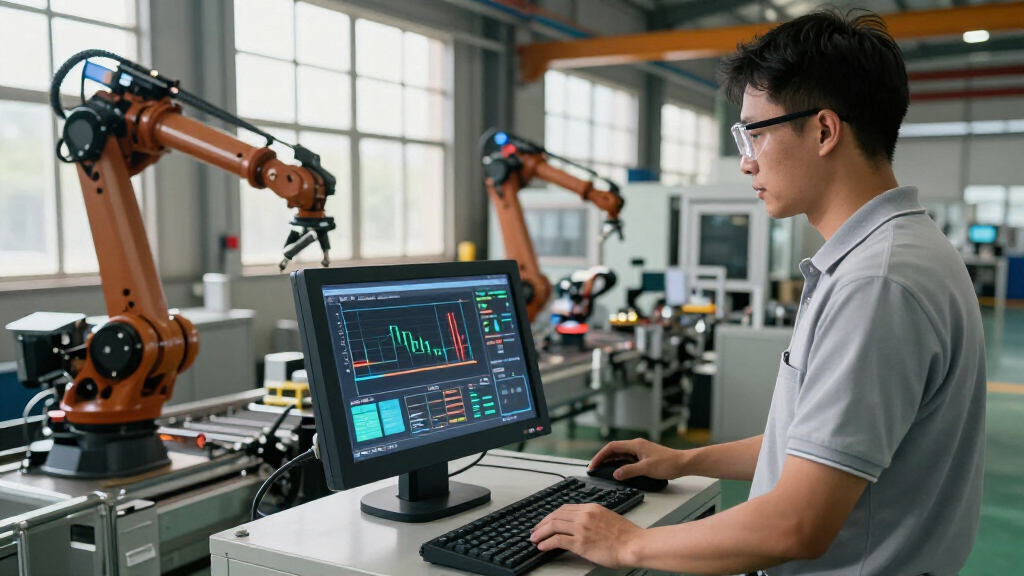
Siemens has announced a strategic shift to embed artificial intelligence directly into factory operations, emphasizing physical AI over chatbots or language models. This move, revealed during its CES 2026 keynote, aims to leverage Siemens’ extensive industrial data and domain expertise to transform manufacturing processes and supply chains. The initiative includes a partnership with NVIDIA to develop an Industrial AI Operating System, targeting a fully AI-driven factory by 2026.
Siemens’ new strategy centers on the development of the Industrial Foundation Model (IFM), a specialized AI model designed to process 3D models, 2D drawings, sensor telemetry, and automation logic. Announced at Hannover Messe 2025, the IFM aims to optimize engineering and automation by contextualizing physical data, contrasting with general-purpose language models that are less effective in industrial settings.
The core of the plan involves an expanded partnership with NVIDIA to create an Industrial AI Operating System. This platform will embed AI across the entire industrial lifecycle, from design and engineering to manufacturing and supply chain management. Key features include GPU-accelerated simulation, generative simulation with NVIDIA PhysicsNeMo, and autonomous digital twins that actively engineer and optimize systems in real time.
The first fully AI-driven, adaptive manufacturing site is scheduled to launch in 2026 at Siemens’ Electronics Factory in Erlangen, Germany. Siemens also plans to introduce Digital Twin Composer and collaborate with clients like PepsiCo to simulate facility upgrades, along with deploying nine industrial copilots across various value chain stages.
The factory floor,
not the chat window.
Siemens’ bet: the biggest untapped AI value is physical — machines, factories, infrastructure — and 175 years of industrial data plus NVIDIA compute beats any frontier lab there. The vehicle: an Industrial Foundation Model and an “Industrial AI Operating System.”
A different language than text
Proprietary + physical data no frontier lab can scrape — the same “specialist beats generalist” logic this week keeps documenting, applied to steel and silicon.
Honest bull / bear
Bull
- Proprietary physical data no lab can replicate
- Domain expertise IS the barrier to entry
- Customers (PepsiCo, Audi) already in the base — warm motion
- Generative simulation: digital twins that engineer, not just mirror
Bear
- The “OS” runs substantially on NVIDIA’s stack — American silicon under a European champion
- No validated performance metrics or timelines disclosed at CES
- Geological sales cycle: decade-scale replacement
- “Industrial AI” now crowded (Palantir, Qualcomm moving in)
industrial AI software for manufacturing
As an affiliate, we earn on qualifying purchases.
As an affiliate, we earn on qualifying purchases.
Implications of Siemens’ Physical AI Focus
This development signifies a major shift in industrial automation, emphasizing that physical AI—processing and analyzing real-world industrial data—is where the most durable value will be created. Siemens’ approach leverages its proprietary data and deep domain knowledge, positioning it to lead in manufacturing AI. The move could accelerate factory automation, improve efficiency, and set new standards for digital twins and autonomous systems in industry.
digital twin simulation tools
As an affiliate, we earn on qualifying purchases.
As an affiliate, we earn on qualifying purchases.
Background of Siemens’ Industrial AI Strategy
Siemens has long been a leader in industrial automation and digitalization, with decades of data from operational telemetry, engineering models, and automation logic. The company’s announcement builds on its earlier efforts, including the 2025 launch of the Industrial Foundation Model and its collaborations with various industry players. The partnership with NVIDIA, announced at CES 2026, aims to accelerate GPU-based simulation and AI integration across Siemens’ portfolio, culminating in a fully AI-enabled factory in Erlangen by 2026.
This strategy reflects a broader industry trend toward integrating AI into physical systems rather than relying solely on language models or chatbots, which are less suited for industrial applications. Siemens’ emphasis on domain expertise and proprietary data distinguishes its approach from many startups and general AI providers.
“Industrial AI is no longer a feature; it’s a force that will reshape the next century.”
— Roland Busch, Siemens CEO
industrial robot sensors
As an affiliate, we earn on qualifying purchases.
As an affiliate, we earn on qualifying purchases.
Unconfirmed Performance and Deployment Details
Many specifics about the performance, hardware configurations, and deployment timelines of the Industrial AI Operating System remain undisclosed. While the Erlangen factory is targeted for 2026, independent validation of the AI models’ effectiveness and the platform’s scalability is still pending. The reliance on NVIDIA’s infrastructure raises questions about hardware sovereignty and performance benchmarks.
GPU-accelerated simulation software
As an affiliate, we earn on qualifying purchases.
As an affiliate, we earn on qualifying purchases.
Next Steps for Siemens’ Industrial AI Rollout
Siemens will likely focus on deploying the Erlangen factory as a proof of concept, followed by expanding AI integration to other facilities globally. The company plans to introduce Digital Twin Composer and collaborate with clients like PepsiCo on simulation projects. Monitoring performance metrics and independent assessments over the coming year will be critical to evaluate the platform’s real-world impact.
Key Questions
What is Siemens’ Industrial Foundation Model?
The Industrial Foundation Model (IFM) is Siemens’ specialized AI designed to process physical industrial data, such as 3D models, drawings, and sensor telemetry, to optimize engineering and automation.
How does Siemens’ partnership with NVIDIA enhance its AI capabilities?
The partnership provides GPU-accelerated simulation, physics-based AI models, and generative simulation tools, enabling Siemens to develop an integrated Industrial AI Operating System for manufacturing.
When will the fully AI-driven factory in Erlangen open?
Siemens aims to launch the fully AI-driven, adaptive manufacturing site in Erlangen in 2026, with subsequent expansion plans across its global operations.
What are the potential challenges for Siemens’ AI strategy?
Key challenges include validating AI performance in real-world settings, managing dependence on NVIDIA hardware, and navigating long industrial adoption cycles that can take a decade or more.
Is this approach unique to Siemens?
No, other industry players like Palantir and Qualcomm are also developing edge and industrial AI solutions, but Siemens’ focus on physical AI and domain expertise gives it a distinct advantage.
Source: ThorstenMeyerAI.com