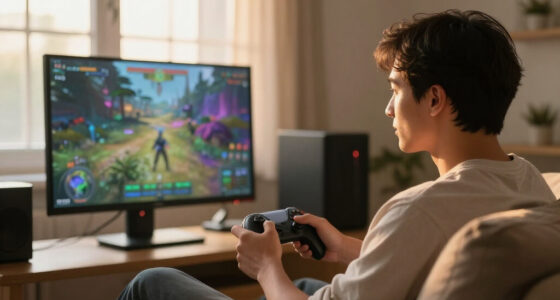

Many new PC gamers make the mistake of not properly calibrating their controllers, which leads to laggy or unresponsive gameplay. They also ignore hardware compatibility and system requirements, causing crashes or lag. Another common error is using default audio settings, missing out on immersive cues. Overly high graphics settings can cause stuttering, while neglecting driver and network updates results in instability. If you want to avoid these pitfalls and boost your gaming experience, you’ll find useful tips below.

Get the latest gadgets delivered free with Prime
- Fast, free delivery on millions of items
- Prime Video, Amazon Music and more included
- Member-only deals all year
Key Takeaways
- Neglecting proper controller calibration leads to unresponsiveness and decreased accuracy during gameplay.
- Ignoring system requirements and hardware compatibility causes lag, crashes, and performance issues.
- Using default audio settings can reduce immersion and miss critical in-game cues.
- Setting graphics too high without balancing performance results in stuttering and lowered frame rates.
- Failing to update drivers and optimize network connections causes lag, disconnections, and unstable gameplay.
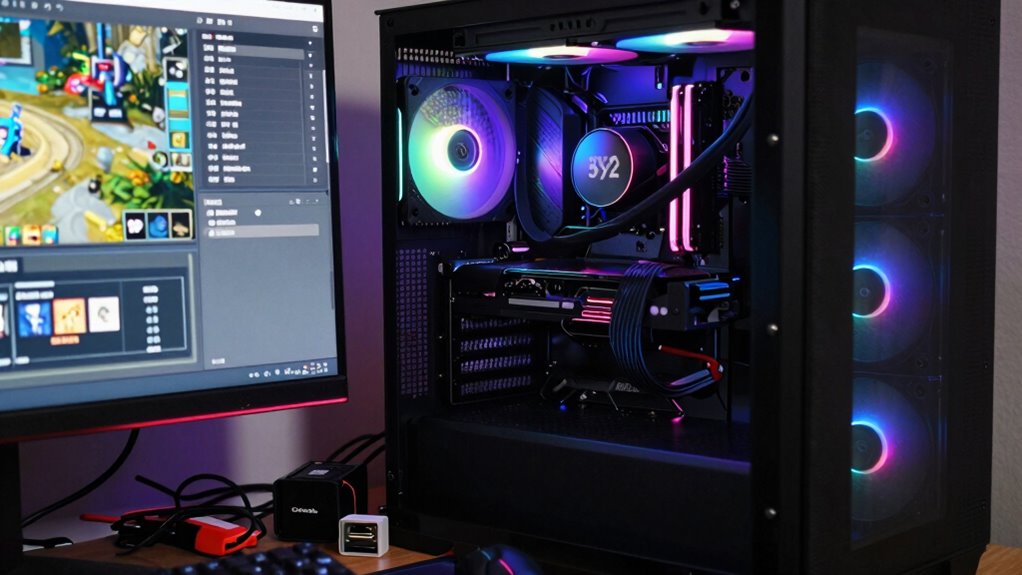
Getting started with PC gaming can be exciting, but many new gamers make common mistakes when adjusting their settings that can hurt their experience. One of the biggest errors is neglecting proper controller calibration. If your controller isn’t calibrated correctly, your in-game movements might feel laggy or unresponsive, making gameplay frustrating. You might notice that your character doesn’t turn as smoothly as it should or that your aiming feels off. To avoid this, take the time to calibrate your controller through your PC’s device settings or the gaming software itself. Proper calibration guarantees your inputs are accurately translated into in-game actions, providing a smoother and more precise experience. It’s a simple step that can notably boost your performance and enjoyment. Additionally, paying attention to hardware compatibility can help ensure your setup runs smoothly and avoids unexpected issues during gameplay. Ensuring your hardware components work well together is crucial for a seamless gaming experience. Being aware of your system requirements can also help you tailor your settings for optimal performance.
Another common mistake involves overlooking audio customization. Many new gamers stick with default sound settings, missing out on the immersive experience that good audio can provide. Your game’s sound design can alert you to nearby enemies, environmental cues, or important story elements. Ignoring audio customization means you might miss critical sounds or have difficulty hearing subtle cues. To optimize your experience, explore your game’s audio settings and adjust the volume levels, sound effects, and background music. Using a good pair of headphones or speakers can also help you better perceive spatial audio cues. Customizing audio settings guarantees you don’t just see the action—you hear it, giving you a tactical advantage and making the game more immersive.
Customize your game’s audio settings and use quality headphones for a more immersive, tactical gaming experience.
Beyond these, many newcomers fall into the trap of sticking with overly high graphics settings that their hardware can’t handle smoothly. Running at ultra settings might look stunning, but it can cause lag, stuttering, or crashes, which ruin the experience. Instead, find a balance where visuals are appealing but performance remains stable. Lowering settings like shadows, textures, or anti-aliasing can improve frame rates markedly without sacrificing too much visual quality. Being aware of contrast ratio and how it impacts image quality can help you choose settings that optimize clarity and detail in your game visuals. Properly adjusting these visual elements can make a significant difference in overall gameplay comfort.
Lastly, don’t ignore your network settings. A wired connection often provides more stability than Wi-Fi, reducing lag and disconnections during multiplayer sessions. Keep your drivers updated, especially graphics and network drivers, to guarantee everything runs smoothly.
As an affiliate, we earn on qualifying purchases.
Frequently Asked Questions
How Do I Optimize Settings for Different Games?
To optimize settings for different games, start by adjusting your controller sensitivity for precise movements. Tweak graphics settings like resolution and quality to balance visuals and performance. Don’t forget audio balancing—set sound levels so you can hear important cues without distortion. Experiment with these settings for each game, and save your preferences. This way, you get the best experience tailored to each game’s demands and your personal playstyle.
What Are the Best Settings for Competitive Gaming?
For competitive gaming, you should prioritize high frame rates and low latency. Set your controller settings for quick responsiveness, reducing input delay. Disable unnecessary visual effects to boost performance, and adjust audio calibration for clear sound cues. Keep your in-game settings optimized for stability, and verify your audio and controller settings are fine-tuned to give you an edge in fast-paced matches. This approach helps you stay sharp and react faster.
How Can I Improve Game Performance Without Sacrificing Visuals?
To improve game performance without sacrificing visuals, you should focus on hardware upgrades like adding more RAM or a better GPU to boost your system’s capabilities. Additionally, perform software tweaks such as updating your graphics drivers, adjusting in-game settings for best balance, and disabling background processes that drain resources. These steps help you achieve smoother gameplay while maintaining the visual quality you enjoy.
Should I Prioritize FPS or Graphic Quality?
Prioritize FPS over graphics quality, especially since studies show smooth gameplay boosts your reaction time and overall experience. To improve performance, consider hardware upgrades like RAM or a better GPU, and fine-tune controller settings for comfort. Remember, a higher frame rate guarantees you don’t miss essential moments, while sacrificing too much graphics quality may diminish immersion. Balance is key—start with FPS and adjust graphics to find your perfect gaming setup.
How Often Should I Update My Graphics Drivers?
You should update your graphics drivers whenever a new version is released, especially if you’re experiencing hardware compatibility issues or bugs. Regular updates optimize game performance and fix security vulnerabilities. However, if a new driver causes problems, don’t hesitate to do a driver rollback to a previous stable version. Staying current guarantees your system runs smoothly, but always keep backups and monitor updates for stability.
gaming headphones with spatial audio
As an affiliate, we earn on qualifying purchases.
As an affiliate, we earn on qualifying purchases.
Conclusion
By avoiding these common setting mistakes, you’ll open your PC’s true gaming potential like a secret door opening to new worlds. Remember, tweaking your settings isn’t just about looking good—it’s about feeling the game breathe under your fingertips. Don’t let bad choices trap you in a fog of lag or poor visuals. Instead, embrace the adventure of fine-tuning, and soon you’ll be steering your games with the confidence of a seasoned explorer charting uncharted territory.
gaming graphics card for smooth performance
As an affiliate, we earn on qualifying purchases.
As an affiliate, we earn on qualifying purchases.
gaming monitor with high refresh rate
As an affiliate, we earn on qualifying purchases.
As an affiliate, we earn on qualifying purchases.
Fall Picks
fall essentials
As an affiliate, we earn on qualifying purchases.