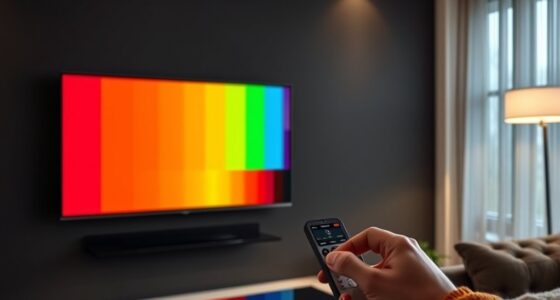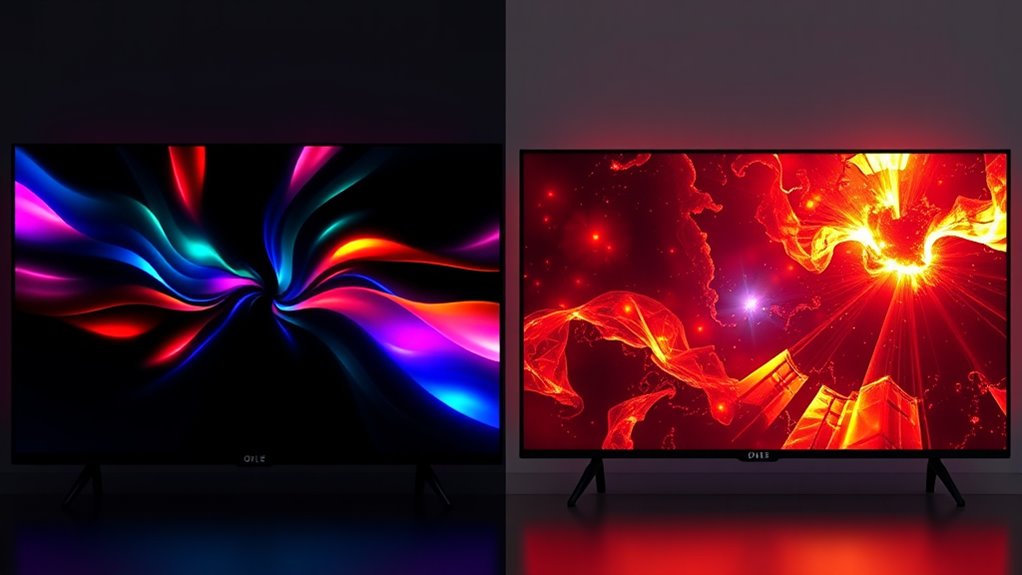
If you’re choosing between OLED and Mini-LED for the best picture, OLED generally offers superior quality with perfect black levels, rich colors, and excellent contrast because each pixel lights up individually. Mini-LED improves contrast with local dimming but can’t match OLED’s pixel-level control. For cinematic visuals and precise color, OLED tends to be the better option. Keep exploring to discover how these technologies compare in real-world use and which might suit your viewing style best.

Get the latest gadgets delivered free with Prime
- Fast, free delivery on millions of items
- Prime Video, Amazon Music and more included
- Member-only deals all year
Key Takeaways
- OLED provides deeper blacks and higher contrast due to pixel-level light control.
- Mini-LED offers strong contrast with localized dimming but may have blooming effects.
- OLED delivers more accurate and vibrant colors with better gradation.
- OLED is generally more energy-efficient and maintains consistent performance over time.
- Overall, OLED typically produces a superior picture quality, especially in dark scenes.

Are OLED and Mini-LED TVs truly different, or just different names for similar technology? While they both aim to deliver stunning picture quality, they do so through distinct mechanisms, influencing factors like color accuracy and energy efficiency. OLED, or Organic Light Emitting Diode, uses self-emitting pixels that produce their own light when activated. This allows for exceptional control over brightness and darkness levels, resulting in deep blacks and vibrant colors. Because each pixel is individually lit, OLED TVs excel at rendering color accuracy, making images appear more natural and true-to-life. Their ability to produce precise colors across the entire screen means you’ll notice richer reds, greens, and blues, especially in scenes with subtle gradations. Additionally, OLED’s thermal behavior enables consistent performance even during extended viewing sessions.
Mini-LED, on the other hand, is a backlighting technology that uses thousands of tiny LEDs behind an LCD panel. Unlike traditional LED TVs, Mini-LEDs are much smaller, allowing for more precise local dimming zones. This enhanced local dimming improves contrast by dimming specific areas of the screen while keeping others bright, but it still doesn’t match OLED’s pixel-level control. As a result, Mini-LED TVs can deliver impressive contrast and vibrant images, but they may struggle with achieving the same level of color accuracy and uniform black levels OLEDs provide. Moreover, Mini-LED displays tend to be more energy efficient than traditional LED sets because of their smaller light sources and improved control, although they generally consume more power than OLEDs due to the backlighting system.
As an affiliate, we earn on qualifying purchases.
Frequently Asked Questions
Which TV Technology Is More Energy-Efficient?
You’ll find that Mini-LED TVs are generally more energy-efficient than OLEDs because they use less power for backlighting and brightness control. OLED displays tend to consume more energy when displaying bright images or full-screen whites, which can increase power consumption. If energy efficiency is your priority, choosing a Mini-LED TV can help reduce overall power use, making it a better option for saving on electricity bills.
How Do OLED and Mini-Led Displays Perform in Bright Rooms?
In bright rooms, OLED and Mini-LED displays handle ambient light well, but Mini-LEDs excel at glare reduction thanks to their higher brightness and local dimming capabilities. You’ll notice less reflection and clearer images with Mini-LEDs in well-lit spaces. OLEDs still perform admirably, offering deep blacks, but they may struggle more with glare. For a bright room, Mini-LEDs provide a more comfortable viewing experience with less distraction from ambient light.
What Are the Durability Concerns for OLED Screens?
You should know that OLED screens have some durability concerns, mainly related to burn-in risk and panel lifespan. Over time, static images can cause burn-in, leaving permanent ghost images. While OLED panels generally last around 30,000 to 50,000 hours, their lifespan can be affected by usage patterns. To prolong your TV’s life, avoid static images and adjust brightness settings. Proper care minimizes burn-in risk and extends panel lifespan.
Can Mini-Led TVS Achieve True Black Levels?
Like a master painter blending shades, Mini-LED TVs can achieve near-perfect black levels, but they rarely reach the absolute black of OLEDs. You’ll notice improved contrast ratios thanks to local dimming, yet some light bleed may occur around bright objects in dark scenes. While they get close, true black levels remain a challenge, meaning OLED still holds a slight edge for the deepest blacks and contrast.
Which Technology Offers Better Viewing Angles?
You’ll find that OLED TVs offer better viewing angles compared to Mini-LEDs. With OLED, colors stay accurate and screen uniformity remains consistent, even when you view from the side. Mini-LEDs can sometimes show color shifts or uneven brightness at sharp angles. So, if wide viewing angles and maintaining color accuracy are essential for you, OLED provides a superior experience, especially in larger rooms or when sharing the screen with others.
As an affiliate, we earn on qualifying purchases.
Conclusion
When you choose between OLED and Mini-LED, imagine stepping into a world where shadows dance and colors burst with life. OLED’s deep blacks and perfect contrast draw you into every scene, like peering into a night sky full of stars. Mini-LED brightens your view with vibrant, shimmering hues, like sunlight on rippling water. Both promise stunning visuals, but it’s your moment to decide—embrace the immersive darkness or bask in dazzling brilliance.
As an affiliate, we earn on qualifying purchases.
As an affiliate, we earn on qualifying purchases.
Halloween Picks
halloween
As an affiliate, we earn on qualifying purchases.