
TL;DR
European game union members published a manifesto on November 16 urging studios to avoid generative AI, workers to avoid using it where possible and negotiate company agreements, and players to support games made without it. The unions also call for consent and fair compensation before creative work is used to train AI systems. The document sets out their position; it does not establish how many workers they represent or whether studios will change their policies.
Members of six European game unions have published a manifesto urging studios to avoid generative AI, workers to avoid using it where possible and players to support games made without it. Published November 16 by the IWGB Game Workers’ Branch, the document also calls for consent and fair compensation before people’s work is used in AI training data.

Get the latest gadgets delivered free with Prime
- Fast, free delivery on millions of items
- Prime Video, Amazon Music and more included
- Member-only deals all year
The manifesto, titled On Generative AI Usage in the Games Industry, names IWGB Game Workers’ Branch members and collaborators from Game Workers Unite Ireland, Spain’s CSVI and the FIOM-CGIL Milan Work Council. Rock Paper Shotgun and Kotaku also identify France’s STJV and Germany’s GDRT among the groups behind it. The document was published on the IWGB Game Workers website.
Its recommendations cover both material players encounter, such as art, sound, code and dialogue, and work used earlier in production, including concept art, reference materials and pre-translations. The authors ask employers not to require any worker to use generative AI, to negotiate agreements with workers over its use, and to label any use that cannot be avoided. They also argue that workers should decide when and how the tools are used.
The unions describe several risks, including job replacement, pressure on working conditions, fewer junior roles, cultural bias and the use of third-party work in training data without permission. Those are the authors’ claims and assessments. The manifesto says training data often includes stolen work; the legality of using copyrighted material to train AI systems remains contested in courts and legislatures.
How AI Policy Reaches Game Workers
The manifesto turns opposition to generative AI into a set of proposed workplace and consumer actions. If studios adopted its recommendations, AI policy would cover the full production process, including early experiments and internal materials, rather than only assets visible in a released game. Negotiated company agreements could also give workers a formal role in decisions about whether the tools are used.
The call to players extends the dispute beyond workplaces. The unions want customers to express support for games made without generative AI, while the call to regulators focuses on consent, compensation and the ability to withdraw work from training datasets. The document does not show that any studio, regulator or player group has accepted those proposals.
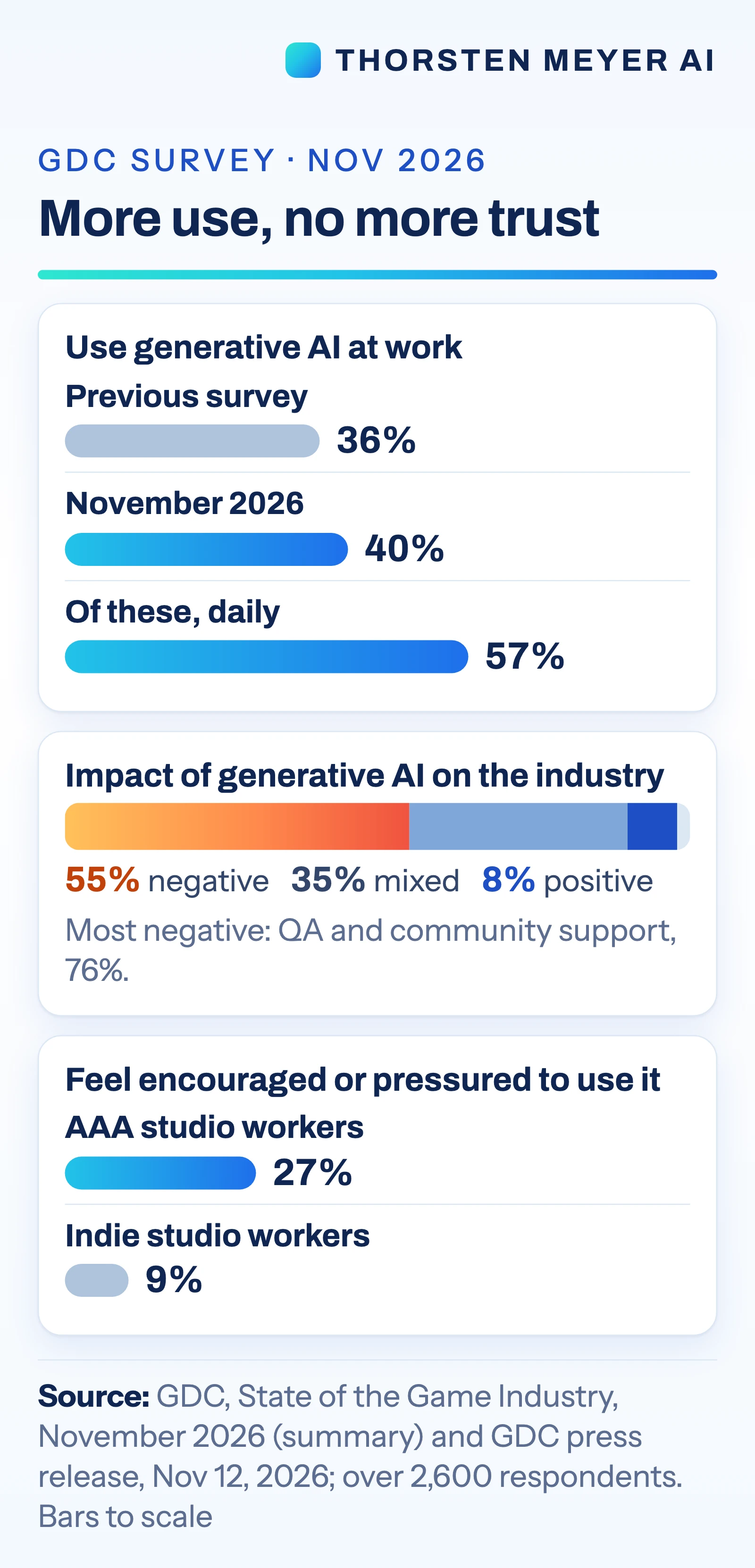
The timing brings the statement into a wider debate about adoption and employment. The Game Developers Conference’s industry survey, published November 12, found 40% of respondents use generative AI at work, up from 36% in the prior survey, while 55% said the technology is having a negative impact on the industry. These figures describe survey responses; they do not establish that AI caused job losses.
Products Worth Considering

DJI Osmo Action 5 Pro 4K Waterproof Action Camera with Dual OLED Touchscreens, Froggi 47-Piece Sport Kit and SD Card

LG UltraGear 34G600A-B 34-Inch Curved WQHD Gaming Monitor, 160Hz, FreeSync Premium, HDR10

Kindle Paperwhite Signature Edition (2024), 32 GB, Metallic Black
As an affiliate, we earn on qualifying purchases.
Industry Debate Around AI Use
The unions’ statement appeared amid other public discussion of generative AI in games. Days before its publication, a group of Independent Games Festival jurors said they would not vote for games using generative AI “in any capacity.” Separately, the studio behind Big Walk said large language models had touched “well under 0.1%” of its code. That figure is the studio’s own description of its project.
Industry bodies and executives have described potential benefits. In 2024, Video Games Europe, a European trade association, said generative AI was widely expected to take game development to the next level and argued against labeling games that use AI. On November 12, Xbox CEO Asha Sharma wrote that “A small team will be able to build worlds that today demand hundreds of developers,” without naming AI in that statement.
The GDC survey also reported that 34% of respondents had been laid off in the prior two years. The survey statistic does not show that AI was responsible for those layoffs. The union manifesto argues that AI is replacing workers and contributing to a decline in junior roles, but its publication does not independently verify those claims.
““Games are best made by people.””
— European game union members, in the manifesto
Who Will Adopt These Demands
The manifesto does not say how many workers its participating unions represent in the game industry. It is also unclear whether any studio will change its AI policy in response. No public response from a studio or trade body to the manifesto was identified in the source material by the time it was written.
The document’s claims about job replacement, shrinking junior opportunities and training data are not accompanied in the supplied material by measurements that establish their scale. The available GDC survey numbers describe respondents’ views and experiences, but do not show that generative AI caused layoffs or specific changes in hiring.
Studio and Union Responses
The next developments to watch are whether studios respond publicly or negotiate company agreements covering generative AI, and whether unions take the manifesto’s recommendations into workplace discussions. The text also calls on regulators to require consent and fair compensation for work used in AI training, though it names no specific legislative timetable or upcoming decision.
Further reporting will be needed to determine whether companies change practices and how workers experience those changes. The manifesto establishes the participating groups’ position; its effect on studio policy, regulation and player behavior remains unknown.
Key Questions
What are the unions asking game studios to do?
They urge studios to avoid generative AI entirely, not require workers to use it, negotiate agreements about its use and label any use that cannot be avoided.
Which unions are named in the manifesto?
The IWGB Game Workers’ Branch names members and collaborators from Game Workers Unite Ireland, Spain’s CSVI and the FIOM-CGIL Milan Work Council. Rock Paper Shotgun and Kotaku also list France’s STJV and Germany’s GDRT.
Does the manifesto apply only to AI assets in released games?
No. It addresses both player-facing content and behind-the-scenes work such as early concept art, reference materials and pre-translations.
Does the GDC survey show that AI caused game industry layoffs?
No. The survey found that 34% of respondents had been laid off in the prior two years, but that statistic does not identify AI as the cause.
Have studios agreed to follow the manifesto?
The source material does not identify any studio that has agreed to its demands. Whether companies change their policies remains unclear.
Source: Thorsten Meyer AI