TL;DR

Get the latest gadgets delivered free with Prime
- Fast, free delivery on millions of items
- Prime Video, Amazon Music and more included
- Member-only deals all year
Google opened Gemini 4 Carbon to paying users on November 10 and published a model card. On the new MKA benchmark, Carbon scored 54.3%, just behind Claude Fable 5.2’s 56.6%; Google DeepMind reported a much lower per-task cost for Carbon, though the benchmark was co-developed by Google and its tasks are private.
Google opened Gemini 4 Carbon to paying developers, businesses and Google AI Ultra subscribers on November 10, the same day Google DeepMind and Artificial Analysis introduced a benchmark for AI agents working with visual documents. Carbon scored 54.3% on MKA, behind Anthropic’s Claude Fable 5.2 at 56.6%; Google DeepMind reported that Carbon cost $5.63 per task, compared with $35.28 for Fable.
MKA tests whether AI agents can interpret materials such as blueprints, scans and charts, rather than relying only on plain text. Its 200 expert-built tasks span 10 sectors. Claude Fable 5.2 scored 56.6%, Gemini 4 Carbon 54.3% and Claude Opus 5.5 53.0%. The source report says the top three results are within the margin of error, so the small score gaps should not be read as a clear separation in performance.
The cost figures come from Google DeepMind’s report: $5.63 per MKA task for Carbon and $35.28 for Fable 5.2. They describe performance on this benchmark, not a general price for using either model. Carbon’s API pricing is $2 per million input tokens and $10 per million output tokens through November 30. From December 1, those rates are scheduled to rise to $4 and $20, respectively.
Carbon is available through the Gemini API, Google AI Studio and Gemini for business. In the Gemini app and AI Mode in Search, access is limited to Google AI Ultra subscribers. Google describes Carbon as a model for demanding work, including complex coding and scientific research, and says it uses more thinking tokens than Gemini 4 Argon. The company says Argon remains its recommended choice for most software engineering and knowledge work.
The Cost of Document-Based AI
MKA focuses on tasks that resemble work in fields where important information is embedded in visual and scanned documents. A model’s ability to read those materials could matter to businesses considering AI for technical or professional workflows. The benchmark result offers one comparison of accuracy and reported task cost, but it does not establish how the models perform across everyday business use.
Carbon’s score is close to Fable’s on MKA, while Google DeepMind reports a substantially lower cost per task. That combination may draw attention from organizations weighing capability against expense. The comparison needs care: Google co-developed the benchmark, and the task set is private, limiting independent inspection of how the evaluation was constructed.
Products Worth Considering

Amazon Kindle Paperwhite (2024, 16 GB) – 7-inch Glare-Free Display, Black

Logitech MX Mechanical Wireless Illuminated Keyboard, Tactile Quiet, Graphite

DJI Mini 4 Pro Fly More Combo Drone with DJI RC 2
As an affiliate, we earn on qualifying purchases.
Carbon’s Scores Beyond MKA
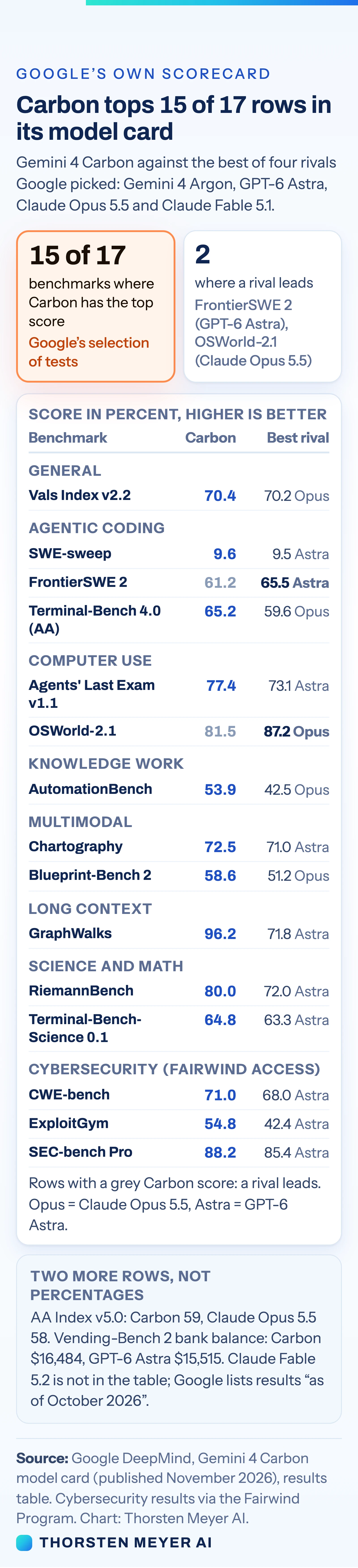
Google’s November model card reports Carbon leading on 15 of 17 tests selected by Google, against four named rivals. The results are dated October 2026, and the comparison excludes Claude Fable 5.2, which the source says was released November 9. On two tests, rivals lead: GPT-6 Astra scored 65.5% to Carbon’s 61.2% on FrontierSWE 2, while Claude Opus 5.5 scored 87.2% to Carbon’s 81.5% on OSWorld-2.1.
A separate comparison from Artificial Analysis places Carbon behind Fable 5.2 on the Intelligence Index v5.0.1. Carbon (high) scored 60; Fable scored 65 at its maximum setting and 62 at high. The index combines nine tests, so it measures a broader collection of tasks than MKA. The source also reports that Carbon first reached a small group of cyber defenders through Google’s Fairwind Program about two weeks before the wider paid release.
Google lists a one-million-token context window, text, image, audio and video inputs, and text output. It also identifies hallucinations, occasional slowness or timeouts, and higher token use at elevated thinking settings as limitations. Google says the model’s knowledge cutoff is March 2026, while warning that information may be less current in some domains.
““tasks that test the limits of a model’s intelligence””
— Google DeepMind, in the Gemini 4 Carbon model card
Limits of the MKA Comparison
The reported MKA results do not settle which model performs best across real-world document workflows. The source says the top three scores are within the margin of error, but does not provide the margin’s size in the supplied material. Because the benchmark was co-built by Google and its tasks are private, outside researchers cannot inspect the full task set or independently reproduce the reported comparison from those materials.
The per-task prices are figures from Google DeepMind’s report. The supplied source does not describe the exact cost calculation or establish whether the same cost relationship would hold for other tasks, usage patterns or settings. Carbon’s announced API rates are also scheduled to change on December 1. Its broader performance, reliability and cost in customer deployments remain uncertain.
Access and Pricing Changes
Developers and businesses can use Carbon through Google’s paid developer and business offerings, while app and Search access requires Google AI Ultra. The next stated pricing milestone is December 1, 2026, when API rates are scheduled to rise from $2 to $4 per million input tokens and from $10 to $20 per million output tokens. The supplied material does not identify a further MKA release date or say whether its private tasks will later be opened for external review.
Key Questions
What did Gemini 4 Carbon score on MKA?
Carbon scored 54.3%. Claude Fable 5.2 scored 56.6%, and Claude Opus 5.5 scored 53.0%. The source says the three results are within the margin of error.
How much did Carbon cost per MKA task?
Google DeepMind reported a cost of $5.63 per task for Carbon, compared with $35.28 for Claude Fable 5.2. These are benchmark-specific figures, not general usage prices.
Who can access Gemini 4 Carbon?
Paid developers and businesses can access it through Google’s Gemini API, Google AI Studio and Gemini for business. Use in the Gemini app and AI Mode in Search is limited to Google AI Ultra subscribers.
When does Carbon’s API pricing change?
Google’s announced rates are $2 per million input tokens and $10 per million output tokens through November 30, 2026. From December 1, the scheduled rates are $4 per million input tokens and $20 per million output tokens.
Can outside researchers verify the MKA tasks?
The source says MKA’s tasks remain private, so outsiders cannot inspect the task set. Google DeepMind co-developed the benchmark with Artificial Analysis.
Source: Thorsten Meyer AI